


























Views
Downloads





Area of Parallelograms Worksheet — Essential Grade 6 Math
Paste this activity's link or code into your existing LMS (Google Classroom, Canvas, Teams, Schoology, Moodle, etc.).
Students can open and work on the activity right away, with no student login required.
You'll still be able to track student progress and results from your teacher account.
This comprehensive Grade 6 geometry worksheet provides students with practice calculating the area of parallelograms and rectangles. By progressing from visual grid models to abstract formulas and complex word problems, students build a deep conceptual understanding of spatial measurement. This resource ensures mastery of area calculation through a structured, multi-step instructional approach.
At a Glance
- Grade: 6 · Subject: Geometry
- Standard:
CCSS.MATH.CONTENT.6.G.A.1— Find the area of special quadrilaterals and polygons by composing or decomposing shapes- Skill Focus: Area of parallelograms and rectangles
- Format: 4 pages · 17 problems · Answer key included · PDF
- Best For: Independent practice or homework
- Time: 30–45 minutes
What's Inside
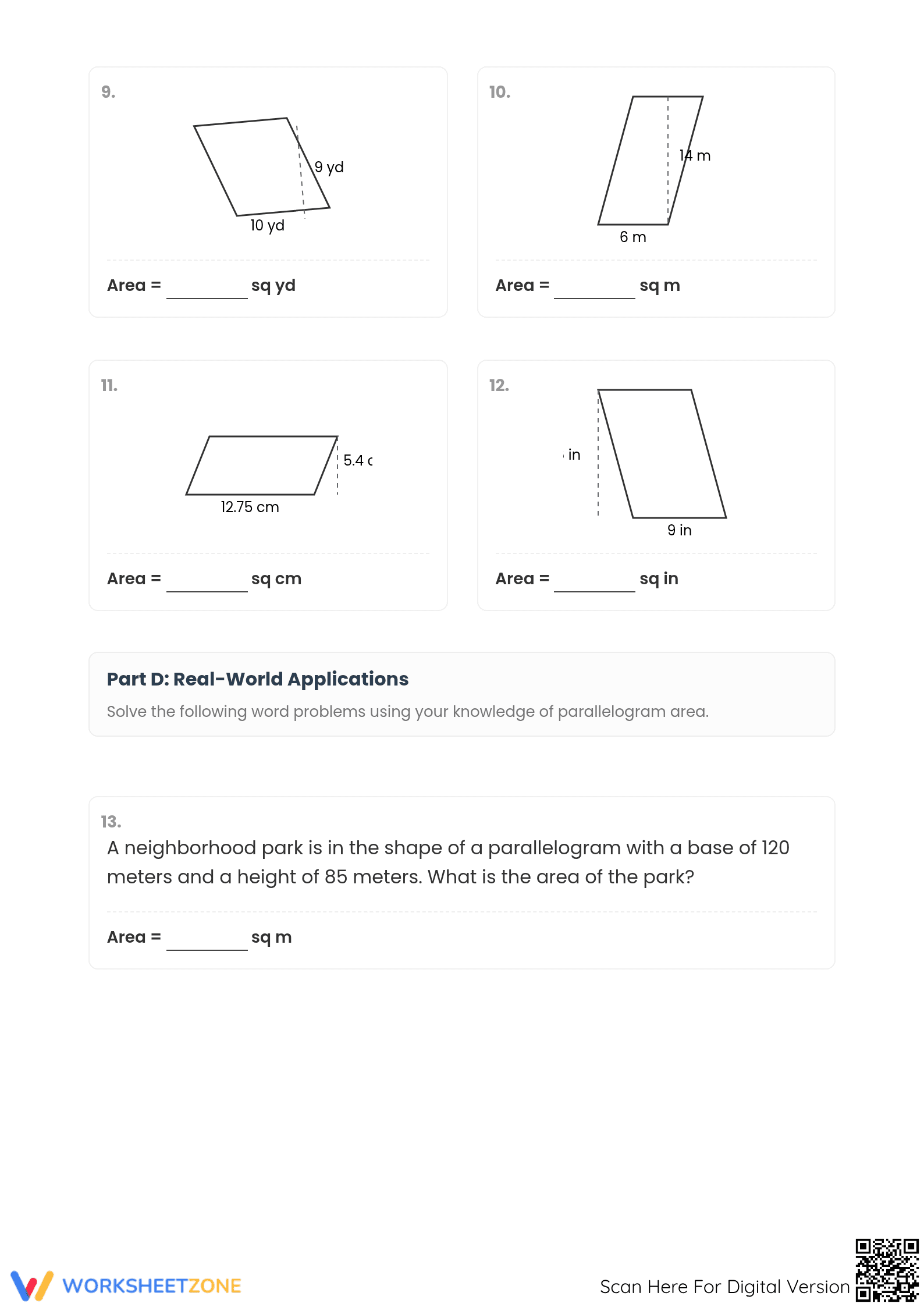
The worksheet is organized into four distinct parts across four printable pages. Part A establishes foundational formulas with basic rectangles and squares. Part B uses grid units to help students visualize base and height. Part C introduces advanced parallelograms with decimal dimensions, while Part D presents real-world applications through word problems. Answer key included.
Zero-Prep Workflow
The zero-prep design allows teachers to implement this lesson in three simple steps. First, print the four-page PDF (30 seconds). Second, distribute the worksheets for independent work or collaborative pairs (30 seconds). Third, review the final word problems using the provided answer key (1 minute). This streamlined process requires less than two minutes of total teacher preparation, making it an ideal choice for substitute plans or urgent instructional needs.
Standards Alignment
This resource is directly aligned to `CCSS.MATH.CONTENT.6.G.A.1`, which requires students to find the area of special quadrilaterals and polygons by composing into rectangles or decomposing into triangles. It specifically targets the mastery of parallelogram area in the context of mathematical and real-world problems. Both standard codes can be copied directly into lesson plans, IEP goals, or district curriculum mapping tools.
How to Use It
Use this worksheet as a summative practice activity after students have been introduced to the area formula. It is particularly effective during the "Independent Practice" phase of a gradual release lesson. For a formative assessment tip, observe students during Part B to ensure they are correctly identifying the height perpendicular to the base rather than using the slant height. Most students will complete the full set within 40 minutes.
Who It's For
This resource is designed for Grade 6 students meeting standard expectations and Grade 7 students requiring a geometry review. It is also suitable for Grade 5 advanced learners. The inclusion of grids and word problems supports differentiation for visual learners. This worksheet pairs naturally with a geometry anchor chart or a short introductory video on decomposing quadrilaterals.
The calculation of area for special quadrilaterals like parallelograms is a cornerstone of middle school geometry, bridging the gap between elementary perimeter concepts and high-school coordinate geometry. According to Fisher & Frey (2014), the use of scaffolded practice—moving from visual grids to abstract word problems—is essential for internalizing the mathematical relationship between base and height. This worksheet implements these proven instructional strategies by providing 17 structured tasks that require students to apply `CCSS.MATH.CONTENT.6.G.A.1` in varied contexts. Research from the NAEP consistently highlights that students who master the decomposition of polygons into simpler shapes demonstrate higher proficiency in spatial reasoning and composite area calculations. By requiring both numerical computation and verbal problem-solving, this 4-page resource ensures that students meet rigorous state and national standards while developing the mathematical fluency needed for success in higher-level STEM coursework. Both standard codes can be copied directly into lesson plans or district curriculum mapping tools.


