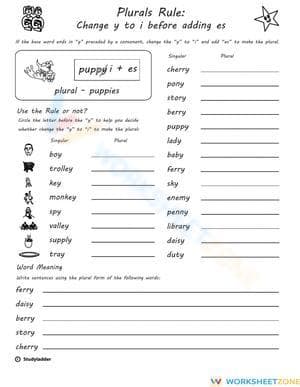
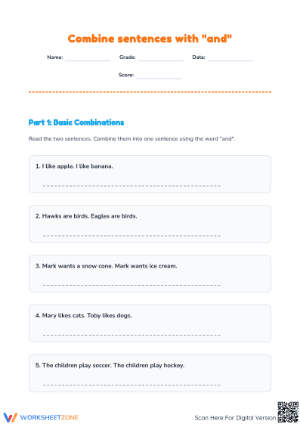
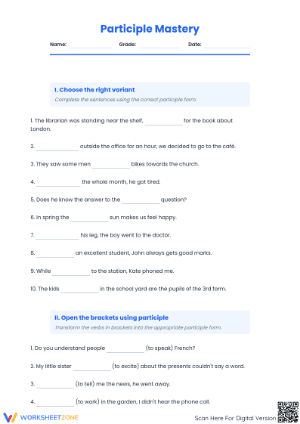
These parts of speech printable worksheets for 7th grade ask students to do more than name a category — they push toward the harder work of analyzing what a word is actually doing inside a sentence. Seventh graders usually arrive knowing the basic labels, but that surface recognition breaks down quickly when two similar-looking categories appear side by side in real text, or when a familiar word like fast shifts roles depending on where it sits. The set closes that gap through identification, comparison, revision, and original sentence work.
What's Inside the Set
All eight major categories appear — nouns, pronouns, verbs, adjectives, adverbs, prepositions, conjunctions, and interjections — but the emphasis falls on function over labeling alone. Each worksheet asks students to do something with the word they identify: note what it modifies, explain what it introduces, or show how it connects clauses. That shift matters because seventh graders who can name every part of speech still write sentences like She runs very quick without flagging the error themselves. Moving from recall to application is where real grammar understanding starts to hold.
Task types across the set include side-by-side sentence comparisons where the same word plays different roles in each, cloze tasks that ask students to choose the right category to complete a sentence naturally, revision exercises where students replace vague or incorrect word choices, and short original writing tasks that require deliberate use of targeted categories. The passage-based worksheets are worth singling out: students analyze parts of speech across a short paragraph rather than a string of unrelated sentences, which mirrors how grammar actually appears in reading and gives teachers stronger evidence of transfer than isolated fill-in-the-blank items do.
Student Errors Worth Watching For and Correcting
A few confusion patterns show up consistently in seventh-grade work. The adjective-versus-adverb distinction generates the most errors, and not for the reason teachers expect. Students who know that adverbs often end in -ly will correctly label slowly every time — but they'll call fast an adjective in every sentence because no suffix signals otherwise. What breaks that habit is asking students to identify what the word is pointing at: a noun calls for an adjective; a verb, adjective, or another adverb calls for something else. The worksheets build this through repeated function-checking rather than suffix drills.
The preposition-versus-adverb confusion runs a close second. Students circle up in she looked up and he climbed up the ladder and call it a preposition in both. Teaching students to check whether the word introduces a noun object resolves most of these cases, and the comparison tasks in the set create exactly that check. Pronouns add a third steady trouble spot: words like that, those, and some function as determiners before nouns but as pronouns when they stand alone. In student writing, those confusions produce vague pronoun reference and inconsistent subject-verb agreement — errors that are far easier to address during worksheet practice than to untangle inside an essay draft.
Fitting These Worksheets Into the Lesson Cycle
The strongest use of parts of speech printable worksheets for 7th grade happens when teachers plan where they fit in the lesson sequence, not when the worksheets get grabbed as filler. A short identification worksheet makes a natural bell ringer after a mini-lesson on verb phrases. A revision task works best mid-unit, once students have a working definition and need to apply it under some pressure. Editing and passage-based worksheets belong later in the cycle, when students are ready to see grammar choices serving writing goals.
- Bell ringers: Three to five targeted sentences revisit one confusion point before new instruction begins.
- Small-group reteach: Pull students struggling with adverbs or prepositions and work through a labeling worksheet together — asking students to read answers aloud surfaces reasoning that a circled letter cannot.
- Homework: Mixed review worksheets with clear directions and worked examples translate well to independent home practice.
- Stations: Pair a cloze worksheet with a partner-checking routine, or have students color-code parts of speech in a short paragraph before comparing with a neighbor.
- Sub plans: Worksheets with built-in example boxes and self-contained directions run without live instruction.
One routine that pays off quickly: ask students to write a brief function note next to each labeled word rather than circling it alone. A student who writes adverb — modifies the verb stumbled is showing real understanding. A student who writes only adverb may be pattern-matching on the -ly suffix. That justification habit takes less than a minute to introduce and cuts down on the guessing that makes grammar quizzes feel like a coin flip.
Adjusting the Set for Students at Different Levels
The same topic lands differently for different students in a seventh-grade room. For students still building their footing with grammar terminology, the identification-focused worksheets — which provide sentence context and ask students to label and briefly explain — keep the cognitive load manageable while still requiring thought. Asking a struggling student to label ten isolated words is low-ceiling practice; asking them to label three words inside a sentence and say what each modifies or introduces is harder in the right way.
For students who already handle identification accurately, the revision and original-writing worksheets push further. Those tasks ask not just what is this word but what would happen if you changed it — the kind of thinking that connects grammar to author's craft. A student who can explain why she sprinted furiously reads differently than she ran quickly has moved past labeling and into the writing conversation. Parts of speech printable worksheets for 7th grade reach their full value at this level when they become a bridge to revision work, not an endpoint in themselves. Students who need extension in mixed-ability pairs also benefit from error-analysis tasks: one student explains the mistake, the other suggests the correction, and both write a justification — a structure that surfaces reasoning that a circled answer can hide.
Standard Alignment
These worksheets align to CCSS.ELA-LITERACY.L.7.1, which asks seventh graders to demonstrate command of standard English grammar conventions, including the use of phrases and clauses and recognition of misplaced or dangling modifiers. Sub-standards address coordination and subordination — both of which require students to understand how conjunctions and prepositions function structurally. In practical terms, this standard surfaces most visibly during the editing and revision phases of writing instruction. Grammar practice carries the most weight when it feeds directly into those moments rather than sitting in a self-contained unit with no connection to student drafts.
Frequently Asked Questions
Which parts of speech give 7th graders the most trouble?
Adjectives versus adverbs and prepositions versus adverbs consistently generate the most errors. Students rely on suffixes like -ly as a shortcut and miss the many cases where that rule doesn't apply. Pronoun reference and determiner use also surface regularly in actual student writing. Revisiting these categories more than once across the set — rather than spending two class days on each and moving on — builds the kind of retention that holds during a quiz three weeks later.
Can these worksheets substitute for direct grammar instruction?
No. These resources work best after brief direct instruction or alongside teacher modeling. A student who has never encountered a clear explanation of prepositional phrases will struggle with a comparison task asking them to distinguish prepositions from adverbs. The worksheets reinforce and extend instruction — they don't replace the teaching moment that makes the practice meaningful.
How often should 7th graders be doing this kind of practice?
Short, frequent practice outperforms longer, infrequent sessions. Three to five sentences as a daily bell ringer does more than one long grammar worksheet completed once a week. Spaced retrieval — returning to the same categories across several weeks — builds retention better than a front-loaded unit. The set supports that approach because teachers can pull individual worksheets as needed rather than working through them in order.
Do these worksheets connect to writing assignments?
Directly. The revision and sentence-construction tasks in the set mirror the decisions students face during drafting and editing. When students have recently worked through a worksheet asking them to replace weak adjectives with precise ones, they're more likely to catch similar problems in their own essays. Parts of speech printable worksheets for 7th grade do their most useful work when teachers refer back to them during writing conferences and revision lessons, rather than treating grammar practice as a separate track from composition.















 Interactive Worksheet Maker
 Quiz Maker
 Word Search Maker
 Crossword Puzzle Maker
 Word Scramble Generator
 Sentence Scramble Generator
 Handwriting Worksheet Generator
 Name Tracing Generator
 Fill In The Blank Generator