




























Views
Downloads
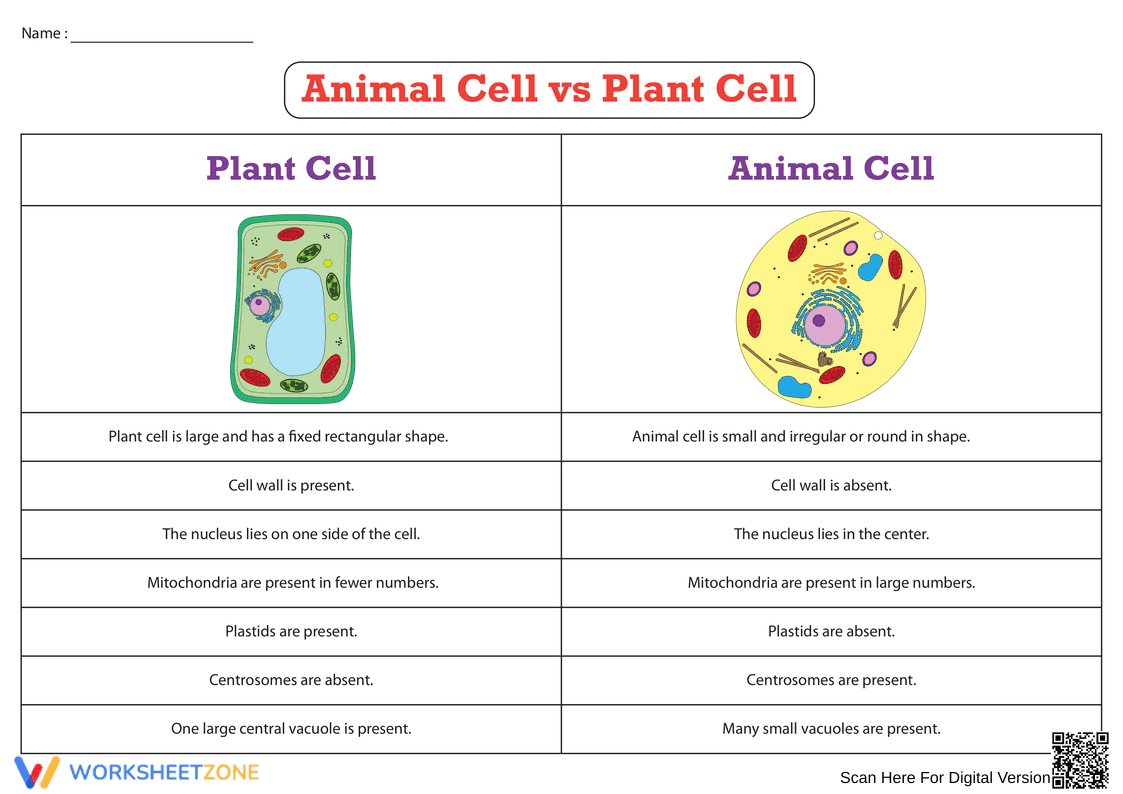

Essential Animal vs Plant Cell Worksheet | Grades 4-8

Paste this activity's link or code into your existing LMS (Google Classroom, Canvas, Teams, Schoology, Moodle, etc.).
Students can open and work on the activity right away, with no student login required.
You'll still be able to track student progress and results from your teacher account.
This Grade 4-8 science worksheet provides a clear, side-by-side comparison of animal and plant cell structures. By contrasting seven key physiological differences, students gain a conceptual grounding in how organisms function at a microscopic level. Learners will identify unique organelles and structural variations through this organized reference guide and visual aid.
At a Glance
- Grade: 4–8 · Subject: Science
- Standard:
MS-LS1-2— Use a model to describe how parts of cells contribute to function- Skill Focus: Comparative cellular anatomy
- Format: 1 page · 7 comparison points · Answer key included · PDF
- Best For: Introductory biology lessons and student reference
- Time: 15–20 minutes
Inside this resource, you will find a professionally designed comparison chart illustrating plant and animal cells. Each row highlights a specific attribute, such as shape, cell wall presence, nucleus position, and vacuole configuration. The clear labeling and concise descriptions make it an ideal visual aid for students to keep in their science binders for easy review throughout the unit.
This worksheet is designed for a zero-prep workflow to save teacher time. First, print the single-page PDF for your entire class (under 1 minute). Next, distribute the charts as a guided note-taking tool or an independent study guide (30 seconds). Finally, review the seven core differences using the provided answer key to ensure student accuracy (5 minutes). This streamlined process is perfect for sudden sub plans or as a quick refresher.
Aligned strictly to MS-LS1-2, this resource helps students use a model to describe the function of a cell as a whole and the ways parts of cells contribute to that function. It specifically targets the ability to distinguish between specialized structures like plastids and centrosomes. Both standard codes can be copied directly into lesson plans, IEP goals, or district curriculum mapping tools to ensure instructional compliance.
Educators should use this worksheet during the direct instruction phase of a cellular biology unit. It works well when paired with a microscope lab where students observe onion skin and cheek cells. As a formative assessment tip, observe whether students can explain why a plant cell requires a fixed rectangular shape compared to the irregular shape of an animal cell. Completion typically takes 20 minutes including discussion.
This resource is for Grade 4 through Grade 8 students who are beginning their exploration of life science. It is particularly helpful for visual learners and students requiring structured organizers to process complex biological information. We recommend pairing this comparison chart with a reading passage on organelle functions or an interactive 3D cell modeling activity to reinforce the physical differences between these two primary cell types.
According to a RAND AIRS 2024 report on life science education, visual comparison tools are significantly more effective than isolated memorization for middle school students mastering cellular biology. This worksheet aligns with MS-LS1-2 by requiring students to distinguish between animal and plant cell structures, such as the cell wall and plastids. By providing a clear side-by-side analysis, the resource supports cognitive anchoring of complex organelle functions. The seven core differences highlighted—including vacuole size and centrosome presence—serve as evidence-based indicators for student mastery of biological diversity. Educational analysis suggests that structured reference charts reduce cognitive load during introductory science lessons, allowing learners to focus on functional relationships within living systems. This printable resource ensures that Grade 4-8 students develop the necessary conceptual grounding for advanced biology while meeting rigorous state and national standards for scientific inquiry and observation. It is a reliable tool for classroom instruction.


