Leaf Worksheets for 6th Grade: Classroom Ideas for Anatomy and Function
These leaf worksheets for 6th grade address the transition point where students move past simple identification and start explaining what each structure actually does for the plant. The set includes five worksheet types — anatomy labeling, a photosynthesis reading with comprehension questions, a compare-and-classify activity, an observation sheet for use with real leaves, and a short assessment — each targeting a distinct science thinking skill so teachers can use them in sequence or pull individual worksheets for targeted practice.
The Specific Skills Targeted
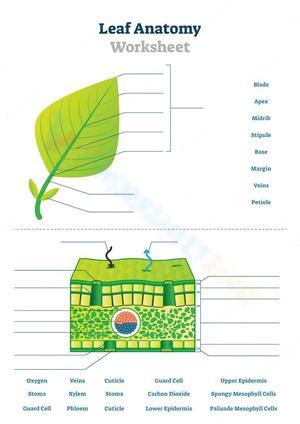
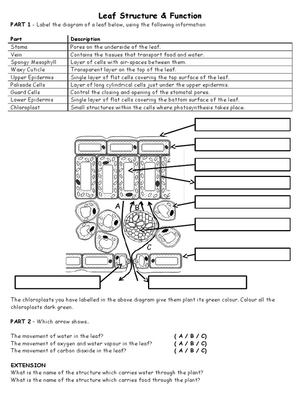
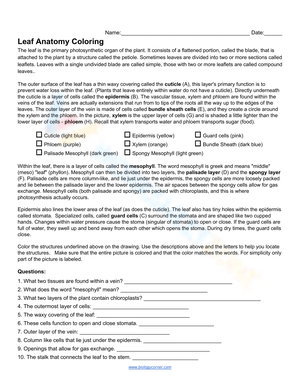
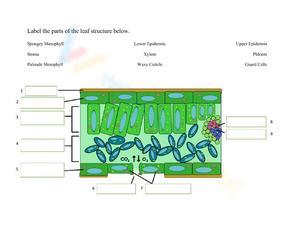
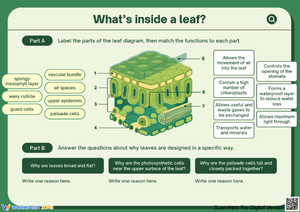
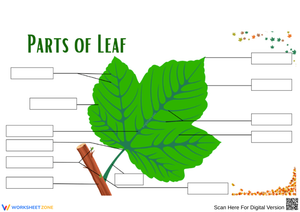
Sixth graders need to know six core leaf structures and the job each one does: the blade captures sunlight across its broad, flat surface; the petiole connects the blade to the stem; veins carry water and minerals inward while moving sugars outward; the cuticle reduces water loss at the leaf surface; stomata — most abundant on the underside of the blade — regulate gas exchange and water vapor release; and chloroplast-containing mesophyll cells are the actual sites of photosynthesis. Each worksheet pairs the structure name with a function prompt, so students are always explaining the "why," not just supplying a label.
The worksheets also push into photosynthesis as a system. Students need to hold the full picture: carbon dioxide enters through stomata, water arrives through veins, and chloroplast-rich cells use sunlight to produce sugars, releasing oxygen in the process. Students who can trace those input-output relationships can explain the leaf's role in plant survival — which is more useful, and more testable, than reciting the photosynthesis equation from memory.
Adaptation is the third thread. The compare-and-classify worksheet asks students to examine leaves from different environments and reason about why a thick, waxy, narrow leaf would lose less water than a thin, broad one — or why a broad leaf captures more light in a shaded understory. That structural reasoning is exactly what NGSS performance tasks ask for at this grade level.
Errors Students Make That These Worksheets Help You Catch
The most consistent error we see in leaf anatomy work is treating stomata as a structural feature only. Students label the stomata correctly on the diagram but describe them as "holes in the leaf" without mentioning gas exchange or water loss. The function prompt on the labeling worksheet exposes this immediately. A follow-up question like What would happen if a leaf's stomata stayed open on a hot, dry day? separates students who understand transpiration from students who are guessing.
Vein confusion comes up just as often. Most sixth graders assume veins carry water to the leaf and stop there — they miss that veins also export sugars from the leaf back to the rest of the plant. On the comprehension worksheet, answers like "veins bring water in" without any mention of sugar transport tell you that a student has a partial model. This is worth addressing directly before the unit moves on to roots and stems, since water and sugar transport are central to understanding how plant systems work together.
In adaptation activities, students often default to ranking leaves — calling a large leaf "better" without anchoring the claim to a specific environment. The classify worksheet corrects this by requiring students to name the habitat condition first, then link the leaf's structure to that condition. Even so, watch for students who write responses like "this leaf is small so it is from the desert" without explaining the connection between small surface area and reduced water loss.
Building These Worksheets Into a Plant Unit Sequence
A three-day block works well for this set. Day one: start with a real leaf or projected close-up photo and ask students to describe what they notice before any vocabulary is introduced, then use the anatomy labeling worksheet to attach terms to those observations. Running it in that order — noticing first, naming second — reduces passive copying and gives labels something concrete to stick to. Day two: students work through the reading passage and comprehension questions on photosynthesis, gas exchange, and transpiration. Day three: classification, adaptation comparison, and the short assessment worksheet as a formative check before the unit moves on.
For a station rotation, the five worksheet types map onto five stations without adjustment: anatomy labeling, reading and questions, observation with real leaves and a hand lens, adaptation classification, and a brief exit check. In a 50-minute class, most groups cycle through three stations per period, which means the full set takes about two class days to complete across all groups.
One technique that raises response quality across leaf worksheets for 6th grade: require a structure plus function sentence format for every labeled part. Instead of writing stomata, students write stomata, which open and close to control gas exchange and limit water loss through the leaf surface. That sentence frame shifts the cognitive demand from recall to explanation, and the shift shows up in student writing within a single class period — it is a small move that produces a measurable difference.
Standard Alignment
The primary standard driving this set is NGSS MS-LS1-6: "Construct a scientific explanation based on evidence for the role of photosynthesis in the cycling of matter and flow of energy into and out of organisms." In classroom terms, this means students need to understand the leaf as the site where the plant converts light energy into chemical energy stored in sugars — not as a passive label on a diagram. The reading worksheet, the anatomy labeling activity, and the adaptation comparison each build toward that explanatory standard from a different angle.
The crosscutting concept of Structure and Function threads through every worksheet in the set. NGSS expects sixth graders to analyze how a structure's form determines its function — the leaf delivers that concept in an especially clear form because stomata open and close, veins branch outward to reach every cell, and the broad blade maximizes surface area for light capture. Requiring the structure-plus-function sentence format described above is a direct application of that crosscutting concept at the language level. The reading comprehension worksheet also addresses CCSS.ELA-LITERACY.RST.6-8.4 by asking students to determine the meaning of domain-specific vocabulary from context rather than from a glossary.
Adjusting the Set for a Range of Learners
Small output adjustments make these worksheets accessible across ability levels without requiring separate materials:
- Remove the word bank from the anatomy labeling worksheet for students ready to work from recall; keep it in place for students who need visual support while building unfamiliar vocabulary.
- Offer sentence starters for explanation questions — The cuticle reduces water loss by... or Stomata close when... — for students who freeze on open-ended prompts.
- Let students who demonstrate understanding visually sketch and annotate on the observation sheet rather than composing full written explanations.
- For students who move quickly, assign the adaptation comparison as a written claim — two or three sentences linking a specific structural feature to a specific habitat pressure — rather than a matching task.
Teachers can also adjust by response length. Some students label and match; others write a four-sentence explanation tracing how a leaf pulls in carbon dioxide, uses water and sunlight to produce sugar, and releases oxygen. The science concept stays consistent — the output format adjusts to fit the learner. Leaf worksheets for 6th grade work especially well for this kind of tiered response because the visible evidence — a labeled diagram or a real leaf on the desk — gives all students the same starting point regardless of reading level.
Frequently Asked Questions
What leaf structures should 6th graders be able to explain, not just name?
At a minimum: blade, petiole, veins, cuticle, stomata, and chloroplast-containing mesophyll cells. Naming them is the floor. Sixth graders should also be able to state what each structure does — how veins move materials both into and out of the leaf, how the cuticle limits water loss, and how stomata control gas exchange. Function is the target, and the labeling worksheet pushes students toward it from the first prompt.
Can these worksheets stand alone or do they require teacher introduction first?
Most of them work well after brief initial exposure — a real leaf, a projected image, or a five-minute class discussion about what students already know. The reading passage worksheet builds in enough explanation to work more independently, but the labeling and observation worksheets land better when students have already noticed the physical structures they are about to name and describe.
How does the observation worksheet differ from the anatomy labeling worksheet?
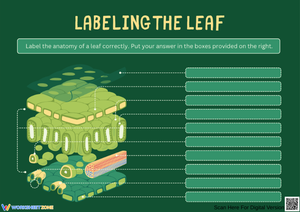
The labeling worksheet gives students a diagram and asks them to identify and explain structures using precise vocabulary. The observation sheet asks students to look at a real or photographed leaf, sketch what they see, describe texture and color, locate visible veins and surfaces, and then make an evidence-based claim about the leaf's likely function or habitat. One worksheet tests knowledge of structure; the other tests observation and scientific reasoning — they pair well on the same day.
When in the unit should I use the short assessment worksheet?
After students have worked through the labeling, reading, and either the comparison or observation worksheet — typically day three or four of a short plant unit. Leaf worksheets for 6th grade are most useful as formative tools when teachers use the assessment to surface gaps before the class moves on to stems and roots, not after the entire plant unit wraps up and revision is harder to fit in.
Clear All