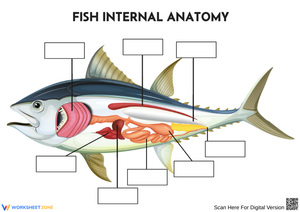
6th grade fish anatomy worksheets give science teachers a direct path into structure-function reasoning — one of the more durable thinking skills students build in middle school life science. The set covers the major external body parts, introduces a few internal structures where appropriate, and moves students from simple labeling toward explaining what each part actually does.
The Structures These Worksheets Target
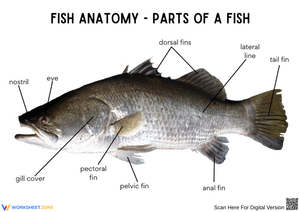
External anatomy comes first, and for good reason: students can observe it on diagrams, photos, or models, which keeps the vocabulary grounded in something visible rather than abstract. The set addresses fins, gills, scales, the caudal fin, eyes, mouth, and the lateral line — each paired with its function so students are connecting parts to survival strategies, not just collecting names.
- Fins: dorsal, pectoral, pelvic, anal, and caudal fins each support different aspects of movement, balance, and directional control.
- Gills: the gas-exchange structure that extracts dissolved oxygen from water as it flows across gill filaments.
- Scales: a protective covering that also reduces drag in many species.
- Lateral line: a pressure-sensitive sense organ that detects water movement — often the structure students find most surprising.
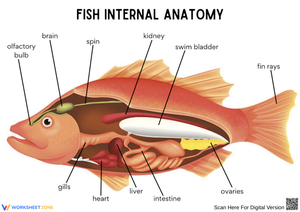
- Swim bladder: the internal gas-filled sac that allows bony fish to regulate depth without continuous swimming effort.
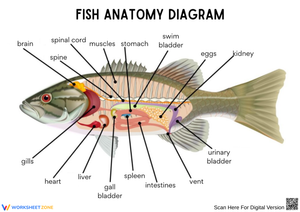
A light internal survey — swim bladder, heart, and basic digestive organs — appears alongside the external work. The goal is not organ-system depth but one or two clear examples that extend the structure-function principle beyond what students can see on the surface. The 6th grade fish anatomy worksheets in this set progress from visual recognition to written explanation, so the level of thinking doesn't flatten out at vocabulary recall.
Working These Worksheets Into Your Science Week
A strong entry point is projecting an actual fish photograph — not a cartoon — and asking students to mark or name any body part they already recognize. Five minutes of that tells you whether students have "gills" in their vocabulary but not "lateral line," or whether the whole map is blank. Either way, you know what the lesson needs to do before you hand out the first worksheet.
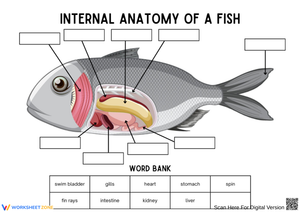
Each worksheet fits a specific moment in a lesson cycle. The diagram-labeling worksheet works best during or just after direct instruction, when students have heard the vocabulary and need to anchor it spatially. Matching and function-explanation worksheets belong in guided practice — after you have modeled thinking out loud at least once. Saying aloud "I know the gills handle gas exchange, so I need to think about where oxygen comes from in water" gives students a reasoning move to imitate before they attempt it independently.
For centers, the set divides naturally: diagram work at one station, function matching or short reading at another, and a compare-and-contrast task at a third. A prompt like "Why does a fast open-water fish look different from a bottom-dwelling species?" generates real discussion that flat vocabulary review never does. Stations running fifteen to eighteen minutes give most students enough time to complete one task and begin writing their reasoning before rotating.
Exit tasks on this topic should be tight and specific. "Name three external structures and explain the job of each" takes about four minutes and gives you genuine formative data. A sharper version — "Which single external structure would most reduce a fish's survival chances if it were missing, and why?" — separates students who are reciting labels from those who understand the biology behind them.
Mistakes Students Make That These Worksheets Help You Catch
The most persistent confusion involves the tail. Students write "the tail helps the fish swim" without specifying the caudal fin, which makes it impossible to assess whether they understand the fin's mechanical role — side-to-side thrust — versus the general posterior region of the body. Worksheets that require students to name the specific fin and describe its motion surface this confusion quickly and give you something to address before students move on.
Gills trip students up in a different way. Many sixth graders enter this unit believing fish breathe air from bubbles in the water rather than extracting dissolved oxygen directly across gill filaments. That misconception is stubborn. A worksheet that asks students to describe the path water takes through the gills — in through the mouth, across the filaments, out through the gill slits — reveals whether a student has genuinely replaced the misconception or is still working around it with vague language.
The lateral line is underestimated as a teaching moment. Students treat it as a vocabulary term they memorized for a quiz, not as a serious sense organ. Asking them to explain how a fish in murky water finds prey or avoids a predator without relying on vision forces them to reckon with the lateral line as a survival structure rather than a piece of trivia.
Adjusting the Set for a Range of Learners
Students who need more language support benefit from word banks, pre-labeled diagram examples alongside the blank practice version, and sentence frames such as "The ___ helps a fish by ___." Those supports keep the cognitive focus on the science rather than on decoding what the task is asking. Color-coding external and internal structures also helps students who struggle to distinguish between the two categories before they have enough vocabulary to sort them confidently.
Students ready for more challenge should move quickly past labeling into explanation. Open-response prompts work well here: ask them to compare the anatomy of a pelagic fish with a benthic species and predict which external features would differ and why. You can also push toward internal anatomy — how the swim bladder relates to buoyancy control, or how digestive system length might correlate with diet. These questions have more than one defensible answer, which is the point. That kind of productive ambiguity teaches students that biology involves evidence-based reasoning, not retrieval of a single correct answer.
Standard Alignment
These worksheets connect directly to the NGSS crosscutting concept of Structure and Function, which holds that complex systems can be described by how their structure supports their function. At the middle school level, that concept applies whenever students explain why a gill's shape allows gas exchange or why fin placement affects directional control. The worksheets also support MS-LS1-3, which asks students to construct arguments for how the body operates as a system of interacting subsystems — a claim students practice by explaining how fins, gills, and the swim bladder work together to allow a fish to move, breathe, and regulate depth simultaneously.
Teachers in states that have adopted or adapted NGSS frameworks will find that 6th grade fish anatomy worksheets sit naturally in the sixth- or seventh-grade life science sequence, depending on local scope-and-sequence decisions. The structure-function reasoning students practice here transfers directly into later units on human body systems and ecological relationships.
Frequently Asked Questions
What external parts should 6th graders know by name and function?
The core content includes fins (dorsal, pectoral, pelvic, anal, and caudal), gills, scales, the lateral line, eyes, and mouth. Students should know both the name and the job — not just "fins help swimming" but which fins affect steering versus thrust. The distinction matters for assessment and for any follow-up work on adaptations.
Should internal anatomy be included at the 6th grade level?
A light introduction to the swim bladder, heart, and digestive organs fits most sixth graders. The goal is not full organ-system coverage but one or two clear examples that reinforce the structure-function principle beyond what students can observe on the surface. Teachers can omit internal content for classes that need more time with external anatomy.
How do these worksheets work in a station-rotation setup?
Each worksheet stands alone, so they sort naturally into stations by task type: diagram labeling at one, function matching at another, and short reading or compare-and-contrast work at a third. Students can move through all three within a single class period if stations run fifteen to eighteen minutes each.
Can these worksheets be used as homework or review after a dissection lab?
Yes — 6th grade fish anatomy worksheets work well as post-lab consolidation tasks. After handling or observing a specimen, students often have strong visual memory but loose terminology. A labeling or matching worksheet completed that same evening helps students attach correct vocabulary to what they observed before that memory fades.












 Interactive Worksheet Maker
 Quiz Maker
 Word Search Maker
 Crossword Puzzle Maker
 Word Scramble Generator
 Sentence Scramble Generator
 Handwriting Worksheet Generator
 Name Tracing Generator
 Fill In The Blank Generator