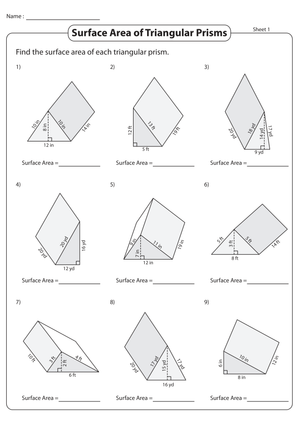
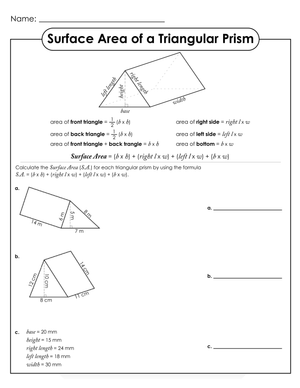
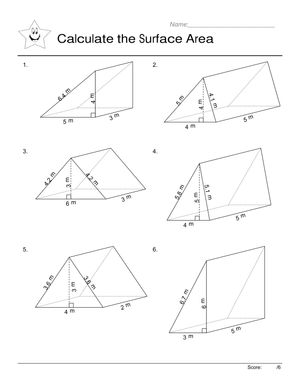
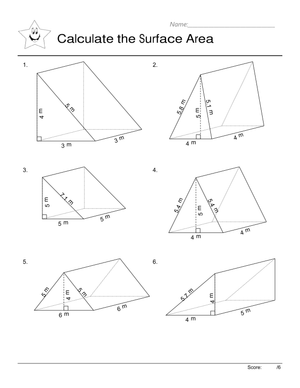
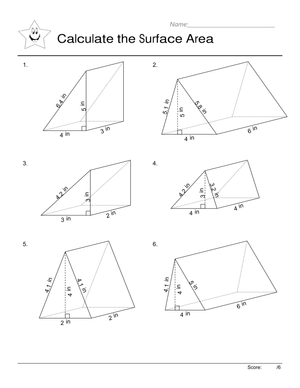
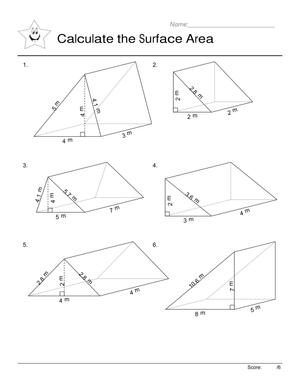
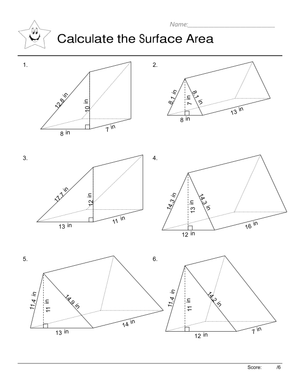
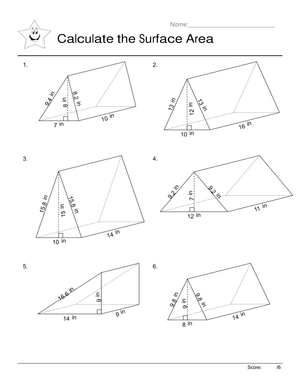
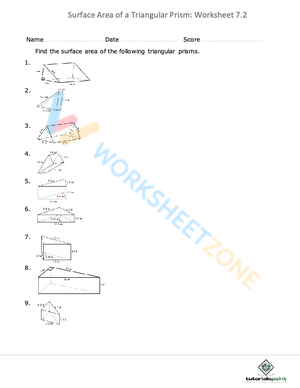
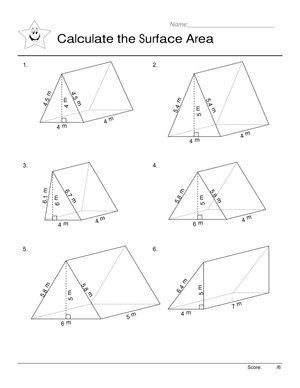
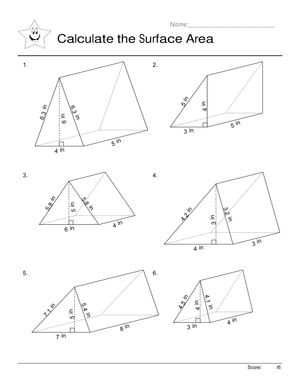
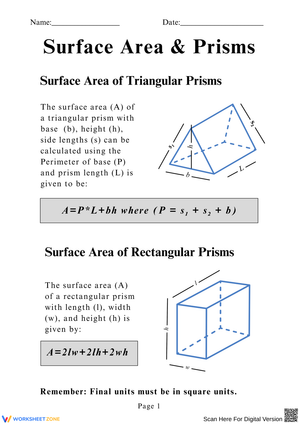
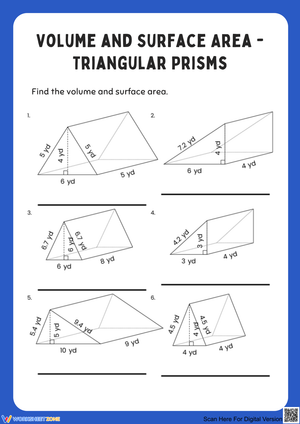
These surface area of a triangular prism printable worksheets for 6th grade give teachers a direct path through one of geometry's trickier spatial leaps — getting students to treat a three-dimensional solid as a collection of flat, calculable faces. A triangular prism has exactly five of them: two triangular bases and three rectangles whose widths come directly from the triangle's side lengths. Students at this level have usually worked with area in two dimensions, but this is their first sustained encounter with surfaces they cannot all see from a single angle. The set moves from labeled nets and diagrams into formula-based practice, keeping the visual step intact so the arithmetic stays connected to something students can name and point to.
The Five Faces and What Students Practice on Each Worksheet
Most of the work in this set builds from one structural fact: a triangular prism has exactly five faces, and each face contributes to the total surface area. Students who miss even one get an incorrect total regardless of how accurate their arithmetic is. The worksheets train students to identify and account for all five before any calculation begins.
Across the set, students work through these skills in a deliberate sequence:
- Identify each face on a net or labeled diagram — both triangular bases and all three rectangular lateral faces.
- Calculate the area of one triangular base using one-half times base times height, then double it for the two bases combined.
- Find the area of each rectangular face, recognizing that the rectangle's width comes from a side of the triangle — not from the triangle's interior height.
- Distinguish the prism's length from the triangle's height, the two measurements 6th graders most reliably confuse.
- Apply the formula SA = ph + 2B — where p is the perimeter of the triangular base, h is the prism length, and B is the area of one triangular base — as a structured way to organize the five-face work.
- Label each partial area before adding: triangle 1, triangle 2, rect A, rect B, rect C. That habit reduces arithmetic errors more reliably than any reminder to check work.
Problems begin with whole-number dimensions and progress to mixed values once students have the five-face structure down. Each worksheet in the set includes enough workspace for students to record and label intermediate steps before combining them — a design choice that makes student thinking visible and makes errors easier to locate and correct.
The Three Mistakes That Show Up Most in 6th-Grade Surface Area Work
The errors students make on triangular prism surface area follow predictable patterns. The most frequent is counting one triangular base instead of two. Students who sketch the prism upright see a triangle on top and three rectangles on the sides; the matching triangle at the bottom vanishes from their mental model. This omission shaves exactly B — the area of one triangular base — off the correct answer. If multiple papers in a class land on the same wrong total, that is almost certainly the source, and it is worth pausing to address before moving forward.
A second pattern involves the triangle's height. When the triangular base is a right triangle, one leg serves as the height, and students assume that relationship holds for every triangle. Give them an acute triangle with the height drawn as a dashed interior line, and a portion of the class will still pull a slant side instead. This is not a prism-specific error — it is a gap in understanding what "height of a triangle" means — but it surfaces here and needs direct correction, not just another problem to practice.
Third, students often assign the same width to all three lateral rectangles, which only produces a correct answer if the triangular base is equilateral. On a scalene or right-triangle base, each side of the triangle differs, so each rectangle is a different width. A net makes this visible almost instantly. An error-analysis task — showing a worked example with exactly one wrong step and asking students to find and explain the mistake — tends to produce stronger retention here than additional computation practice, because it requires students to reason about the structure rather than avoid the error by habit.
Where These Worksheets Fit Across a Geometry Unit
The surface area of a triangular prism printable worksheets for 6th grade fit naturally at several points in a geometry unit, not just on the day the formula is introduced. Early in the unit, a net-based worksheet works well as a whole-class opener: project it, ask students to color each face type differently, and have them record the area of each colored region before any formula is mentioned. That 10–12 minute activity front-loads the spatial understanding that formula problems later assume.
For stations, split the set by task type — one group reviewing triangle area, a second practicing labeling the five faces of a prism, a third solving complete surface area problems. This handles the common classroom reality that some students still need triangle area support while others are ready to combine all five faces. Exit tickets are another natural fit: a single problem with one unlabeled rectangle reveals in under five minutes whether a student is tracking all five faces or only the three visible from the front. On review days, showing a worked solution with one wrong step — specifically a missing triangular base — and asking students to locate and explain the error consistently produces better discussion than another round of routine computation.
Tiering the Practice for Students at Different Starting Points
Students who need more support do best with worksheets where every face on the net is pre-labeled with a letter or color, where the triangle's interior height appears as a separate dashed line rather than something implied by the figure, and where a structured table provides a row for each face area before students sum them. Whole-number dimensions throughout keep the arithmetic from competing with the geometric reasoning.
On-level students work from standard labeled diagrams with enough white space to show their full process. They can handle one or two problems with a decimal dimension, and at least one word problem — a camping tent, a wedge-shaped planter, a triangular greenhouse panel — where they have to identify which measurements belong to the triangular face and which to the prism's length.
For students ready for extension, remove some labeled dimensions and require the Pythagorean theorem or given perimeter information to find a missing side before calculating. A writing extension asking students to explain, in plain terms, why face-by-face addition and the formula SA = ph + 2B always produce the same result pushes the work well beyond computation into mathematical reasoning — and it reveals whether their understanding is conceptual or procedural.
Standard Alignment
This set addresses CCSS 6.G.A.4, which requires students to represent three-dimensional figures using nets and use those nets to find surface area. Within a typical 6th-grade sequence, this standard follows area of triangles and quadrilaterals (6.G.A.1) and often appears after surface area of rectangular prisms, which require only rectangle area. The triangular prism is introduced next because it demands two face types at once — triangles and rectangles — which raises the cognitive load substantially. The surface area of a triangular prism printable worksheets for 6th grade meet that demand by holding the net-based representation in place through the early problems, then shifting toward the compact formula only after students can reliably account for all five faces.
Frequently Asked Questions
What formula do students use, and should they be expected to know it from memory?
The formula is SA = ph + 2B, where p is the perimeter of the triangular base, h is the prism length, and B is the area of one triangular base. Most 6th-grade teachers have students build toward the formula by adding each face separately first — two triangles plus three rectangles — and then observing that the result always equals ph + 2B. Students who understand that connection can reconstruct the formula on an assessment rather than depending on having memorized it in exactly the right form.
How does the triangular prism differ from the rectangular prism students studied first?
A rectangular prism has six rectangular faces, which makes face-counting repetitive but not conceptually complex. The triangular prism introduces triangle area — including the one-half factor and the distinction between a triangle's interior height and its side lengths — as a prerequisite step before any surface area calculation can begin. That added prerequisite is exactly why the triangular prism follows the rectangular prism in most 6th-grade geometry sequences.
Can students work through these worksheets independently after missing a lesson?
The surface area of a triangular prism printable worksheets for 6th grade hold up well for independent reteaching because the net-based worksheets build the concept from first principles. A student who missed direct instruction can work through the first worksheet — identify the five faces, label each one, find each area in order — with a brief teacher check-in at the start, and arrive at the same foundation as peers who were present. The structured workspace on each worksheet makes independent catch-up legible without requiring a full re-teach.
How do I know when students are ready to move from face-by-face addition to the formula?
The clearest signal is whether a student can predict the faces of a triangular prism without a diagram — say "two triangles and three rectangles" without prompting, and explain that each rectangle's width comes from a different side of the triangle. A student who can do that is ready for the formula. A student who still needs to count faces on a net one at a time is not — the formula becomes a rote sequence they cannot reconstruct or adjust, which causes problems when the problem format changes later in the unit or on assessments.













 Interactive Worksheet Maker
 Quiz Maker
 Word Search Maker
 Crossword Puzzle Maker
 Word Scramble Generator
 Sentence Scramble Generator
 Handwriting Worksheet Generator
 Name Tracing Generator
 Fill In The Blank Generator