


























1 / 2
0
Views
0
Downloads

0.0
0
Save
0 Likes
Share
Master Triangular Prisms: A Geometry Worksheet
0 Views
0 Downloads
Paste this activity's link or code into your existing LMS (Google Classroom, Canvas, Teams, Schoology, Moodle, etc.).
Students can open and work on the activity right away, with no student login required.
You'll still be able to track student progress and results from your teacher account.
Information
Description
What It Is:
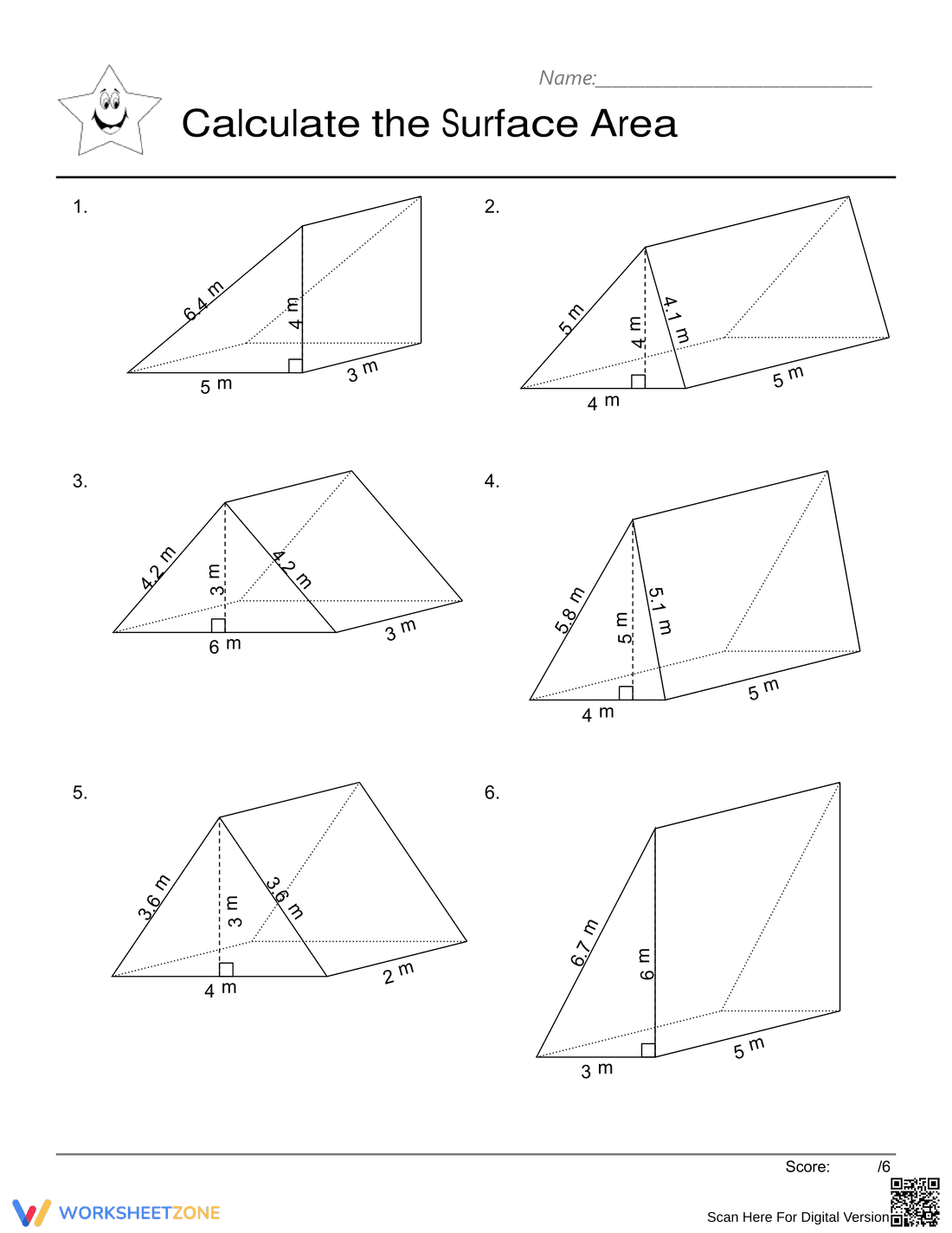
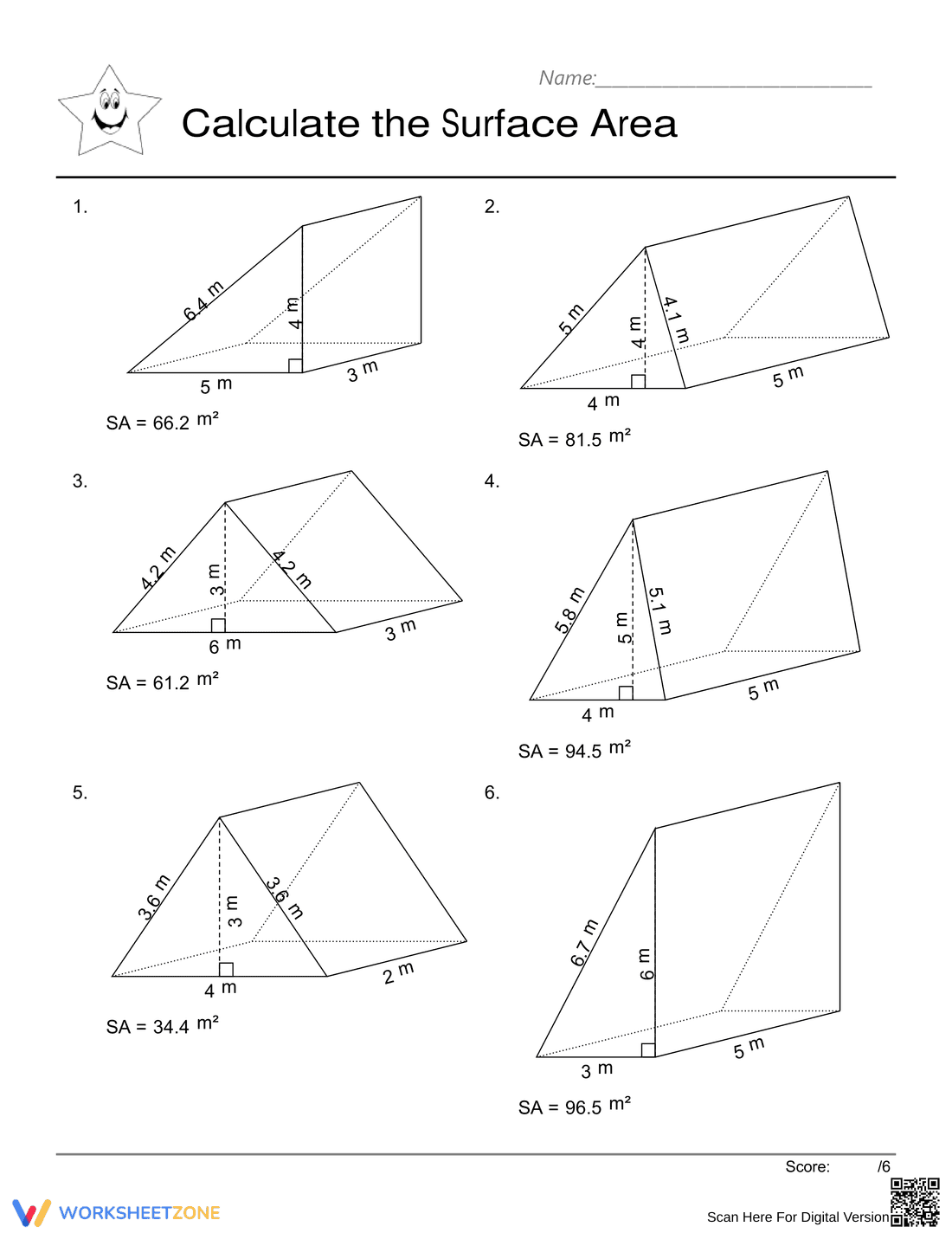
This is a math worksheet focused on calculating the surface area of triangular prisms. The worksheet presents six different triangular prisms, each with labeled dimensions in meters. Students are expected to calculate the surface area of each prism based on the provided measurements.
Grade Level Suitability:
This worksheet is suitable for grades 6-8. It requires students to apply their knowledge of area formulas for triangles and rectangles, as well as spatial reasoning skills to visualize the faces of the prisms.
Why Use It:
This worksheet helps students develop their understanding of surface area calculations for 3D shapes. It reinforces the application of geometric formulas and improves problem-solving skills in a real-world context.
How to Use It:
Students should first identify the different faces of each triangular prism (two triangles and three rectangles). Then, they should calculate the area of each face using the provided dimensions. Finally, they should add up the areas of all the faces to find the total surface area of the prism.
Target Users:
This worksheet is ideal for students who are learning about surface area and volume in geometry class. It can be used as a practice activity, homework assignment, or assessment tool. It is also suitable for students who need extra practice with applying geometric formulas.
This is a math worksheet focused on calculating the surface area of triangular prisms. The worksheet presents six different triangular prisms, each with labeled dimensions in meters. Students are expected to calculate the surface area of each prism based on the provided measurements.
Grade Level Suitability:
This worksheet is suitable for grades 6-8. It requires students to apply their knowledge of area formulas for triangles and rectangles, as well as spatial reasoning skills to visualize the faces of the prisms.
Why Use It:
This worksheet helps students develop their understanding of surface area calculations for 3D shapes. It reinforces the application of geometric formulas and improves problem-solving skills in a real-world context.
How to Use It:
Students should first identify the different faces of each triangular prism (two triangles and three rectangles). Then, they should calculate the area of each face using the provided dimensions. Finally, they should add up the areas of all the faces to find the total surface area of the prism.
Target Users:
This worksheet is ideal for students who are learning about surface area and volume in geometry class. It can be used as a practice activity, homework assignment, or assessment tool. It is also suitable for students who need extra practice with applying geometric formulas.


