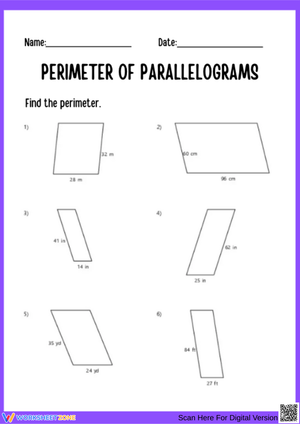
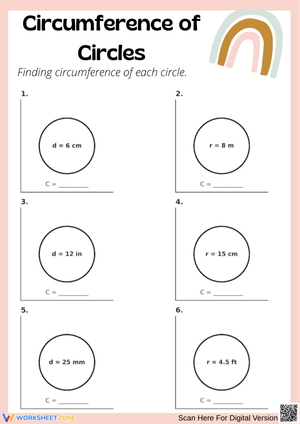
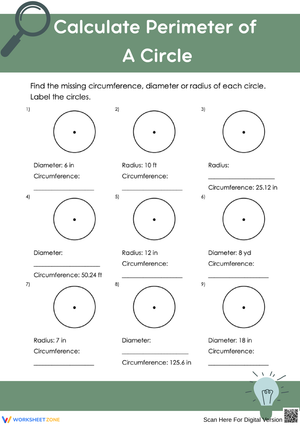
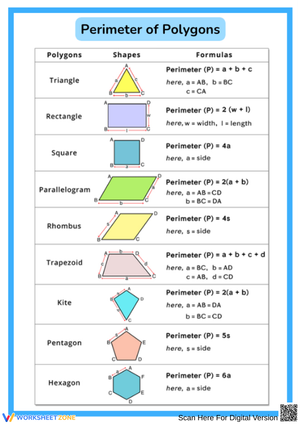
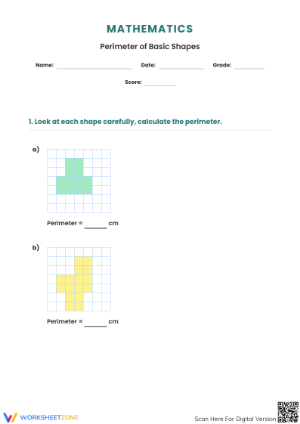
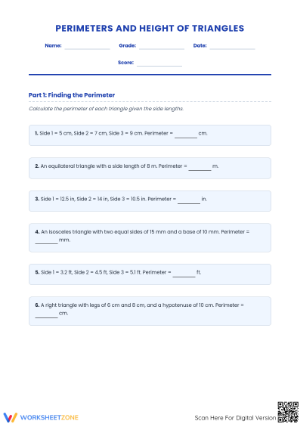
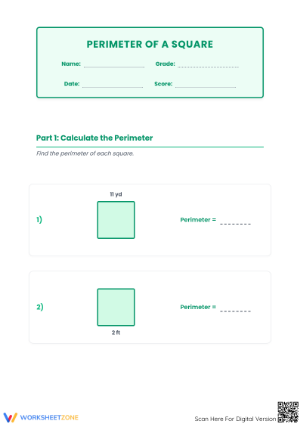
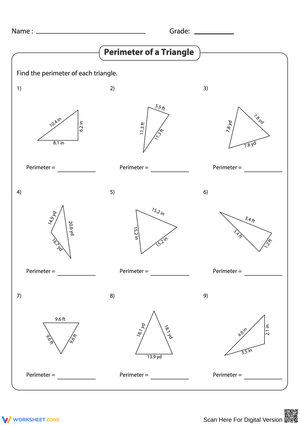
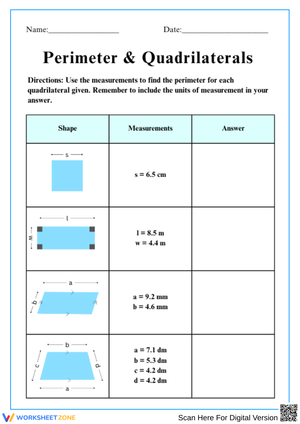
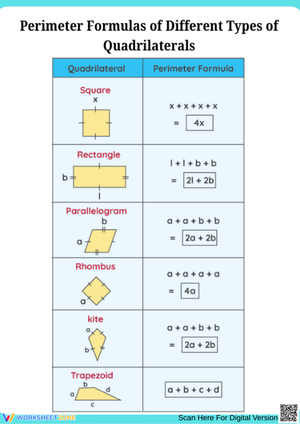
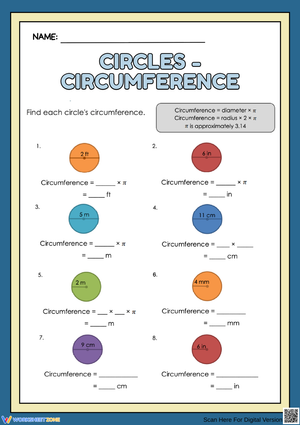
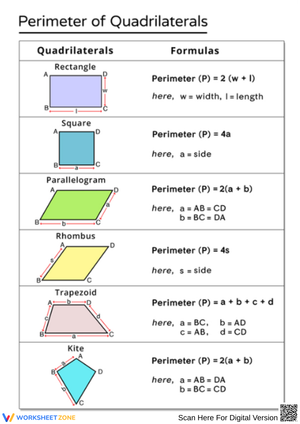
These 6th grade perimeter worksheets give teachers a ready-to-print resource for the geometry work that shows up across a middle school unit — composite figures, missing side lengths, and the word problems where students have to decide which dimensions matter before they can calculate anything. The set builds on what students first encountered in 3rd grade but demands more from them: shapes become irregular, not all sides are labeled, and at least a few problems require working backward from a known perimeter to find an unknown side.
The Specific Skills Targeted
Each worksheet concentrates on a distinct category of perimeter work. That makes it straightforward to assign the right worksheet at the right point in the unit rather than handing students a mixed pile at the start and hoping they sort it out.
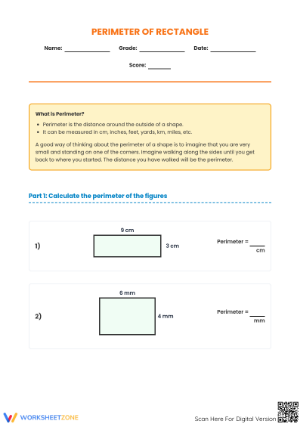
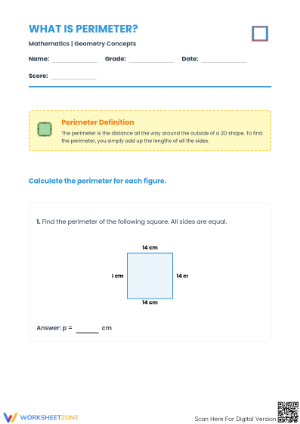
- Rectangles and squares: Direct computation with side lengths or the P = 2l + 2w formula, with a clear expectation that answers include units.
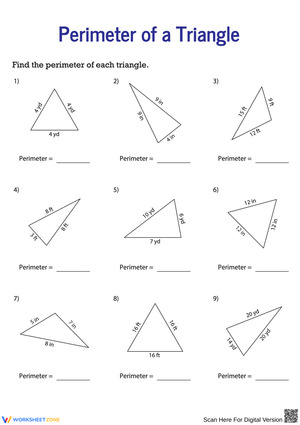
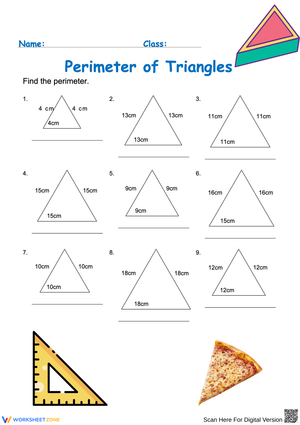
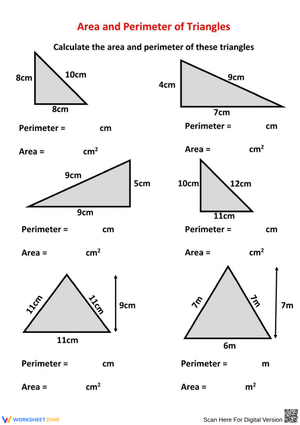
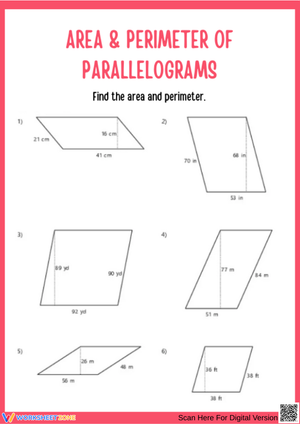
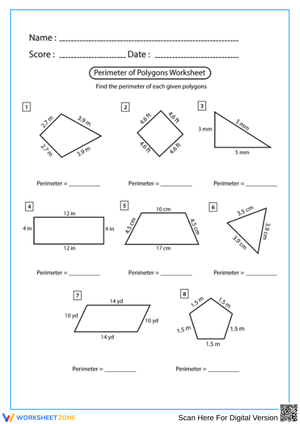
- General polygons: Triangles, pentagons, hexagons, and irregular multi-sided figures where students add all sides rather than relying on a single formula.
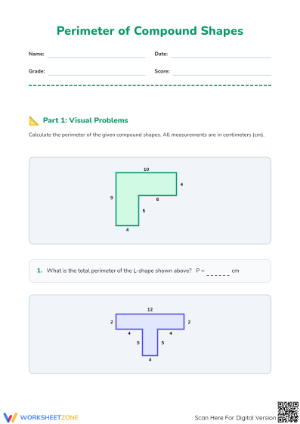
- Composite figures: L-shapes, T-shapes, and stepped outlines where students must determine which segments belong to the outer boundary and which are interior lines.
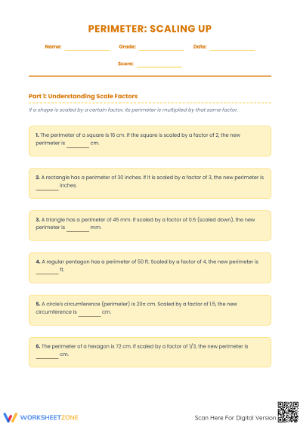
- Missing side problems: Given a total perimeter and all but one side length, students write and solve an equation — the format that ties perimeter most directly to 6th grade algebra.
- Decimal and fraction measurements: Side lengths in tenths, hundredths, and simple fractions that shift the challenge from concept recall to computational precision.
- Real-world applications: Fencing, picture framing, room layout, and track distance problems that require students to interpret a context before setting up any calculation.
Frequent Errors Worth Anticipating Before the Lesson
Composite figure problems surface the most consistent error in this unit: students count interior segments. When an L-shaped figure is drawn by joining two rectangles, the shared wall between them appears in the diagram, and students add it to their total. The shape looks complicated, so they include everything visible. The correct answer skips any segment that doesn't sit on the outer edge — but students have to make that decision actively, and many don't until it's pointed out directly.
Missing side problems reveal a different confusion. Students who understand that all sides must sum to the given perimeter will still subtract only one side from the total rather than accounting for all the known sides. For a rectangle with perimeter 40 cm and one labeled side of 12 cm, a student writes 40 − 12 = 28 rather than recognizing that two sides of 12 account for 24 cm, leaving 16 cm for the remaining pair. That step — using the properties of the shape to account for unlabeled but implied sides — needs explicit attention during instruction, not just correction after students turn in the worksheet.
Units are the third persistent issue. Students who calculate 36 correctly will write "36" as the final answer without a unit label. By 6th grade that habit needs correcting before it shows up on a state assessment. Marking unit omissions consistently from the first worksheet onward teaches students to treat the label as part of the answer, not an afterthought.
Building These Worksheets Into Your Lesson Plans
The composite figures worksheet works well as a whole-class activity on the day you introduce that problem type. Before students calculate anything, ask them to trace only the outer edge of each figure lightly with a pencil. This takes about two minutes and makes the geometric decision visible — students who would have counted an interior wall see their pencil stop before reaching that segment. It's also an easy circulating check: a messy trace through the inside of a figure tells you immediately who needs support before they've written a single calculation.
The missing side worksheet pairs naturally with whatever lesson introduces one-step equations. When students solve for an unknown side length, they're applying the same equation structure they're learning in algebra, and the geometric context gives the equation real meaning. Teachers who run both together often notice students asking better questions about why they're writing an equation rather than just following a subtraction procedure.
Word problem worksheets fit better in the middle or end of a class period than as openers. Students need settled attention to read and interpret the context before they can set up the math. As bell ringers, the polygon or decimal computation worksheets produce cleaner data and cause less frustration before the lesson starts.
Adjusting the Set for a Range of Learners
Students who struggle with multi-digit decimal addition run into trouble on the composite figures and decimal worksheets — not because the geometry is beyond them, but because arithmetic becomes a barrier mid-problem. A simple fix: give those students a small side-length table beside each figure. They record each side, then add the column. That step-by-step format keeps the geometric reasoning in play and makes it easier to diagnose whether an error comes from the concept or the computation.
On-level students generally move well from labeled polygon problems to missing side problems within the same unit block. Once they add all sides consistently and label with units, the unknown-side format adds the next layer without requiring a completely new skill set.
For extension, skip the straightforward computation items and assign composite figures with unlabeled sides and decimal measurements — or ask students to design their own composite figure that meets a specified perimeter. That task requires genuine reasoning about how side lengths relate to each other and generates productive conversation when students compare figures. A well-organized 6th grade perimeter worksheets set includes enough range in problem types that teachers can identify an appropriate entry point for most learners and a meaningful challenge for those who move through the core work quickly.
Standard Alignment
Perimeter as a concept has its CCSS anchor at 3.MD.D.8, but the 6th grade application here aligns most directly to two later standards. 6.G.A.1 expects students to find area by composing and decomposing shapes into triangles and other polygons — the same composite-figure reasoning that perimeter work at this level requires. 6.EE.B.7 addresses solving equations of the form x + p = q, which is precisely the structure students use when they write an equation to find a missing side length. For teachers who want a printable 6th grade perimeter worksheets that pulls double duty across geometry and expressions standards, the missing side problems are the most efficient items in the set.
State standards closely mirroring CCSS place these skills at the intersection of geometry and early algebra — which is where 6th grade perimeter instruction sits regardless of which framework a district follows.
Frequently Asked Questions
What prior knowledge do students need before starting these worksheets?
Students should be able to add side lengths accurately and understand that perimeter measures the distance around the outside of a two-dimensional figure. Familiarity with units — centimeters, inches, feet — also matters, since most problems require students to label answers correctly. Students who are still uncertain about adding decimals or fractions will need targeted support on those specific worksheets, though the polygon and whole-number computation worksheets remain accessible without that fluency.
How long does each worksheet take to complete in class?
The focused worksheets — labeled polygons or whole-number rectangle problems — typically take on-level students 12–18 minutes working independently. Composite figure and word problem worksheets tend to run 20–25 minutes because students pause more often to re-examine diagrams or re-read the context. Knowing that difference matters when planning where in the period to assign each one.
Can these be used with students who are significantly below grade level?
Yes. Start those students on the labeled-rectangle and simple polygon worksheets before moving to composite figures or missing side problems. The 6th grade perimeter worksheets set includes enough variation in difficulty that teachers can find a reasonable starting point for students who need to rebuild from simple shapes, then advance through the set as confidence and accuracy develop.
Are answer keys included?
Answer keys come with the set. Teachers use them for math station rotations, quick grading, and student self-correction after independent work — especially useful on days when a teacher is pulling small groups and needs the rest of the class to check their own progress without waiting.













 Interactive Worksheet Maker
 Quiz Maker
 Word Search Maker
 Crossword Puzzle Maker
 Word Scramble Generator
 Sentence Scramble Generator
 Handwriting Worksheet Generator
 Name Tracing Generator
 Fill In The Blank Generator