


























Views
Downloads
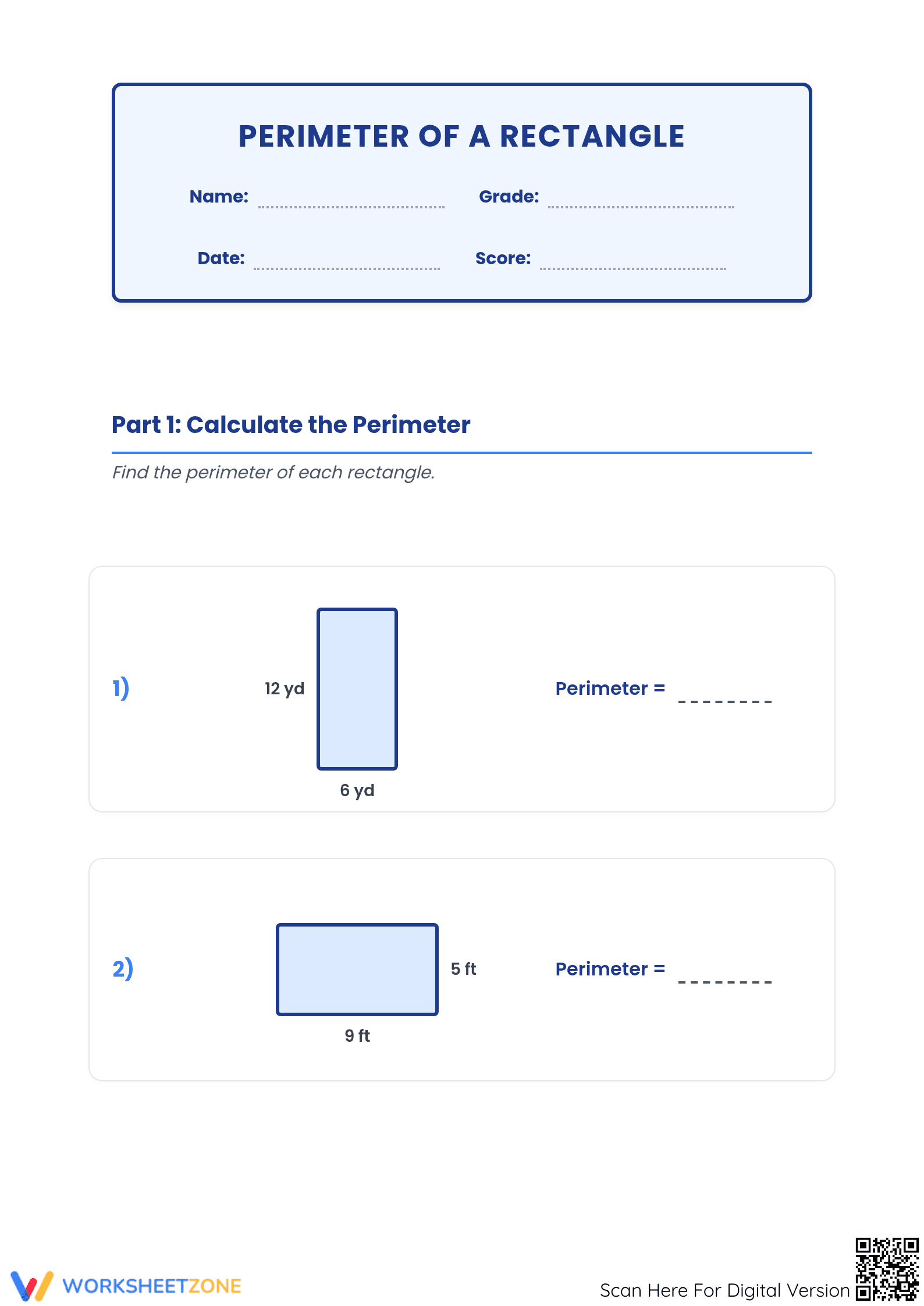



Essential Grade 4 Perimeter of Rectangles Worksheet
Paste this activity's link or code into your existing LMS (Google Classroom, Canvas, Teams, Schoology, Moodle, etc.).
Students can open and work on the activity right away, with no student login required.
You'll still be able to track student progress and results from your teacher account.
This Grade 4 math worksheet focuses on the essential skill of calculating the perimeter of rectangles. Students apply the perimeter formula to a variety of rectangles, reinforcing their understanding of linear measurement and additive properties. It provides extensive practice to ensure students move from simple calculation to conceptual fluency in geometry.
At a Glance
- Grade: 4 · Subject: Math
- Standard:
CCSS.MATH.CONTENT.4.MD.A.3— Apply the perimeter formula for rectangles in mathematical problems- Skill Focus: Rectangle Perimeter Calculation
- Format: 4 pages · 48 problems · Answer key included · PDF
- Best For: Independent practice and homework reinforcement
- Time: 25–40 minutes
The resource consists of four pages of structured practice, containing 48 distinct rectangular shapes with labeled side lengths. Each problem provides a dedicated workspace for students to perform calculations and record their final answers. A comprehensive answer key is included at the end of the set, allowing for rapid grading or student self-correction.
Zero-Prep Workflow
The workflow is designed for maximum efficiency in busy classrooms. Teachers can print the multi-page set in under 30 seconds, distribute the packets immediately, and use the included answer key for a 2-minute review session. This zero-prep structure makes it an ideal candidate for emergency sub plans or last-minute homework assignments that require minimal setup time.
Standards Alignment
This resource is directly aligned to CCSS.MATH.CONTENT.4.MD.A.3, which requires students to "Apply the area and perimeter formulas for rectangles in real world and mathematical problems." It isolates the perimeter component to ensure students master the "sum of all sides" concept. This standard code can be copied directly into lesson plans, IEP goals, or district curriculum mapping tools.
How to Use It
Use this worksheet as an independent practice set following a direct instruction lesson on measurement. It also serves as an excellent formative assessment; observing if students use the formula (2L + 2W) versus adding four individual sides provides insight into their algebraic readiness. Expect completion in 25 to 40 minutes depending on student familiarity with the formula and calculation speed.
Who It's For
This is designed for Grade 4 students but supports Grade 3 extension or Grade 5 review for students needing remediation. It pairs naturally with geometric anchor charts or hands-on measurement activities using rulers to bridge the gap between abstract numbers and physical dimensions. It is also suitable for small group intervention sessions or specialized education settings.
Standard CCSS.MATH.CONTENT.4.MD.A.3 focuses on applying perimeter formulas for rectangles to solve mathematical problems in various contexts. According to RAND AIRS 2024, consistent drill on geometric properties significantly improves student retention of measurement concepts and formulaic fluency. This Grade 4 worksheet provides 48 targeted tasks that build computational speed and accuracy through repeated practice. By isolating the calculation of perimeter, it allows students to focus on the additive relationship of side lengths without the cognitive load of more complex area transformations. The inclusion of an answer key supports immediate feedback, which is a critical component of effective mathematics instruction and formative assessment strategies. This resource serves as a foundational tool for developing the spatial reasoning and formulaic application required for higher-level middle school geometry and real-world engineering applications in future stem careers.


