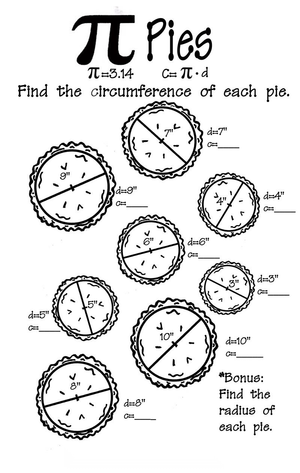
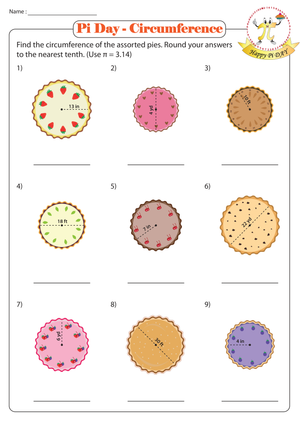
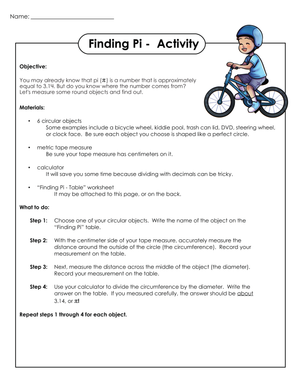
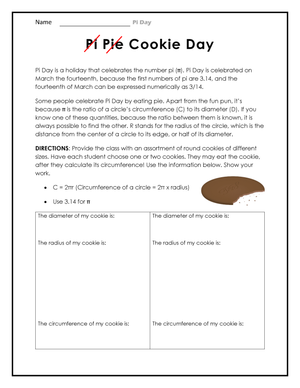
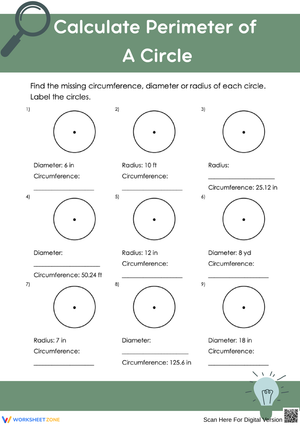
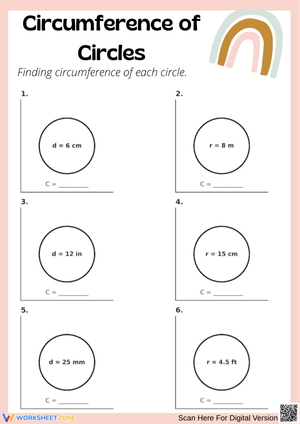
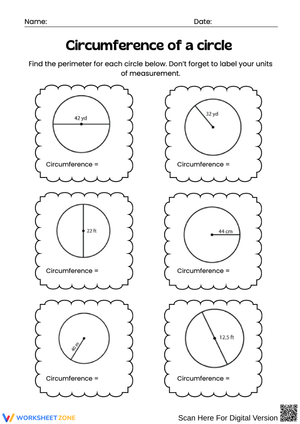
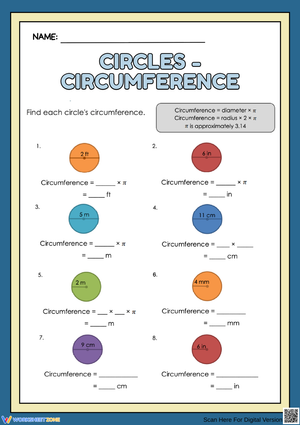
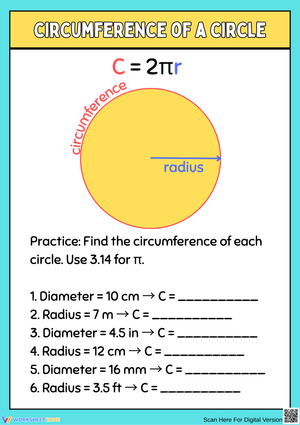
These 6th grade circumference of a circle worksheets resources give teachers practice sets where the first real decision isn't arithmetic — it's identification. Before students multiply anything, they have to locate the given measurement and determine whether it's the radius or the diameter. That one reading habit, built early, eliminates a surprising share of downstream errors.
The Specific Skills Each Worksheet Targets
Circumference sits at an interesting instructional moment in sixth grade: students have usually done area and perimeter for years, but this is often the first time they encounter pi as something they actually work with rather than just define. Each worksheet in the set focuses on that transition — from "I know what pi is" to "I know how to use it to find a measurement."
- Vocabulary identification: Students mark the radius, diameter, and circumference on labeled or partially labeled circle diagrams before any calculation begins.
- Formula selection: Problems alternate between giving the radius and giving the diameter, so students must choose between C = 2πr and C = πd rather than applying a single formula reflexively.
- Exact and approximate answers: Some worksheets ask students to use 3.14; others request answers left in terms of pi. Directions specify which, consistently within each worksheet.
- Unit labeling: Problems use inches, centimeters, feet, and meters. Students record units as part of every final answer.
- Word problems with real contexts: Wheels, garden borders, circular tracks, and clock faces give students something concrete to attach the formula to.
- Graduated difficulty: Easier items use whole-number measurements; later items involve decimals or ask students to work backward from a known circumference to find the diameter or radius.
Lesson-Planning Ideas to Get the Most From These Worksheets
A single worksheet works well as a bell ringer during the week you introduce circumference. Four focused problems at the start of class take about eight minutes and show immediately whether students from the previous day's lesson actually internalized the radius-versus-diameter distinction. That early read is worth more than waiting until a quiz to find out.
Once students move into independent practice, a full worksheet with mixed problem types — diagrams, word problems, and at least one reverse problem — gives a clearer instructional picture than a problem set that stays in one format the entire time. The reverse problem (given circumference, find the diameter) is especially useful because students who have only memorized the forward formula have nowhere to hide. When teachers searching for 6th grade circumference of a circle worksheets options describe what they actually need, it's usually this kind of variety — not more of the same problem type repeated across every item.
For small-group reteach, start with the vocabulary worksheet first. Students who struggle with circumference problems often have a simpler underlying issue: they aren't certain which line segment in a circle is the radius and which is the diameter. Sorting that out visually before returning to calculation usually moves instruction faster than re-explaining the formula from scratch.
Mistakes Students Make Before the Calculation Even Starts
The most consistent error pattern in student work on circumference is not wrong arithmetic — it's a wrong starting value. A student reads "a circle with a radius of 7 centimeters" and writes C = π × 7, arriving at approximately 21.98 cm instead of the correct 43.96 cm. The multiplication itself is accurate; the student simply treated the radius as if it were the diameter. Because the error happens at step one, checking only the final answer doesn't catch it. Worksheets that require students to write out the full substitution step — showing which formula they used and what value they plugged in — make this mistake visible at a glance during a quick room scan.
A second pattern worth anticipating: students who just finished an area unit sometimes apply the area formula reflexively. When a problem shows a circle diagram with a radius labeled, a student still thinking about A = πr² may square the value instead of multiplying by 2. Side-by-side comparison problems — one circumference item and one area item using the same circle measurement — help students hold the two formulas apart. Some worksheets in the set use exactly this format.
Students also drop units at a higher rate on circumference than on simpler perimeter work, possibly because carrying pi through the multiplication occupies enough working memory that the unit label falls out. A practical habit: ask students to write the unit label immediately after writing the formula, before substituting any numbers. That anchors it at the start rather than asking students to remember it at the end.
Adjusting the Set for Different Learners in the Same Room
For students who need more structured entry, assign worksheets that include a formula reference box and use whole-number measurements throughout. Before calculating, have those students circle the given measure and write "radius" or "diameter" next to it — a small annotation step that consistently improves formula selection. This works better than re-explaining the formula verbally, because the student is making the distinction actively rather than receiving it passively.
On-level students benefit most from the mixed-format worksheets: some items with diagrams, some with word problem text only, and no formula box at the top. That combination asks students to transfer the formula across presentation formats, which is where durable fluency actually builds. For students ready for extension, include the reverse problems and ask for written reasoning: "Explain how you know your answer is reasonable." Those explanations surface conceptual understanding that a clean numerical answer alone doesn't show.
Teachers pulling intervention materials can find 6th grade circumference of a circle worksheets sets useful precisely because the print format allows easy segmenting — assign two problems instead of twelve, stop after the diagram section, or use just the vocabulary identification portion for a student who needs that work separately before rejoining the calculation tasks.
Standard Alignment
Formally, circumference of a circle appears under CCSS.MATH.CONTENT.7.G.B.4, which asks students to know and use the formulas for the circumference and area of a circle and apply them to solve problems. Many 6th grade teachers work with these worksheets as an early introduction to that standard — in accelerated courses, during the final geometry unit of the year, or in states whose frameworks place circumference at grade 6. The instructional placement matters: 7.G.B.4 expects more than formula recall. It expects students to apply the formula to real problems, which is why worksheets that include word problems and reverse tasks are more directly aligned to that standard than drill sets that isolate the calculation step.
Frequently Asked Questions
If the problem gives the radius, which formula should students use?
Students should use C = 2πr and substitute the radius directly. The common mistake is reaching for C = πd but plugging in the radius as if it were the diameter — producing an answer that is exactly half of what it should be. Worksheets that ask students to label their formula choice before substituting make this particular error easy to catch during a class walkthrough.
Should students use 3.14 or leave answers in terms of pi?
Both approaches appear across the set, and each worksheet specifies which to use. As a general rule, leaving answers in terms of pi is more useful when you want students to understand the formula structure and the relationship between the parts; using 3.14 is better when the lesson involves practical measurement or numerical comparison. Keeping the expectation consistent within a single worksheet reduces confusion and speeds up grading.
These worksheets are labeled for 6th grade, but CCSS places circumference at 7th grade — does that matter?
Not in most classrooms. Many 6th grade courses introduce circumference near the end of the geometry unit as a preview of 7th grade work, and a number of state frameworks place it at grade 6. The worksheets address the same skill regardless of the grade label. If your course follows strict CCSS pacing, use them as enrichment or early preparation for students who will benefit from the exposure before 7th grade.
What's the most useful thing to examine when reviewing student work on circumference problems?
The substitution step, not just the final answer. A student who used the wrong formula but calculated accurately will have a wrong answer that looks arithmetically clean. A student who used the right formula but dropped units will have a correct calculation with an incomplete answer. Both errors require different follow-up conversations, and you can only distinguish them by looking at the work itself. Sets of 6th grade circumference of a circle worksheets that require students to show their substitution step make that kind of review significantly faster.













 Interactive Worksheet Maker
 Quiz Maker
 Word Search Maker
 Crossword Puzzle Maker
 Word Scramble Generator
 Sentence Scramble Generator
 Handwriting Worksheet Generator
 Name Tracing Generator
 Fill In The Blank Generator