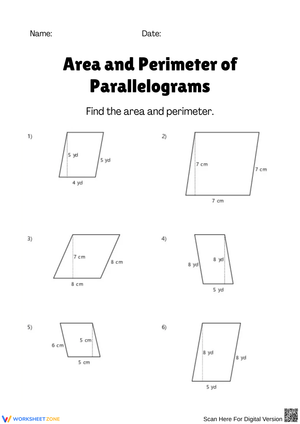
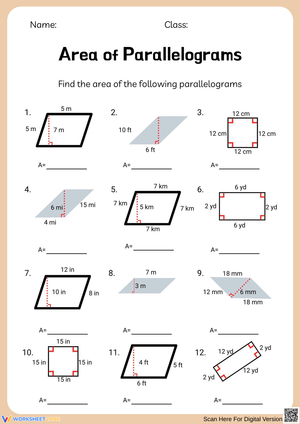
These 6th grade parallelogram printable worksheets give teachers a focused set of resources for the geometry work that trips students up most in this unit — not naming shapes, but explaining why a figure belongs in a category and what its properties mean once students reach area problems. The set covers identification, vocabulary, missing-measure reasoning, and area calculation in a format teachers can drop into classwork, centers, or homework without significant prep.
Concepts Each Worksheet Covers
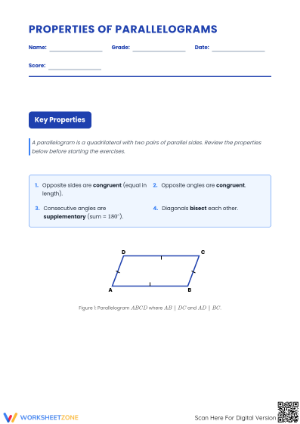
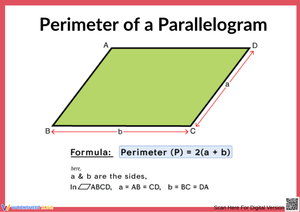
Parallelogram work in grade 6 sits at the intersection of classification and calculation, and the strongest 6th grade parallelogram printable worksheets keep those two demands tightly connected rather than treating them as separate units. Students need to recognize the defining attribute — both pairs of opposite sides parallel — and then apply that understanding through properties they can actually use: opposite sides are equal in length, opposite angles are equal, and diagonals bisect each other. The moment those properties connect to computation is when area problems become meaningful rather than formula-memorization.
Each worksheet in the set targets one or more of the following skills:
- Identification from visuals and descriptions: students circle, sort, or mark figures as parallelograms or non-parallelograms, including shapes shown in non-standard orientations where appearance misleads
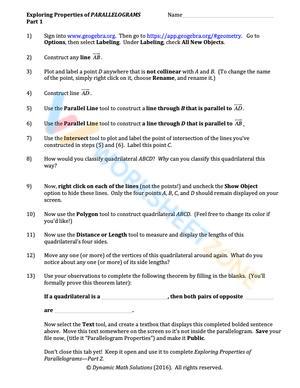
- Vocabulary in context: labeling and applying terms like opposite sides, perpendicular height, base, diagonal, and interior angle in actual problems rather than standalone definitions
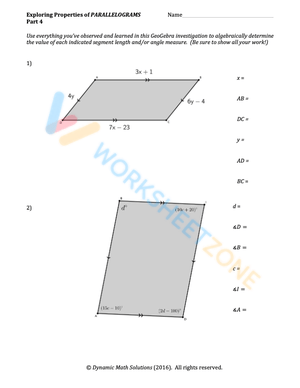
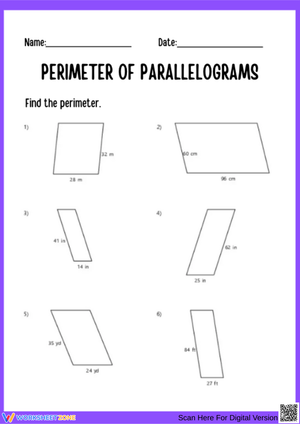
- Property-based reasoning: finding missing side lengths, angle measures, or diagonal segments by using parallelogram properties rather than measuring
- Classification within quadrilaterals: placing rectangles, rhombuses, and squares correctly inside or outside the parallelogram category, with written justification
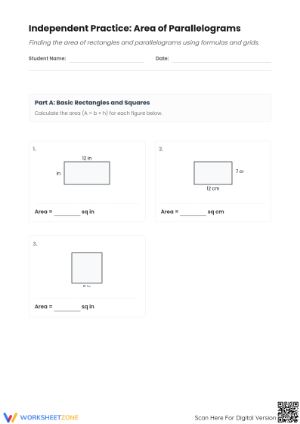
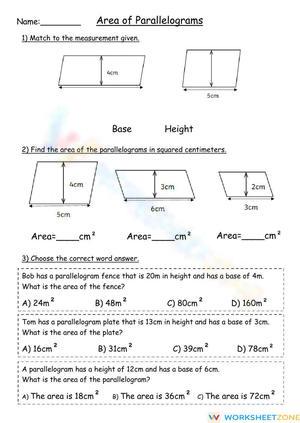
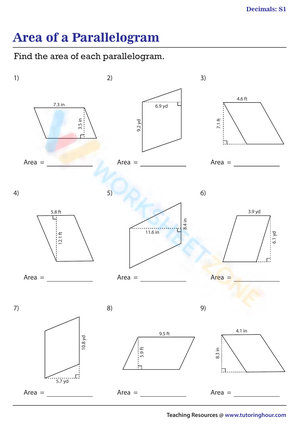
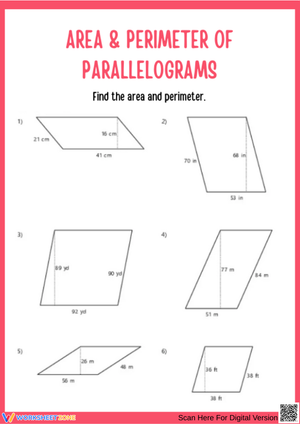
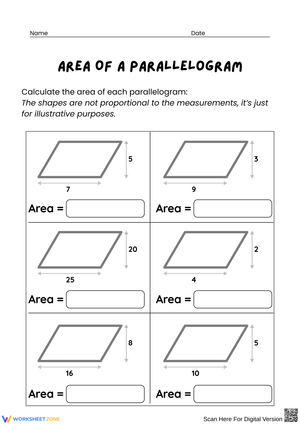
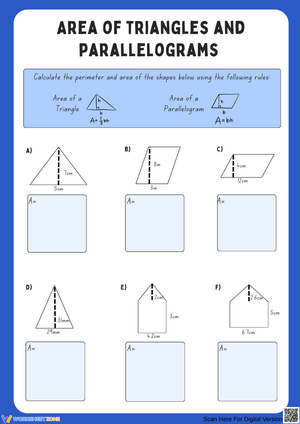
- Area from base and height: calculating area in diagrams where the height is drawn as a dashed line outside the slanted edge — not along it
Student Mistakes That Surface Consistently on This Topic
The most persistent error is treating the slanted side as the height when calculating area. A student who sees a parallelogram tilted at roughly 45 degrees will often multiply the base by that slanted edge because it is the visible boundary of the figure — the perpendicular height, shorter and usually shown as a dashed line, reads as an extra label rather than the essential measurement. One classroom fix: before any multiplication, ask students to trace the height in a different color. That single step makes it immediately visible who understands the diagram and who is guessing.
Classification errors run a close second. Students who confidently mark a slanted quadrilateral as a parallelogram will mark a rectangle as something else, because a rectangle does not look "tilted." They are sorting by visual impression rather than by the defining property. These worksheets include non-examples and unusual orientations specifically to surface that confusion before a quiz exposes it. A rectangle rotated 30 degrees is still a rectangle and still a parallelogram — students should be able to defend that with attributes, not appearance.
Two smaller errors appear regularly once students reach property problems. First, students who know that opposite sides are equal will still write different values for those sides when a problem gives only partial labeling, because they do not apply the property automatically — they need to see it stated and then transfer it to an unlabeled side. Second, students conflate a diagonal's length with a side length when reading a fully labeled figure, grabbing the nearest number without checking what each measurement actually refers to.
How to Work These Worksheets Into Your Lesson Sequence
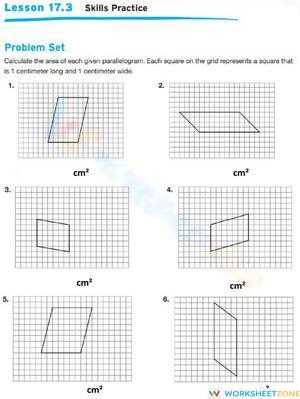
A three-day arc works well for most classrooms. On the first day, use identification and sorting worksheets as the entry point — students circle, sort, and label before any formula appears. That keeps cognitive load manageable while building the vocabulary and visual recognition students need later. On the second day, property questions carry the lesson: missing sides, missing angles, diagonal segments. On the third day, area worksheets with grid models and labeled diagrams give students a place to apply base-and-height reasoning to actual figures.
Outside of a dedicated unit, these worksheets also fit into shorter windows. The identification worksheets make natural warm-ups at the start of a week when students need low-stakes review before a new lesson. The area worksheets work well in the final ten minutes of a Friday block — long enough for focused practice, too short for anything new. For small-group reteaching, the property-reasoning worksheets give teachers a concrete task while the rest of the class works independently on something familiar.
Standard Alignment
These worksheets align primarily to CCSS 6.G.A.1, which expects students to find the area of triangles, special quadrilaterals, and polygons by composing and decomposing figures. Parallelogram area is a direct application of that standard, and the identification and classification tasks build the conceptual groundwork the standard assumes students have. In most grade 6 pacing guides, this unit lands in the second semester — after students have reviewed angle relationships and before they move into surface area and volume. Teachers in states using CCSS-aligned frameworks will find these worksheets fit directly into that placement without adjustment.
Adjusting the Set for Different Readiness Levels
Students who are still building basic shape recognition start with the identification worksheets — circling and sorting before any property or calculation language appears. Labeling tasks, such as marking parallel sides with tick marks and identifying the base and height on a diagram, give those students concrete steps that do not require computation yet.
Students who have the identification piece solid move into property and reasoning worksheets, solving for missing angle measures or side lengths by applying what they know about opposite sides and opposite angles. For the strongest students, the most productive challenge is explaining why a rectangle is a parallelogram and then using that relationship to verify whether the area formula applies — that task requires holding classification and calculation in mind simultaneously, which is a genuine grade-level stretch and not something a routine drill worksheet asks for.
The 6th grade parallelogram printable worksheets in this set are sequenced so teachers can assign different worksheets to different groups without writing entirely separate lesson plans. A clear difficulty progression across the set makes it practical to hand one group the sorting worksheets while another works through area problems with labeled diagrams.
Frequently Asked Questions
Are rectangles, rhombuses, and squares considered parallelograms?
Yes. Each of those shapes has two pairs of opposite sides that are parallel, so each fits the definition of a parallelogram. This is one of the most important classification insights in grade 6 geometry, and also one students resist most strongly. A set of worksheets that includes rectangles and squares in identification tasks — rather than only slanted figures — forces students to work through that resistance directly instead of carrying the misconception into later units.
How are these worksheets different from general quadrilateral practice?
General quadrilateral work often stays at the level of naming shapes and listing attributes. These resources stay focused on the specific properties of parallelograms — the equality of opposite sides and opposite angles, the bisecting diagonals, the perpendicular-height relationship in area — and ask students to use those properties to solve problems, not just recall them. The distinction matters because 6th grade parallelogram printable worksheets built around property application and reasoning produce more durable understanding than identification-only worksheets do when it comes time for a unit assessment.
What order should I use these worksheets in?
Start with identification and sorting, then move to labeling and property questions, and finish with area calculation. That sequence lets students build familiarity with the figures before the formulas appear. Jumping directly to area worksheets without the classification groundwork is one of the most common pacing mistakes in geometry units — students can execute the formula while still believing a rectangle is not a parallelogram.
Can these worksheets work for homework or test review?
Yes. Mixed-practice worksheets that combine a few identification items, one or two property questions, and two or three area problems make the most effective homework or review assignments. Single-skill worksheets suit initial in-class instruction better, but review situations benefit from the interleaving that forces students to decide which concept applies — that decision-making is exactly what assessments require.













 Interactive Worksheet Maker
 Quiz Maker
 Word Search Maker
 Crossword Puzzle Maker
 Word Scramble Generator
 Sentence Scramble Generator
 Handwriting Worksheet Generator
 Name Tracing Generator
 Fill In The Blank Generator