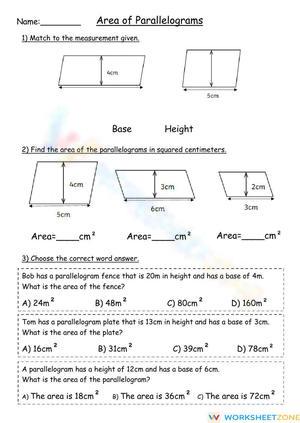
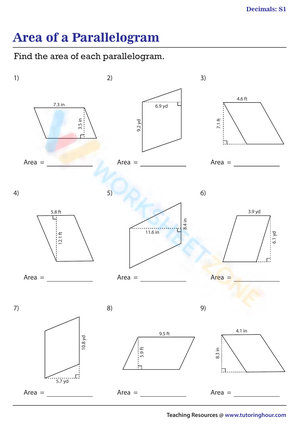
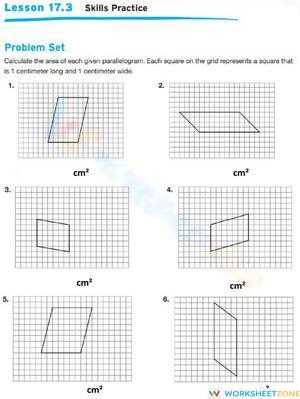
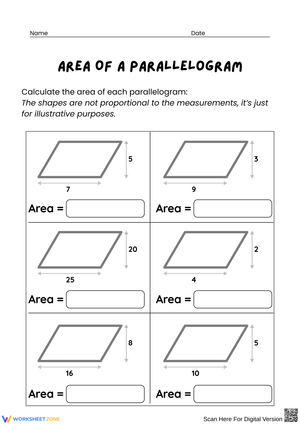
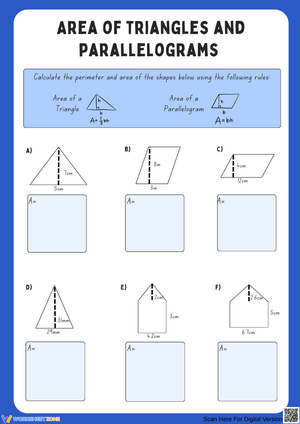
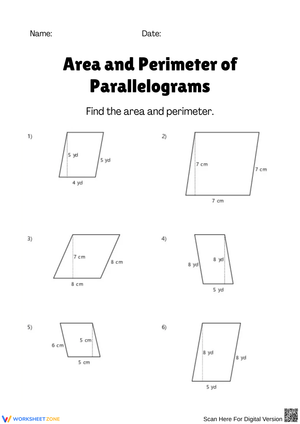
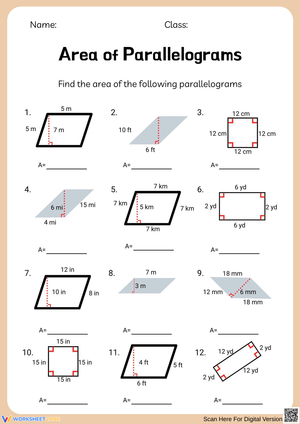
These 6th grade area of parallelogram worksheets give teachers targeted, print-ready practice around one of the most reliably mishandled ideas in grade 6 geometry: telling the difference between a parallelogram's perpendicular height and its slanted side. Students who multiply fluently still reach for the wrong number when two measurements appear in the same diagram. Each worksheet in this set puts that confusion directly in front of students and gives them repeated chances to work through it.
What Makes Perpendicular Height Hard to Teach
The formula A = b × h is four characters long. The concept behind it takes considerably longer to stick. A parallelogram leans — and because it leans, the perpendicular height either sits inside the figure as a drawn dashed segment or falls entirely outside it, extending beyond the base line. Grade 6 is the first time most students encounter a shape where a labeled side length is not the height, and that displacement is what trips them. Seeing "8 cm" next to the slanted side feels like useful information, and for many students it overrides whatever they remember about perpendicular distance.
This set targets that problem by rotating through multiple diagram orientations — upright figures, tilted figures, and figures where the height segment extends outside the shape — so students build recognition across varied visual presentations rather than just the tidy textbook version where the height neatly drops inside.
Skills Each Worksheet Targets
Each worksheet in this 6th grade area of parallelogram worksheets set focuses on a specific layer of the skill rather than mixing all difficulty levels into one exercise. That separation makes it easier to assign the right practice at the right point in your unit.
- Identifying and labeling the correct base and perpendicular height in a diagram before any calculation begins
- Applying A = b × h with whole-number dimensions and expressing answers in square units
- Distinguishing slanted side from perpendicular height when both measurements appear on the same figure
- Computing area with decimal and fraction dimensions once identification is reliable
- Connecting the parallelogram to a rectangle through cut-and-rearrange reasoning — a task where students explain why the two shapes share the same area formula
- Solving word problems involving tile layouts, banner dimensions, and garden plots that require students to determine which given measurement serves as base and which serves as height
Common Mistakes Teachers Should Anticipate in This Unit
The most consistent error: a student multiplies base by slanted side instead of base by perpendicular height. This happens even when students have just reviewed what "perpendicular" means. A diagram showing a base of 10 cm, a slanted side of 7 cm, and a height of 6 cm will produce "70" from a meaningful portion of the class — and those students will feel confident about it. Worksheets that position the height outside the parallelogram slow this pattern down because students cannot rely on visual proximity. When the height segment floats to the left of the figure with a right-angle mark, students have to locate it deliberately rather than grab the nearest labeled number.
A second consistent issue involves units. Students write 40 when the answer should be 40 square inches. Worksheets that include labeled answer blanks — "Area = ___ sq. ___" — and treat answers without units as incomplete build precision into the routine without requiring a separate instructional episode about notation.
A third pattern surfaces when decimals and fractions enter the problems. A student who correctly identifies the base as 4.5 m and the height as 3 m may still produce a wrong area because fraction arithmetic becomes the new obstacle. Watching where students stall — at identification or at calculation — tells you precisely what the next small-group session needs to address. The two errors call for completely different responses.
Fitting These Worksheets Into Your Instructional Week
Timing within the unit matters more than volume of practice. In the first two days of a parallelogram area unit, use identification-only worksheets — no formula yet, just circling the correct height in a set of labeled diagrams. After one or two sessions of that, students move into computation and find A = b × h far more intuitive because they can already locate the height.
Teachers find 6th grade area of parallelogram worksheets resources most productive across several classroom formats:
- Monday warm-up: two or three diagrams from the previous Friday, revisited for spaced retrieval before new instruction begins
- Guided release: five or six problems assigned after a modeled example, with the teacher circulating to mark misconceptions before they become habits
- Small-group reteach: one worksheet with whole-number dimensions and the height always drawn inside the shape, used with students still confusing sides with heights
- Exit check: one diagram with the height drawn outside the shape, plus one word problem — fast to assign at the last eight minutes of class and fast to scan for the base-height error
- Sub day coverage: each worksheet carries enough diagram context that students can work independently without additional teacher explanation
A marking habit worth building into the routine: before any calculation, students draw a small right-angle box at the point where the height meets the base or its extension. This takes three seconds and gives you an immediate visual read across a class set — students who understand perpendicular height place the mark correctly; students who do not place it on the slanted side or skip it altogether.
Adjusting the Set for a Range of Student Readiness
For students still working on the core concept, choose worksheets with large, uncluttered diagrams, whole-number values, and direct attention cues: "Circle the base. Mark the height. Then multiply." A sentence frame at the bottom — "The base is ___ units. The height is ___ units. The area is ___ square units." — reduces reading load without removing mathematical thinking from the task.
For students ready for more, assign worksheets where neither measurement is explicitly labeled as height. Students must use the right-angle mark in the diagram to determine which segment represents perpendicular distance. Other extension tasks include comparing two parallelograms to determine which has greater area when the numbers look deceptively similar, or analyzing a worked example that uses the slanted side and writing a correction with an explanation — work that pushes toward mathematical communication rather than answer production.
Some students who have already grasped the formula benefit from worksheets that connect parallelogram area back to their earlier rectangle work. These 6th grade area of parallelogram worksheets include tasks where students explain why a parallelogram with a base of 7 and a height of 4 covers the same area as a rectangle with those same dimensions — a line of reasoning that pays forward directly when students encounter the triangle area formula later in the unit.
Standard Alignment
These worksheets address CCSS.MATH.CONTENT.6.G.A.1, which asks students to find the area of right triangles, other triangles, special quadrilaterals, and polygons by composing and decomposing them into rectangles and triangles. Parallelogram area is a direct application of this standard. In most grade 6 schedules, this work falls in the geometry unit that sits between ratio and rate work earlier in the year and surface area and volume work later. Teachers typically teach parallelogram area after students have revisited rectangle area and before introducing triangle area, where the connection to half of A = b × h becomes the conceptual bridge.
Frequently Asked Questions
Do these worksheets include answer keys?
Yes. Each worksheet comes with answer support so teachers can run self-check routines at stations, assign peer grading, or quickly scan a class set. The keys include full square-unit notation — square centimeters, square inches, and so on — so teachers can hold students to that standard from the first problem.
What if students are still shaky on fraction and decimal multiplication?
The set separates computation difficulty from concept difficulty. Worksheets using whole-number dimensions give students meaningful parallelogram area practice without arithmetic becoming the main obstacle. Fraction and decimal problems appear in later worksheets, assigned once students can reliably identify the base and height on their own. Moving too quickly to fractional dimensions before that step is solid tends to produce errors that obscure what students actually understand about the geometry.
Can these worksheets function as formative assessments?
Yes, and they work particularly well for that purpose because the errors are predictable and sortable. A five-problem worksheet assigned at the end of a lesson reveals whether students are confusing slanted side with height, omitting units, or making arithmetic mistakes. Those three error categories call for three different instructional responses. Sorting a class set of papers by error type takes under ten minutes and gives teachers a clear picture of who needs which kind of follow-up.
What lesson structure works best with these worksheets?
The most effective sequence starts with one or two teacher-modeled examples — projected, discussed, and annotated together — followed by independent or partner work on one worksheet. The worksheet handles practice after the lesson, not during it. Teachers who project a problem, talk through the height identification step, and then release students generally see fewer base-height errors than teachers who distribute a worksheet and explain from the front while students are already looking at the diagrams.













 Interactive Worksheet Maker
 Quiz Maker
 Word Search Maker
 Crossword Puzzle Maker
 Word Scramble Generator
 Sentence Scramble Generator
 Handwriting Worksheet Generator
 Name Tracing Generator
 Fill In The Blank Generator