




























Views
Downloads

Essential Area of Trapezoids Worksheet | Grade 6-8

Paste this activity's link or code into your existing LMS (Google Classroom, Canvas, Teams, Schoology, Moodle, etc.).
Students can open and work on the activity right away, with no student login required.
You'll still be able to track student progress and results from your teacher account.
Help students master the geometry of four-sided figures with this comprehensive area of trapezoids worksheet. This resource provides a clear instructional bridge from basic formula application to complex algebraic thinking. Students will move beyond simple calculation to truly understand the relationship between bases, height, and total area in varied geometric contexts.
At a Glance
- Grade: 6–8 · Subject: Math
- Standard:
6.G.A.1— Find area of special quadrilaterals by decomposing into triangles and other shapes- Skill Focus: Area of Trapezoids (Direct & Inverse)
- Format: 5 pages · 10 problems · Answer key included · PDF
- Best For: Middle school geometry practice and assessment
- Time: 30–45 minutes
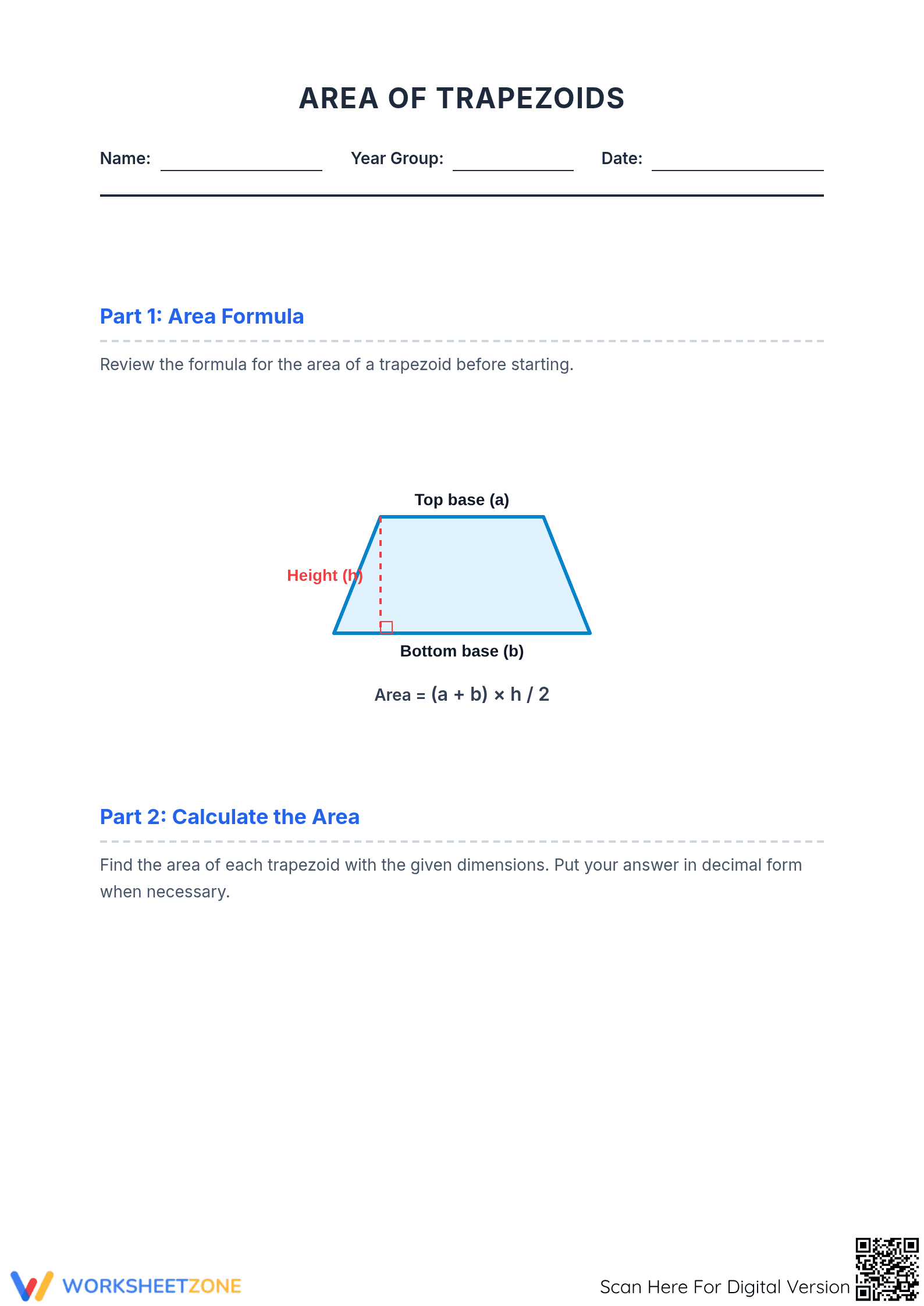
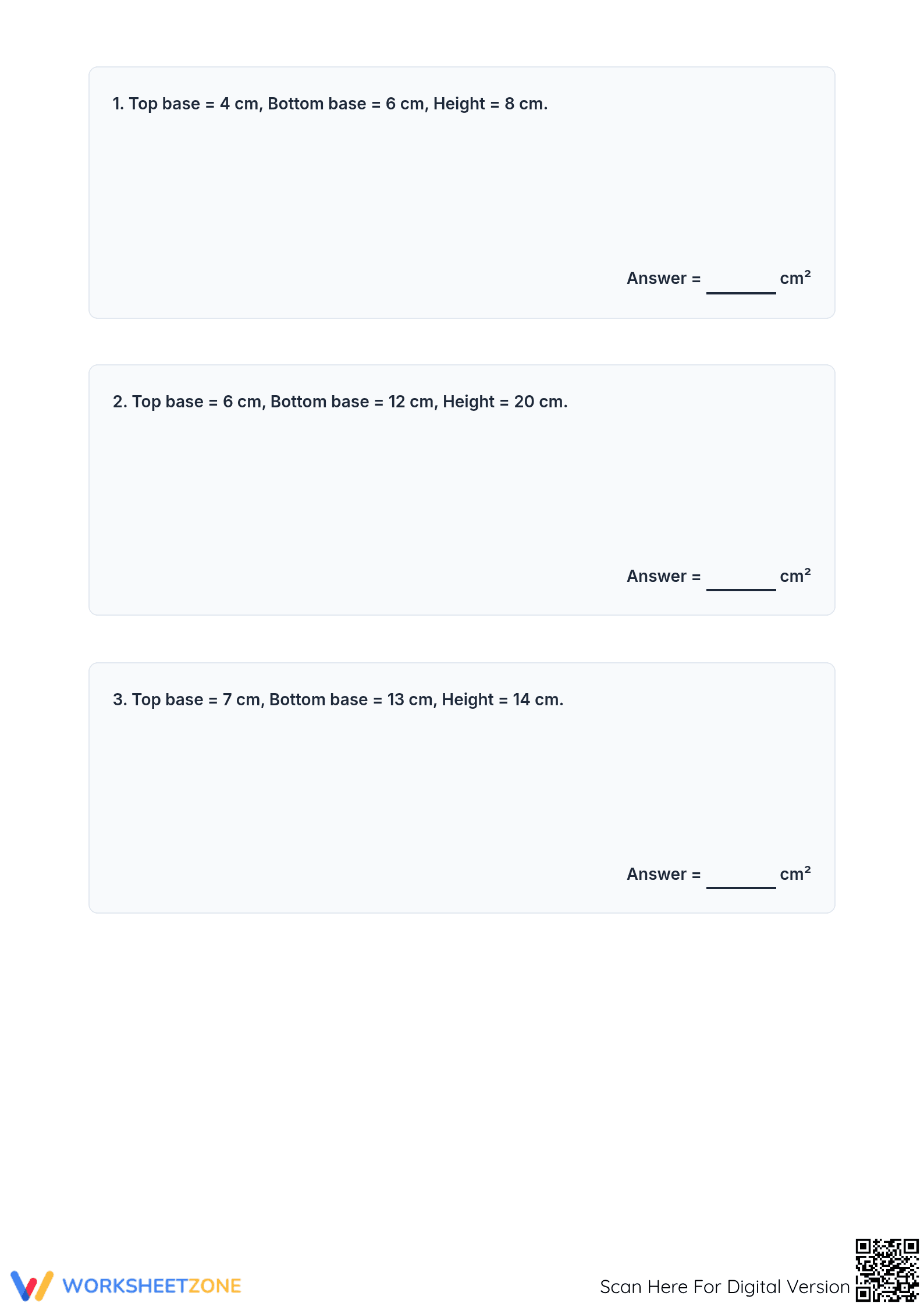
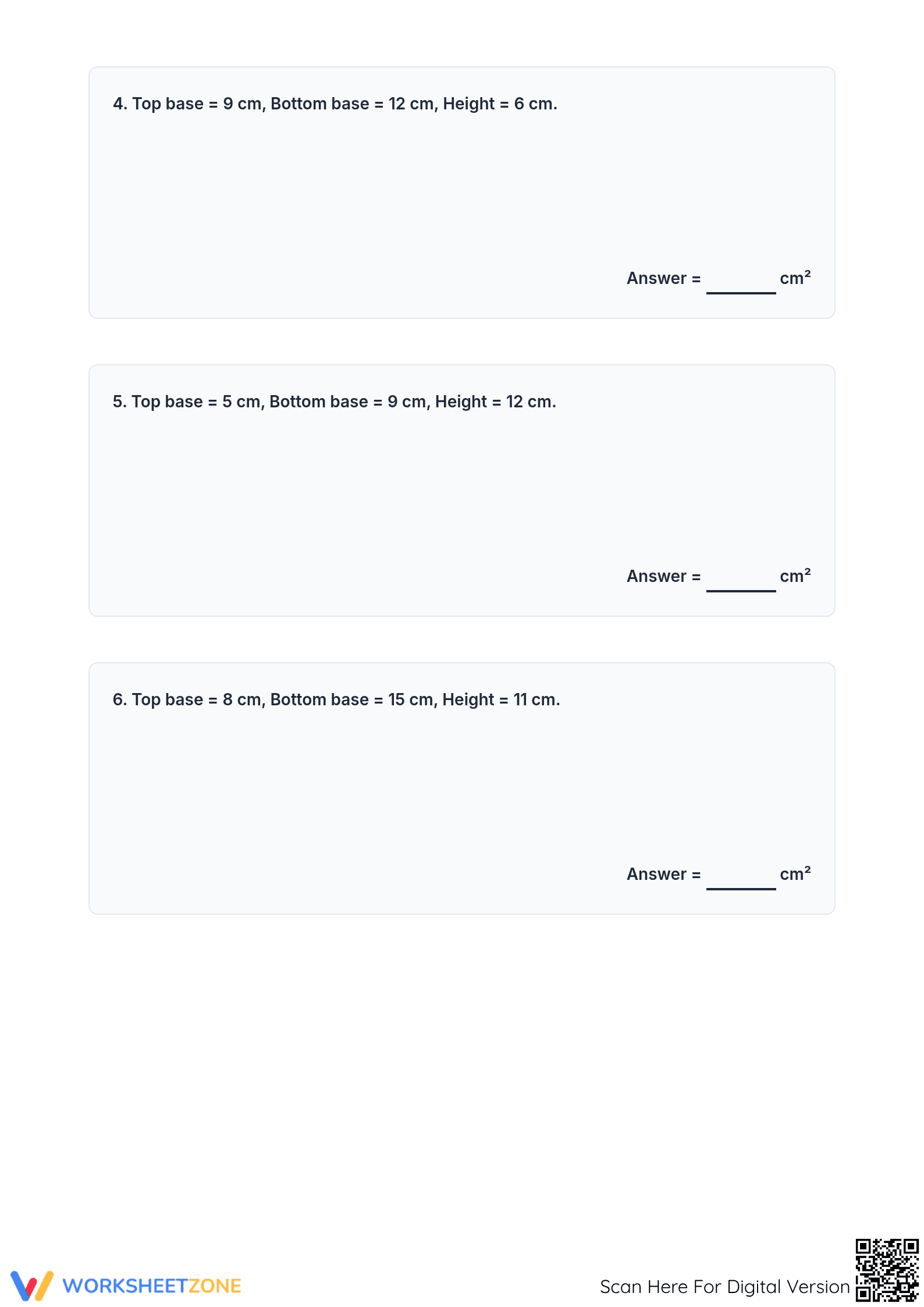
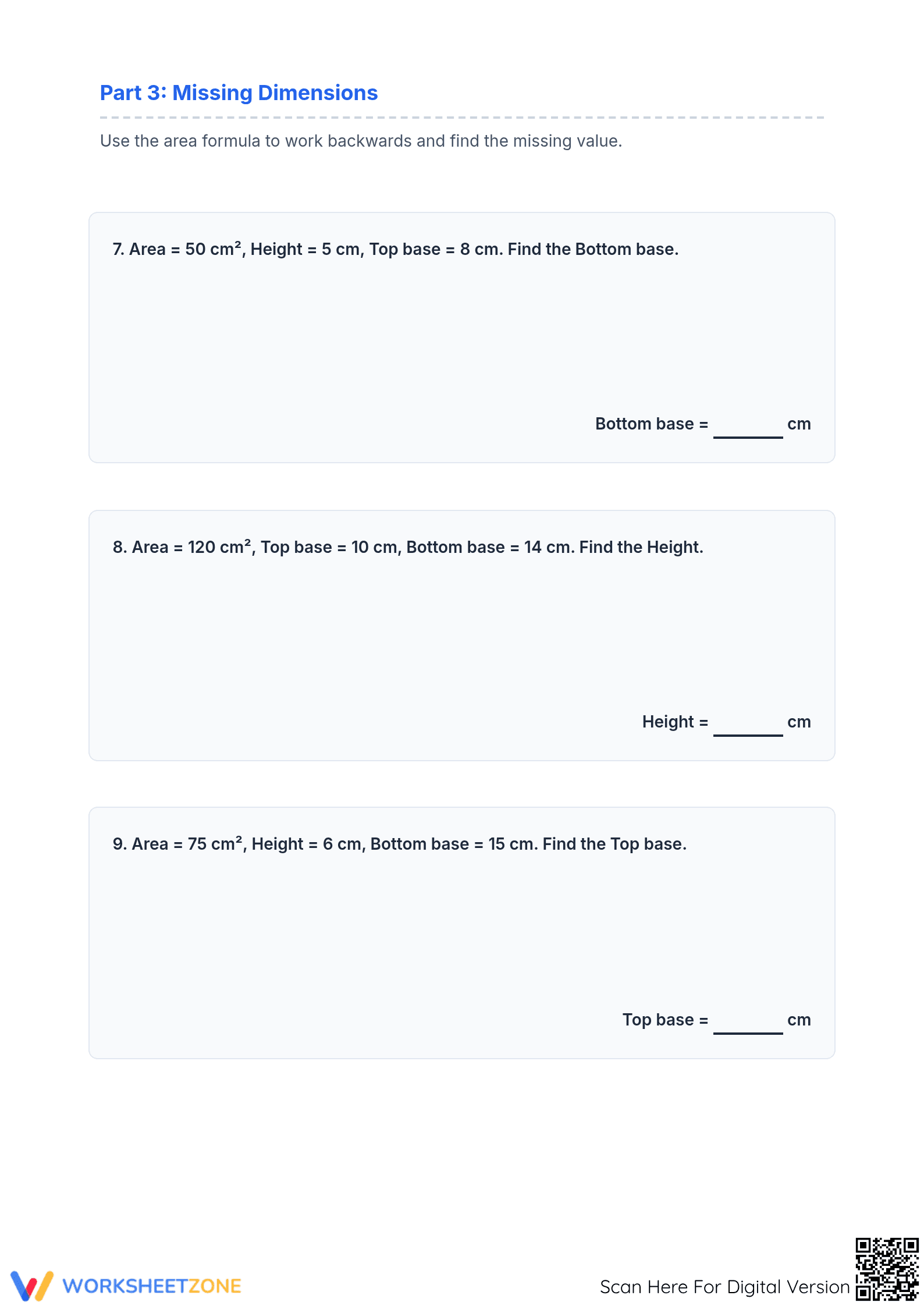
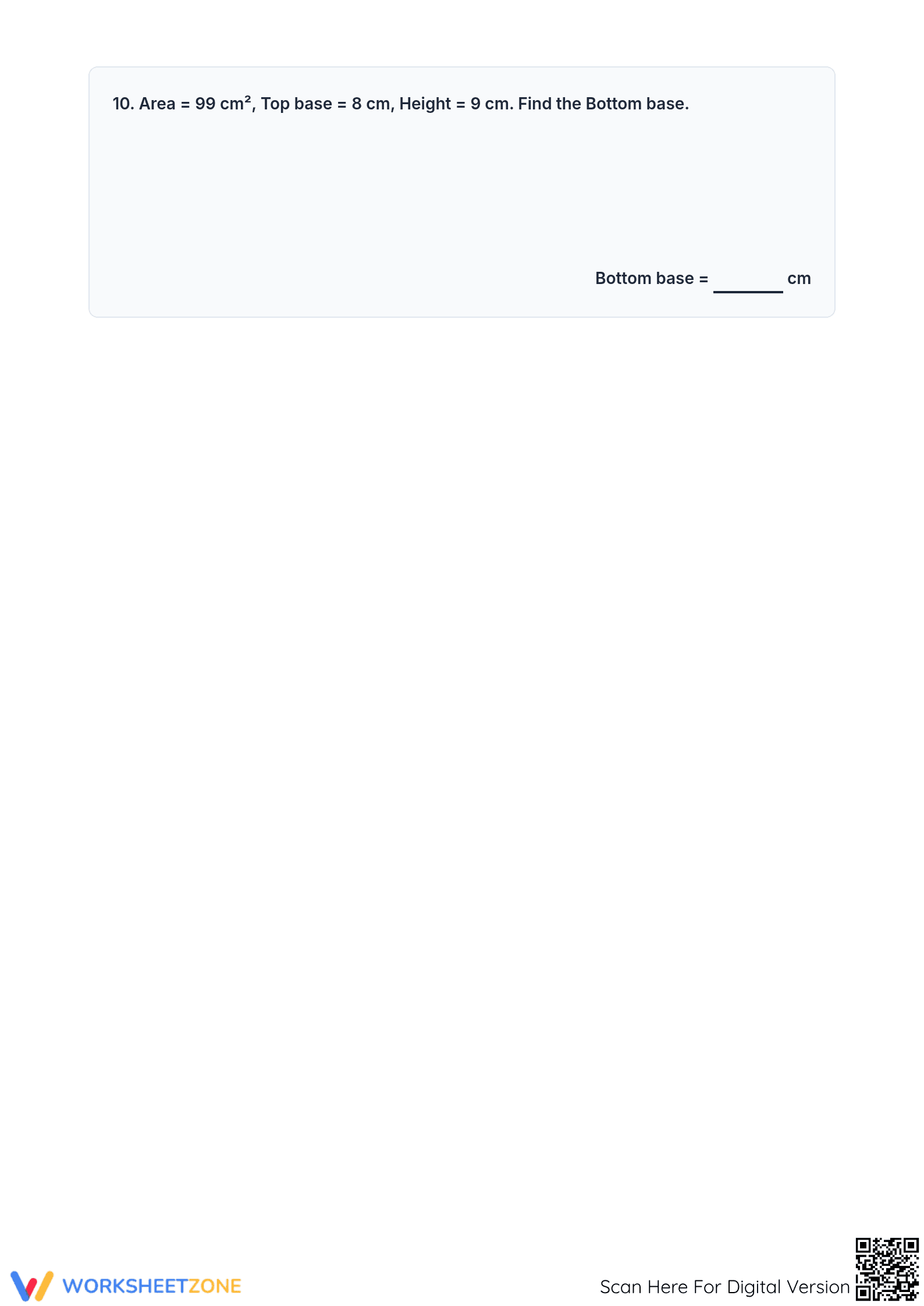
This 5-page PDF bundle begins with an instructional guide illustrating the trapezoid area formula with visual labels for height and bases. The practice section contains six direct calculation tasks where students determine area from given dimensions. The final portion introduces four "Missing Dimension" challenges, requiring students to work backward from a known area to find a missing base or height value.
Designed for immediate classroom implementation, this resource requires no advance preparation from the instructor. The "Print-Distribute-Review" workflow is optimized for efficiency. Printing takes less than 30 seconds, distribution is immediate as the instructions are self-contained on page one, and the provided answer key allows for a full-class review or self-grading session in under five minutes. This makes it an ideal choice for emergency sub plans or spontaneous skill reinforcement.
This resource is strictly aligned with `CCSS.MATH.CONTENT.6.G.A.1`, which requires students to find the area of special quadrilaterals, including trapezoids. By including problems that require solving for missing variables, the worksheet also supports 6th and 7th-grade expressions and equations standards. Both standard codes can be copied directly into lesson plans, IEP goals, or district curriculum mapping tools.
Use this worksheet as a primary practice set immediately following your direct instruction on geometric formulas. For a formative assessment observation, watch how students approach the "Missing Dimension" section; students who successfully isolate the unknown variable demonstrate a strong grasp of both geometric properties and algebraic manipulation. The expected completion time for the full 10-task set is 35 minutes.
This practice set is designed for middle school students in Grades 6, 7, and 8 who are developing their proficiency with area formulas. It is particularly effective for students requiring structured practice with multi-step calculations. For best results, pair this worksheet with a physical or digital manipulative that allows students to visually decompose trapezoids into a rectangle and two triangles.
Calculations involving the area of trapezoids are a fundamental component of the middle school geometry curriculum, serving as a vital bridge between basic arithmetic and formal algebra. According to the NAEP, proficiency in geometric measurement is a key predictor of success in high school mathematics. This worksheet facilitates this growth by providing 10 scaffolded tasks that progress from formula review to inverse operations. The inclusion of "Missing Dimension" problems aligns with modern pedagogical standards that emphasize the "backward design" of mathematical reasoning. Research from Fisher & Frey (2014) indicates that such gradual release of responsibility—moving from worked examples to independent problem-solving—is essential for long-term retention of spatial concepts. By using this standard-aligned CCSS.MATH.CONTENT.6.G.A.1 resource, educators ensure students develop the precision required for complex STEM applications while building a durable foundation for future coordinate geometry and calculus coursework.


