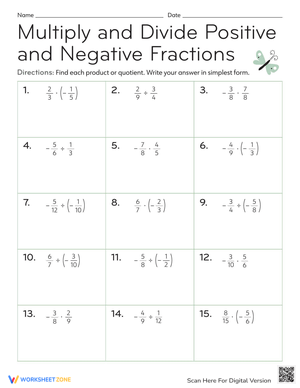
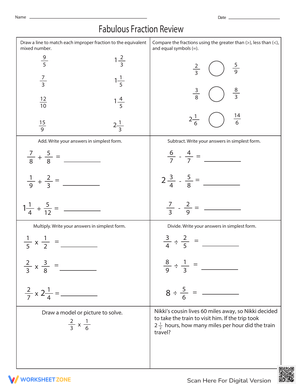
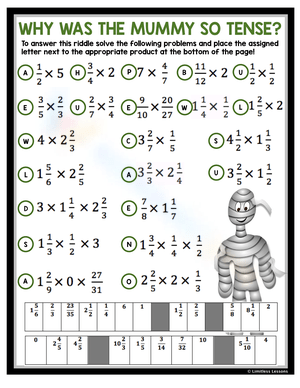
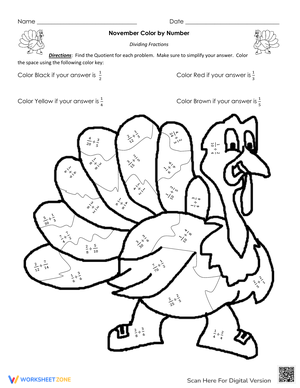
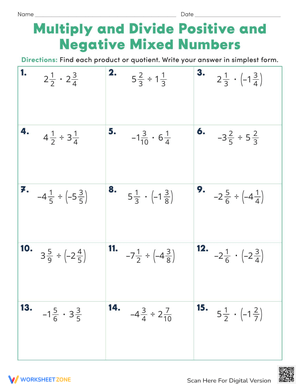
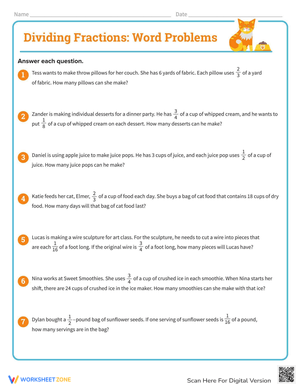
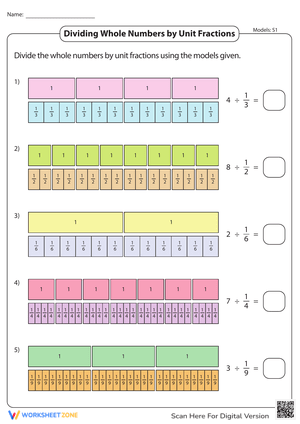
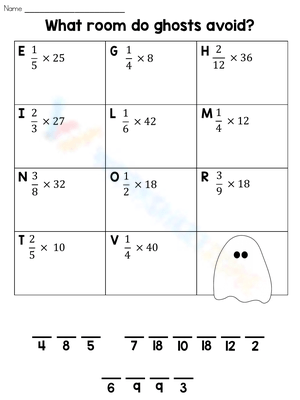
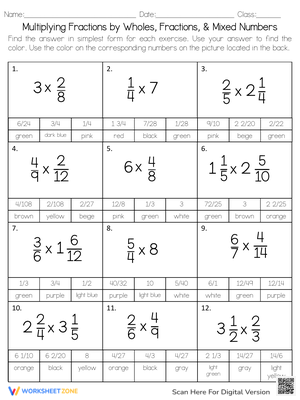
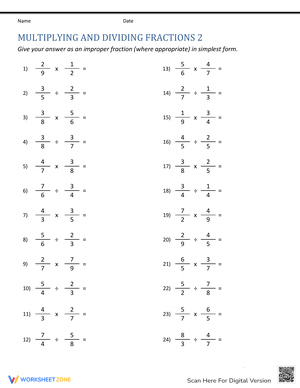
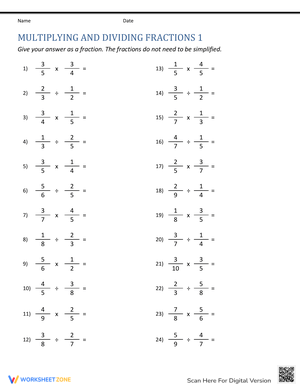
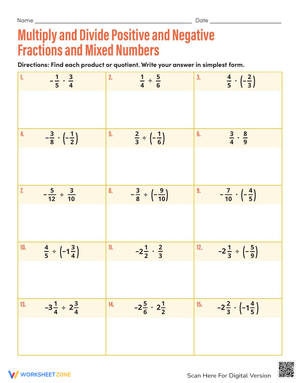
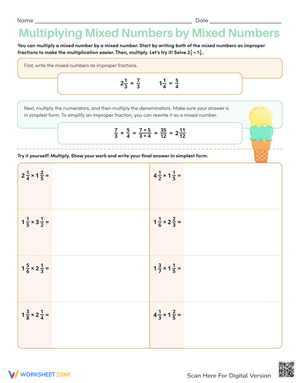
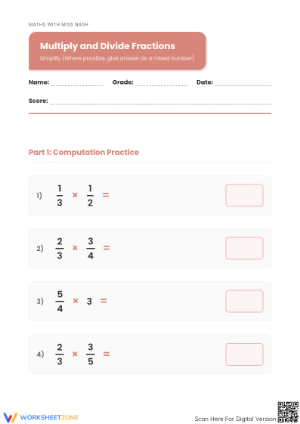
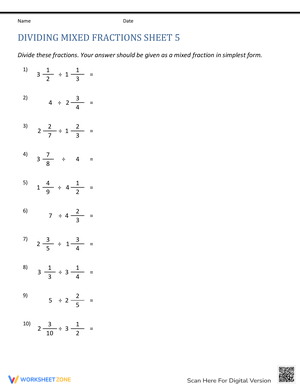
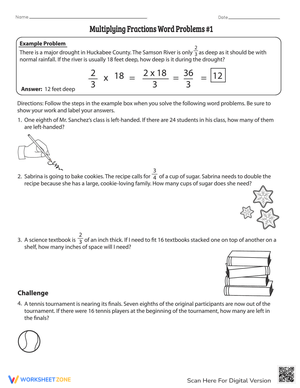
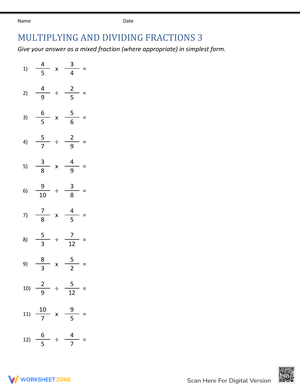
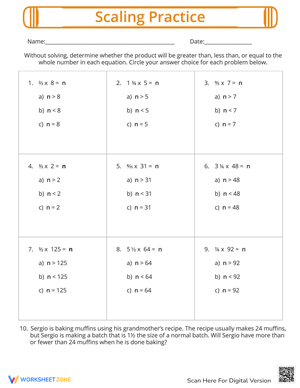
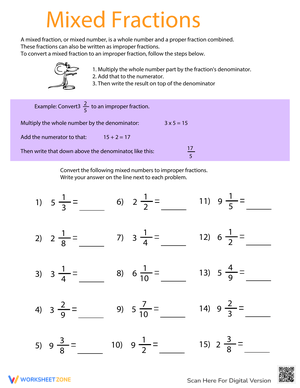
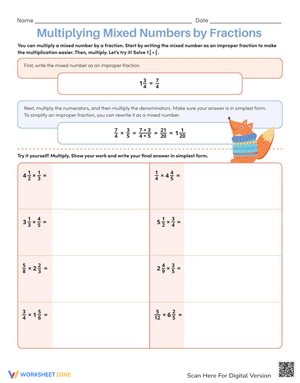
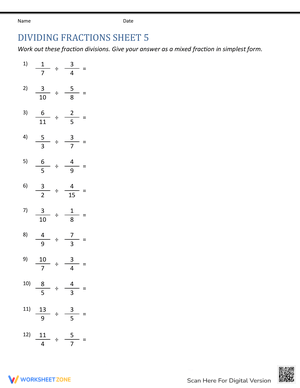
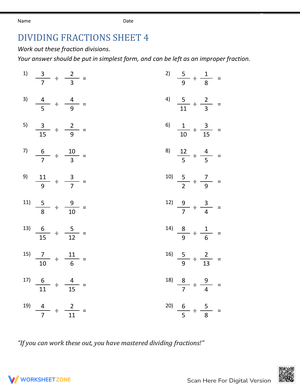
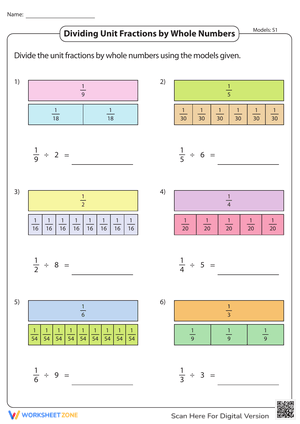
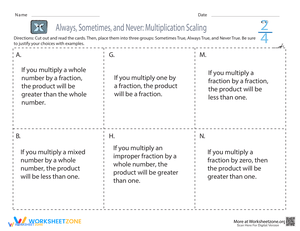
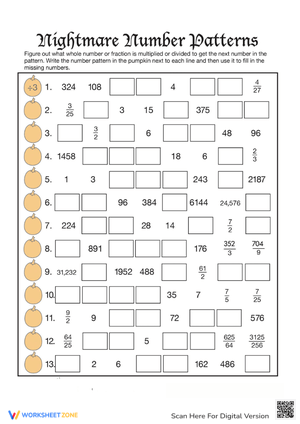
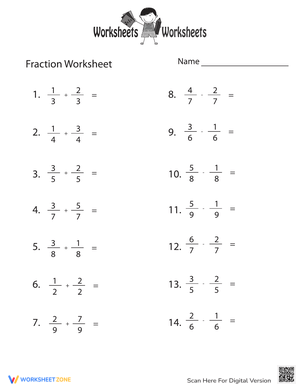
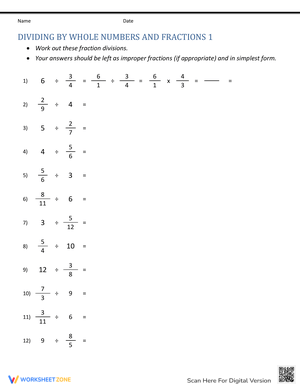
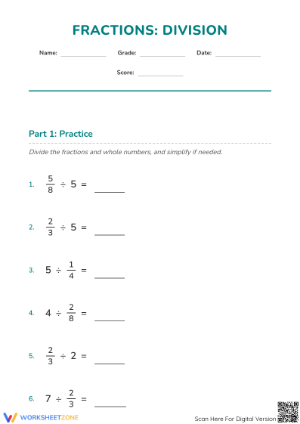
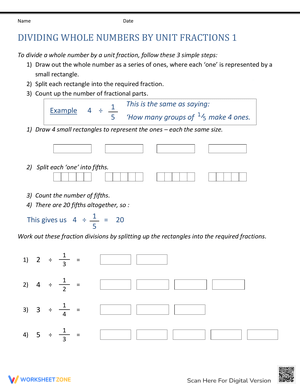
These multiplying and dividing fractions pdf worksheets for 6th grade arrive at the moment students most need them: the transition from fraction recognition into fraction computation, where procedural and conceptual demands hit simultaneously. Each worksheet addresses a distinct operation or problem type — multiplying fractions by whole numbers, multiplying two fractions, dividing with the reciprocal, computing with mixed numbers, and working through word problems that require choosing the correct operation. The resources include show-work space and sequenced problems that make it straightforward to read exactly where a student's understanding breaks down.
The Specific Skills Each Worksheet Builds
The set moves through operations in a deliberate order. Multiplication worksheets begin with the entry points that tend to feel most intuitive — a whole number times a fraction, or unit fractions multiplied together — before moving into fraction-by-fraction and mixed-number computation. Division worksheets open with whole-number-divided-by-fraction contexts, where the meaning of the quotient stays visible (how many ¾-cup portions fit in 3 cups?), then shift into fraction-divided-by-fraction problems where the algorithm needs to be both fluent and understood.
What separates a useful set of multiplying and dividing fractions pdf worksheets for 6th grade from generic computation drill is whether the problems force students to make decisions — not just execute a memorized step. These worksheets include problems that require cross-canceling before multiplying, answers that must be simplified or converted back to mixed-number form, and word problems where the surface features don't reveal which operation applies.
Skills covered across the set:
- Multiplying fractions by whole numbers, unit fractions, and non-unit fractions
- Converting mixed numbers to improper fractions before multiplying or dividing
- Simplifying products and quotients, including cross-canceling before computing
- Applying the reciprocal correctly in fraction division
- Solving word problems by identifying what the operation means in context
- Checking whether answers are reasonable given the original values
Student Errors Worth Anticipating Before You Assign
The most consistent multiplication error in 6th-grade work isn't a wrong algorithm — it's treating a mixed number as two separate quantities. A student who sees 2½ × ⅓ will often multiply the whole-number part and the fractional part independently: 2 × ⅓ = ⅔, then ½ × ⅓ = ⅙, then add them. In this case the answer (5/6) happens to be correct, but the procedure is fragile. When mixed numbers appear in division or in multi-step problems, the same approach produces errors that compound quickly. Students who convert first — 5/2 × ⅓ = 5/6 — have a single reliable process that holds up across all problem types.
Division errors concentrate around one specific misstep: flipping the dividend instead of the divisor. When a student writes ¾ ÷ ½ and inverts the first fraction rather than the second, arriving at 4/3 × ½ = 4/6, the result (⅔) is wrong but plausible enough that a quick reasonableness check won't always catch it. Having students explicitly label the divisor before applying the reciprocal — literally circling the second fraction and writing "flip this" — reduces this error in most classes within two practice sessions. It takes thirty seconds to add to directions and makes a measurable difference in accuracy.
In word problems, students frequently multiply when they should divide. Two fractions appearing alongside the word "of" triggers a multiply response even when the situation calls for grouping or finding how many portions fit. Asking students to name the unit of the answer before computing — "Are we finding a number of portions or a number of cups?" — forces reading the situation rather than pattern-matching on surface features alone.
Making These Worksheets Work Inside Your Lesson Week
Using multiplying and dividing fractions pdf worksheets for 6th grade as short daily sequences — rather than one extended block — produces noticeably better retention and fewer compounding errors. A four-day rhythm works well in most middle school schedules: Day 1 reviews simplifying and mixed-number conversion, the prerequisite moves that cause problems downstream if they're shaky; Day 2 focuses on multiplication with increasing complexity; Day 3 introduces division starting from a grounding context and moving toward abstract computation; Day 4 puts both operations together in a word-problem worksheet where students must identify which applies.
Bell-ringer use on Days 2 through 4 is especially effective. Three or four targeted problems at the start of class — reactivating the prior day's work before new instruction begins — outperform longer homework sets in terms of error reduction. Those 8 minutes after students settle in and before the main lesson starts give the teacher a real-time read on who is confident and who is running a shaky procedure. A student who multiplies fluently but stalls on the first division problem tells you something specific and actionable before the lesson has properly begun.
When reviewing completed worksheets, sorting by error pattern rather than by score speeds up re-teaching decisions considerably. A student missing six problems because of unsimplified answers needs different support from a student who consistently inverts the wrong fraction. Grouping those students for a 10-minute targeted conversation — rather than re-explaining the full procedure to the whole class — is the most efficient use of the feedback each worksheet provides.
Standard Alignment
The division worksheets directly address CCSS 6.NS.A.1: "Interpret and compute quotients of fractions, and solve word problems involving division of fractions by fractions." That standard explicitly names visual fraction models and equations as tools for representing these problems, which is why worksheets that pair area models or measurement contexts with computation serve it more fully than procedure-only practice. Students who only practice the reciprocal algorithm without any contextual work may pass a computation item on an assessment while still being unable to set up or interpret a division word problem.
Fraction multiplication in this set extends CCSS 5.NF.B.4 and 5.NF.B.7 from the prior grade. By 6th grade, the expectation is not that teachers introduce fraction multiplication as a new concept, but that they apply it in more demanding contexts — mixed numbers, scaling, multi-step situations — that weren't the focus of 5th-grade formal assessment. Teachers using the multiplication worksheets in 6th grade are building fluency and extending application rather than introducing the operation from scratch, which means moving through that portion of the set is typically faster than the division work.
Adjusting the Set for Different Learners in the Same Room
Students who struggle with fraction operations frequently hit a wall earlier than the operation itself — in simplifying, in recognizing equivalent fractions, or in understanding what a fraction quantity represents. For those students, worksheets that include fraction bar models or number lines alongside computation give them something to anchor the procedure to. Reducing the item count per worksheet also helps: ten problems with full show-work space gives the teacher cleaner diagnostic information than twenty rushed answers crowded onto a worksheet.
On-level students work through the standard computation-and-word-problem sequence, but one small adjustment raises the cognitive demand without changing the arithmetic: adding a "Does this make sense?" sentence prompt at the end of each section. A student who writes "My answer is less than 1 because I multiplied two fractions that are both less than 1" demonstrates number sense that computation practice alone never surfaces.
For students who move through worksheets quickly and accurately, multi-fraction problems or word problems embedded in multi-step contexts — recipes scaled by fractional amounts, measuring tasks requiring division — extend the demand without requiring separate materials. These can be added as two or three items at the bottom of any worksheet a student finishes early.
Frequently Asked Questions
What should students know before working through these fraction operation worksheets?
Students need fluent simplification, reliable mixed-number conversion, and a working understanding of what a fraction represents as a quantity. Those three skills underlie every operation in the set. A student who can't convert 3¾ to 15/4 confidently will struggle with every mixed-number problem regardless of how well they understand the multiplication or division procedure itself.
How should fraction division be introduced before students use the computation worksheets?
Start with a measurement context before the algorithm. A prompt like "You have 3 yards of ribbon and each bow requires ¾ of a yard — how many bows can you make?" gives students a way to check whether the reciprocal procedure produces a sensible answer. Once students can estimate a reasonable quotient from context, the algorithm becomes a tool they can verify rather than a rule they either remember or forget.
Are these resources appropriate for intervention, or only for core instruction?
The multiplying and dividing fractions pdf worksheets for 6th grade are organized by skill rather than by lesson sequence, which makes it straightforward to pull one worksheet for a small-group re-teach or assign one for independent practice after initial instruction. Teachers using the set for intervention typically start with the simplifying and conversion worksheet rather than jumping directly into operation-specific computation.
How many problems per worksheet is appropriate for classwork versus homework?
For classwork with discussion built in, 8 to 12 problems gives enough repetition to build fluency without pushing students into careless work. For homework, 6 to 8 well-chosen items focused on one skill type works better than a longer mixed set — especially early in the unit when the goal is accuracy and understanding rather than speed.













 Interactive Worksheet Maker
 Quiz Maker
 Word Search Maker
 Crossword Puzzle Maker
 Word Scramble Generator
 Sentence Scramble Generator
 Handwriting Worksheet Generator
 Name Tracing Generator
 Fill In The Blank Generator