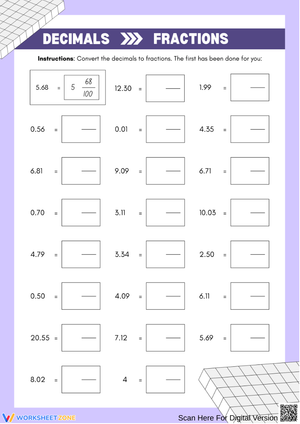
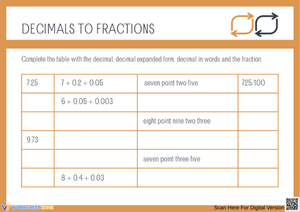
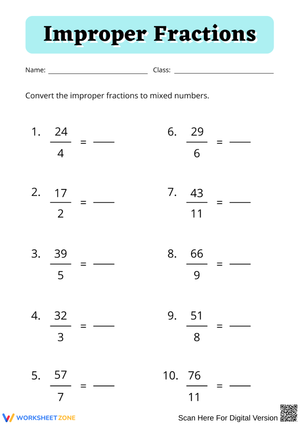
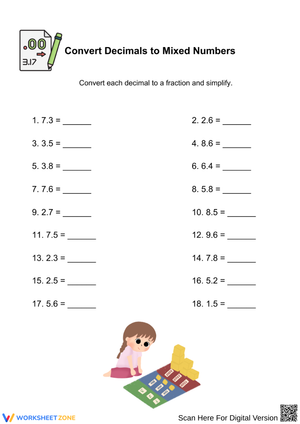
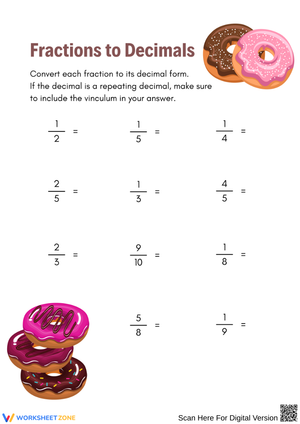
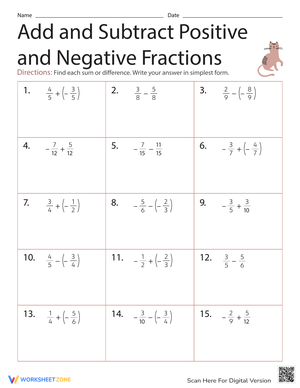
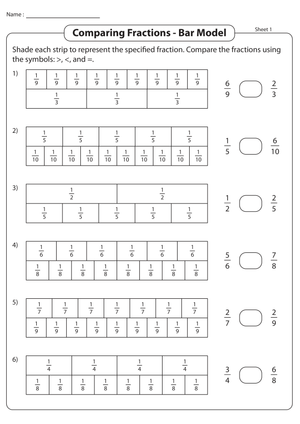
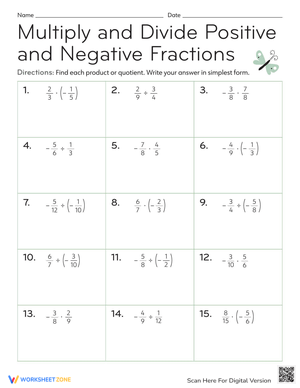
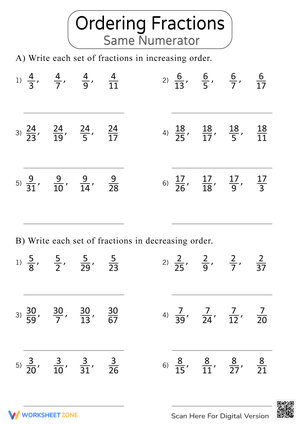
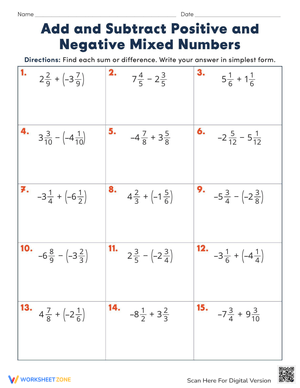
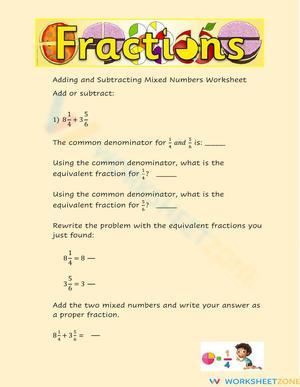
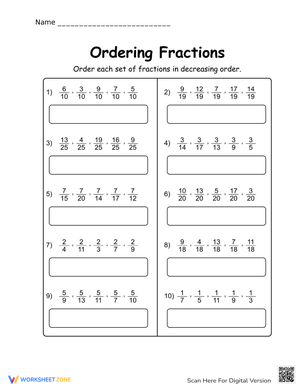
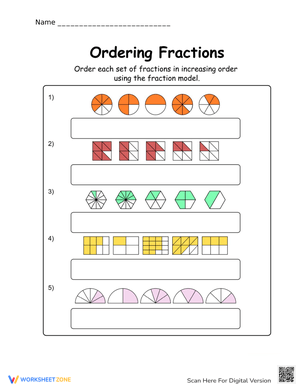
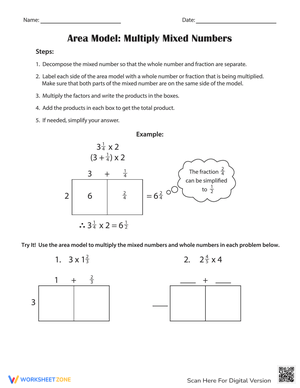
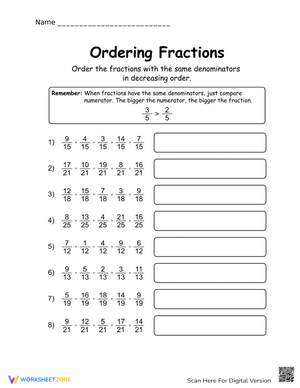
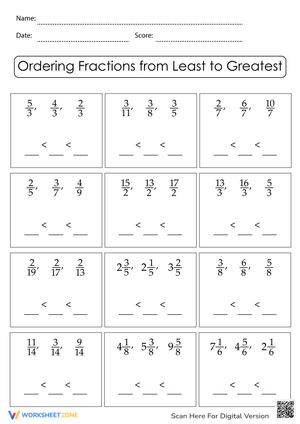
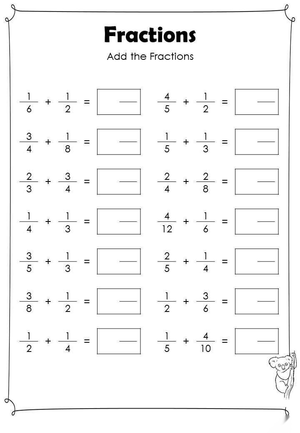
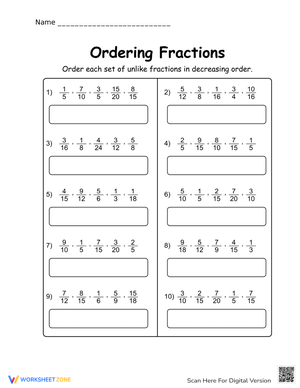
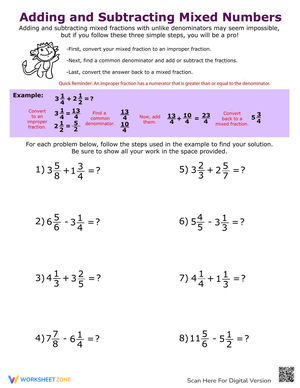
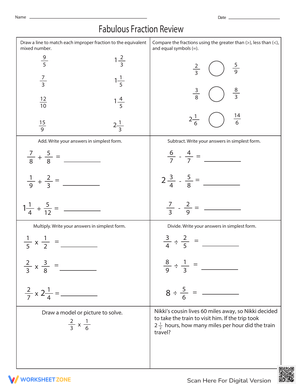
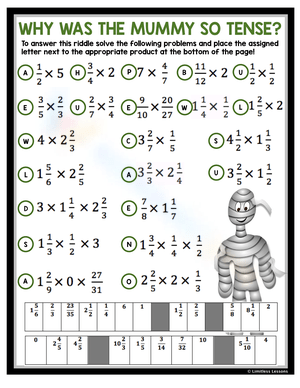
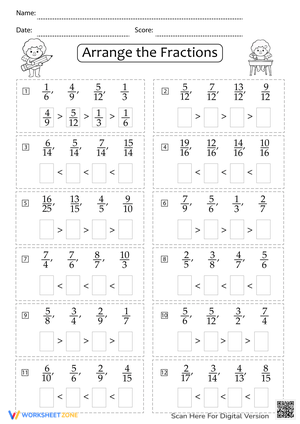
These fraction worksheets for 6th grade are organized by individual skill, which means teachers always know exactly what a given worksheet targets — and what student work on it reveals about understanding versus gaps. The set spans equivalent fractions through multi-step division word problems, covering the full range of fraction work students need from initial instruction through spiral review.
The Specific Skills Targeted
Each worksheet addresses one of the major fraction concepts students must control by the end of sixth grade:
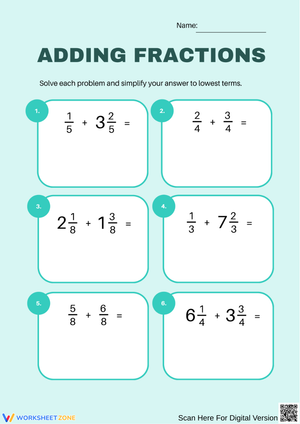
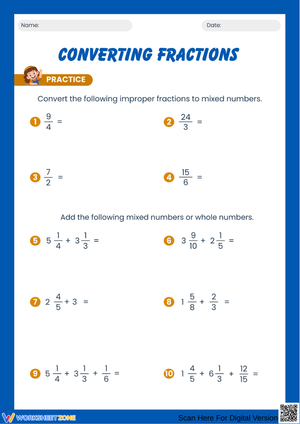
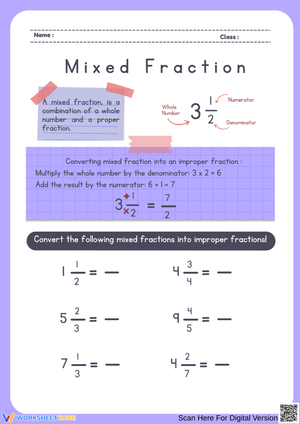
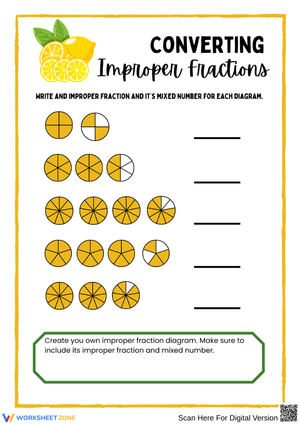
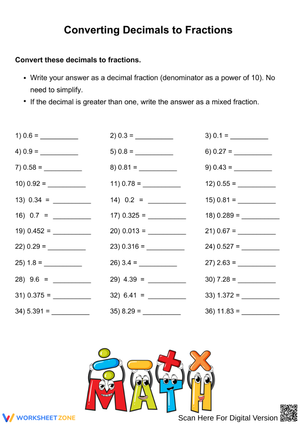
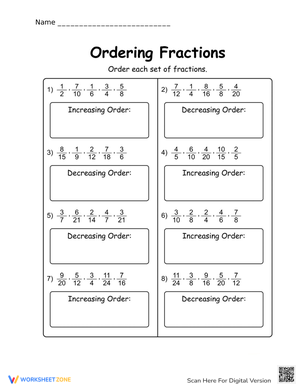
- Equivalent fractions and simplification — rewriting fractions, reducing to lowest terms, and recognizing equal values across different forms
- Adding and subtracting fractions with unlike denominators — problems that require identifying the least common denominator before computing
- Adding and subtracting mixed numbers — with and without regrouping, which is where procedural comfort tends to break down
- Multiplying fractions and mixed numbers — direct computation and problems where simplifying before multiplying reduces the chance of arithmetic errors downstream
- Dividing fractions — fraction divided by fraction, mixed number divided by fraction, and word problems that test whether students understand what division means in context, not just how to execute the steps
The fraction worksheets for 6th grade are most effective when used in sequence — one focused skill at a time before students encounter mixed review. Mixing operations too early tends to show teachers who can pattern-match the problem type, not who actually understands what the operation means.
Fitting These Worksheets Into Your Teaching Routine
The fraction worksheets for 6th grade fit into several distinct classroom roles, and using each worksheet with a clear purpose produces better results than treating any of them as general filler practice.
Bell ringers are one of the most consistent uses. Two or three problems from a focused worksheet take about five minutes and reactivate the previous lesson before instruction begins. This works especially well on Monday mornings after morning meeting, when students need a low-stakes re-entry into math before the lesson proper.
After a mini-lesson, assigning the matching focused worksheet gives students immediate practice with the exact procedure just modeled. Teachers can circulate, catch errors while they're fresh, and pull a small group to the board before the period ends. The key move here is grouping students by error pattern rather than overall quiz score. Two students who both scored 68 percent on a fraction assessment may have entirely different gaps — one needs work on common denominators; the other is misapplying keep-change-flip in word problems. Matching each student to the worksheet that addresses their specific error makes reteaching feel relevant rather than repetitive.
- Mini-lesson follow-up — same-skill practice immediately after modeling
- Math workshop groups — different worksheets running simultaneously by readiness and error type
- Homework — one focused worksheet is more useful than a mixed review worksheet at this stage of instruction
- Exit tickets — three to five problems from the target skill, self-checked with an answer key before students hand in
- Intervention folders — organized by skill so small groups know exactly what they are working on and teachers can track progress across sessions
Predictable Mistakes These Worksheets Help You Catch Early
Sixth grade fraction errors follow recognizable patterns, and knowing them in advance changes how teachers read student work.
The most persistent addition error is operating on both the numerator and denominator simultaneously — writing 1/3 + 1/4 as 2/7. Students who made this mistake in fourth grade sometimes carry it forward, particularly when fraction addition reappears after a long gap. A focused unlike-denominator worksheet surfaces this quickly, and the fix is straightforward once the misconception is named aloud.
Regrouping in mixed number subtraction creates a different kind of confusion. A student working on 5 1/6 − 2 5/6 may correctly recognize that regrouping is necessary, borrow 1 from the whole number, and then add it to the fraction part incorrectly — writing 5/6 + 1/6 rather than thinking about what borrowing a whole unit means in fraction terms. The final answer looks like carelessness, but it almost always points to a conceptual gap in how students connect whole numbers and fractions as parts of the same value.
Division causes a distinct problem. Most students learn the keep-change-flip sequence, apply it accurately on isolated computation problems, and then fail to use it correctly when division appears inside a word problem with real-world context. They know the steps but not what the operation means. Asking students to write one sentence explaining why they flipped and multiplied — even informally — separates procedural recall from actual understanding faster than any score does.
Simplification is the last common miss. A student multiplies 3/4 × 8/9 correctly, arrives at 24/36, and writes that as the final answer. The process was right; the last check was skipped. These are easy to catch with a quick scan of student work against the answer key, and they are worth addressing explicitly because the habit of checking for lowest terms carries into ratio and proportion work later in the year.
Standard Alignment
The primary standard driving this set is CCSS.MATH.CONTENT.6.NS.A.1, which requires students to interpret and compute quotients of fractions and solve word problems involving division of fractions by fractions. This is the one fraction operation formally introduced in sixth grade rather than reviewed from prior years. It gets dedicated worksheets because the conceptual step — understanding what it means to divide by a fraction — requires more instructional time and attention than the procedure alone suggests.
The broader set also supports consolidation of 5.NF (Number and Operations — Fractions) standards that most 6th grade teachers revisit at the start of the year. Students arrive with uneven mastery of adding, subtracting, and multiplying fractions, and the focused worksheets here let teachers address those gaps without reaching back into 5th grade materials. In instructional planning terms, this fraction work belongs in the first quarter of the year — before students move into ratio and proportional reasoning — because fraction fluency and notation transfer directly into that unit.
Making Each Worksheet Work Across Readiness Levels
These fraction worksheets for 6th grade are flexible enough to serve students at significantly different readiness levels with a few intentional adjustments at each tier.
For students who need more support, assign fewer problems — the first several on a worksheet rather than the full set — and allow a fraction reference chart showing common equivalent families. The goal is reducing the retrieval demand so students can focus attention on the target operation rather than splitting it between the procedure and basic fraction facts they haven't yet internalized. Partner checking followed by self-grading with the answer key gives more immediate feedback than waiting for teacher review during a busy group rotation.
On-level students generally work through a complete worksheet independently. One follow-up move worth building into the routine: ask them to circle the two problems they found hardest and write one sentence about what made each difficult. That step takes three minutes and tells a teacher more than the score alone about where a student's thinking is breaking down.
Advanced students rarely need a separate worksheet with harder numbers — they need harder questions about the same worksheet. Ask them to find two problems with equivalent answers and explain why the results are the same. Or ask them to write a word problem that matches one of the bare computation expressions on the worksheet. These tasks push toward mathematical reasoning and communication without requiring extra prep on the teacher's end.
Frequently Asked Questions
Do these worksheets cover fraction division, or mainly addition and subtraction?
The set covers all four operations — addition, subtraction, multiplication, and division — with both fractions and mixed numbers. Division gets its own focused worksheets because the conceptual step it requires is distinct enough that students need time to practice it in isolation before encountering it alongside other operations in word problems.
How should I sequence the worksheets across a unit?
The most effective sequence follows the standard instructional progression: equivalent fractions and simplification first, then addition and subtraction with unlike denominators, then mixed number operations, then multiplication, then division, and finally word problems that draw across all operations. Mixed review worksheets are most effective after students have had focused practice on each individual skill — not as an introduction to the unit.
Can these be used for intervention as well as grade-level instruction?
The single-skill format makes these particularly well-suited for intervention. When a formative check shows that a student is struggling specifically with mixed number subtraction, a teacher can assign that worksheet directly rather than giving the student a mixed review that also includes skills they have already mastered. For grade-level instruction, the same worksheets serve as follow-up practice after whole-group modeling.
Do the worksheets include answer keys?
Every worksheet in the set includes a full answer key. This matters for two practical reasons: it saves grading time, and it supports self-checking routines that give students immediate feedback. Teachers also use the answer keys to scan a class set quickly, identify recurring error patterns across multiple students, and decide whether to reteach the whole group or pull a small group the next day.













 Interactive Worksheet Maker
 Quiz Maker
 Word Search Maker
 Crossword Puzzle Maker
 Word Scramble Generator
 Sentence Scramble Generator
 Handwriting Worksheet Generator
 Name Tracing Generator
 Fill In The Blank Generator