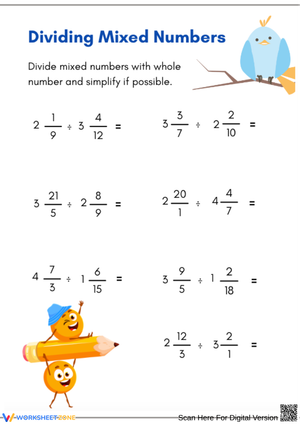
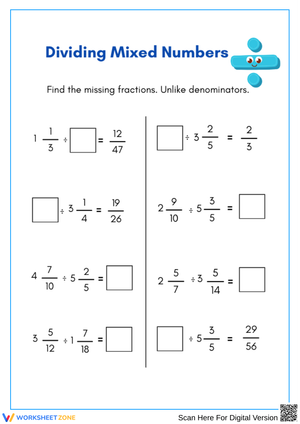
6th Grade Divide Mixed Numbers Worksheets for Targeted Fraction Practice
These 6th grade divide mixed numbers worksheets give teachers a targeted set of resources for one of the procedurally densest skills in the middle school fraction sequence. Unlike multiplying fractions, dividing mixed numbers demands that students hold and execute four distinct decisions in order: convert the mixed number correctly, keep it in place, identify and flip the divisor's reciprocal, then multiply and simplify. When students rush or misremember one step, the error is usually invisible to them — the answer looks plausible even when it's completely wrong.
Skills These Worksheets Build
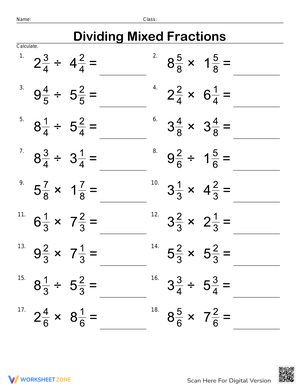
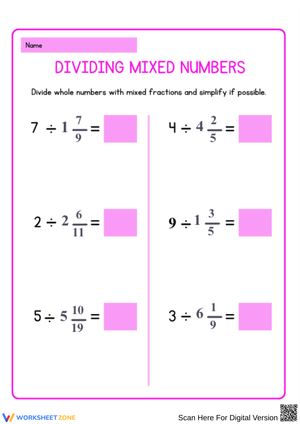
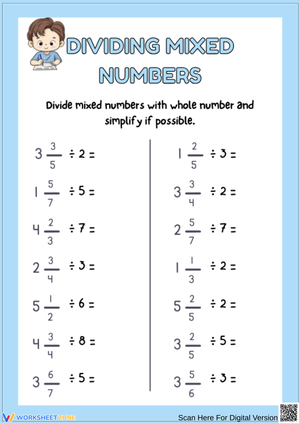
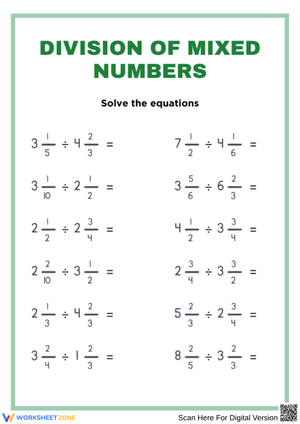
Each worksheet in the set targets a specific phase of fraction division rather than mixing every problem type into one undifferentiated assignment. That distinction matters for instruction. A worksheet focused on conversion gives teachers a clean window into a specific misconception. A worksheet built around word problems tells teachers something different — whether students can recognize a division situation when it's embedded in a context, not just when the equation is already written. The collection includes:
- Conversion practice: students rewrite mixed numbers as improper fractions before any division takes place, isolating the step most likely to derail later work
- Reciprocal identification: students circle or label the divisor and write its reciprocal as a separate step, keeping that decision distinct from the multiplication that follows
- Core division computation: standard problems with denominators that simplify cleanly, building fluency with the full procedure
- Mixed-operation sets: problems where students first decide whether to multiply or divide before computing
- Error analysis: completed worked examples containing deliberate mistakes for students to locate, explain, and correct
- Word problems: measurement, grouping, and recipe contexts that ask students to write and solve the division equation from a written scenario
Answer keys with worked steps accompany the worksheets. When the set moves into centers or intervention rotations, a step-by-step key means students can self-check their process — not just their final answer — without waiting for a teacher to circulate.
Student Error Patterns Worth Catching Early
The most damaging error in this skill sequence happens before the reciprocal step. Students converting 4⅗ who write 7/5 instead of 23/5 — adding the whole number to the numerator rather than multiplying it by the denominator — have already lost the problem. That specific conversion mistake shows up in roughly a third of first-attempt class sets, and it's worth addressing directly rather than assuming the prerequisite is secure.
Flipping the wrong fraction is the second common breakdown. In a problem like 2⅓ ÷ 1¾, students take the reciprocal of 7/3 (the dividend) instead of 7/4 (the divisor). Because the result still involves multiplying two fractions, it looks procedurally correct from the student's seat — they arrive at a numerical answer with no internal signal that they've inverted the wrong quantity. A small physical habit helps: before taking any reciprocal, students underline the second number in the original equation, then flip only that one. That action alone reduces this error noticeably across a class.
A third pattern appears at the end. Students multiply correctly and land on something like 28/12, then stop — leaving an unsimplified improper fraction as the final answer. This is partly carelessness, partly a sign that simplification feels like an optional finishing step rather than part of the answer. Error-analysis worksheets address all three patterns by asking students to examine a pre-written solution, identify the exact step where it breaks down, and rewrite the work correctly from that point forward. That task pushes students to reason about process, not just chase a number.
Fitting These Worksheets Into Your Instructional Week
The clearest entry point for these 6th grade divide mixed numbers worksheets is the day after initial instruction, when students have seen the procedure modeled but have not yet practiced it independently. Assigning the conversion worksheet as exit work or a next-morning warm-up gives teachers a natural formative checkpoint before the full division procedure is attempted. If conversion errors surface on that first worksheet, address them directly — five minutes of explicit correction the following morning saves considerable reteach time later in the unit.
In a small-group reteach block, the error-analysis worksheet does work that a standard computation worksheet cannot. Students who have already practiced incorrectly benefit more from examining and explaining a mistake than from running the same procedure again. Pair it with a brief discussion about where the sample solution went wrong — not just that it's wrong — and students leave with a sharper mental model of the sequence.
Word-problem worksheets belong after students demonstrate basic computation fluency, not before. A question worth asking aloud before students write any equation: Are we finding the size of each group, or how many groups fit? That framing question helps students connect the written scenario to the correct operation before they commit to a setup.
Standard Alignment
These worksheets address CCSS 6.NS.A.1, which requires students to interpret and compute quotients of fractions and solve word problems involving division of fractions by fractions. Dividing mixed numbers sits at the most complex end of that standard — students must apply conversion, reciprocal reasoning, and simplification in sequence, which is exactly what the problems in this set demand. In most 6th-grade pacing guides, 6.NS.A.1 falls in the first major unit of the year, making this set timely from the start of the semester and available for spiral review throughout.
Adjusting the Worksheets for a Range of Fraction Readiness
Fraction division readiness in 6th grade varies more than teachers expect. Some students arrive with solid conversion fluency from 5th grade; others are still uncertain about how a denominator functions. These 6th grade divide mixed numbers worksheets support differentiation without requiring entirely separate assignments. A few practical adjustments:
- Students who need additional support: provide the conversion step already completed — the mixed number rewritten as an improper fraction — so students practice the reciprocal and multiplication steps without the added load of conversion
- On-level students: assign the full procedure from the start, with the computation worksheet followed by three or four word problems
- Students ready for a challenge: give the error-analysis worksheet first, then ask them to write two original word problems that a classmate would solve using the same operation
- Intervention groups: isolate the specific error pattern you have observed — conversion mistakes, reciprocal confusion, or simplification gaps — and assign only the worksheet that directly targets that one breakdown
Color-coding the four steps (convert, keep, flip, multiply) during initial group work gives students a visual anchor they can return to during independent practice. It is low-tech and works well for students who lose track of where they are in the sequence, particularly during the keep-and-flip transition where the two decisions sit right next to each other.
Frequently Asked Questions
When in a unit should these worksheets be introduced?
Start with the conversion-focused worksheet on the first day of independent work, before students attempt the full division procedure. Once conversion is reliable — students are accurately rewriting mixed numbers as improper fractions on at least four out of five attempts — move to the core division worksheet. Word problems come last, after computation fluency is established.
How do I know if a student is ready for fraction division or still needs prerequisite work?
A short pre-check works well: five conversion problems and five fraction multiplication problems. If a student cannot reliably convert a mixed number to an improper fraction or multiply two fractions correctly, those gaps need targeted practice before 6th grade divide mixed numbers worksheets will be productive. Students who practice the full division procedure with weak prerequisites tend to reinforce incorrect steps rather than build accurate ones.
Can these worksheets go home for homework, or do they work better in class?
Both settings work, with one practical consideration: fraction division is a skill where students who practice incorrectly at home without feedback lock in the wrong sequence. If assigning worksheets for homework, include the answer key with worked steps and ask students to check each problem before moving to the next — not at the end of the whole assignment. A student who has been flipping the dividend instead of the divisor catches the pattern after problem two rather than after problem twelve.
What should I do when a student converts correctly but still arrives at a wrong answer?
Ask them to point to exactly which fraction they flipped. Most of the time the error is reciprocal reversal — flipping the dividend instead of the divisor — which students cannot self-catch because the arithmetic still involves multiplying two fractions and looks structurally correct. Have the student underline the divisor in the original problem before converting anything, then flip only that quantity. That physical marking step separates the identification decision from the computation and makes the error visible.
Clear All