


























Views
Downloads

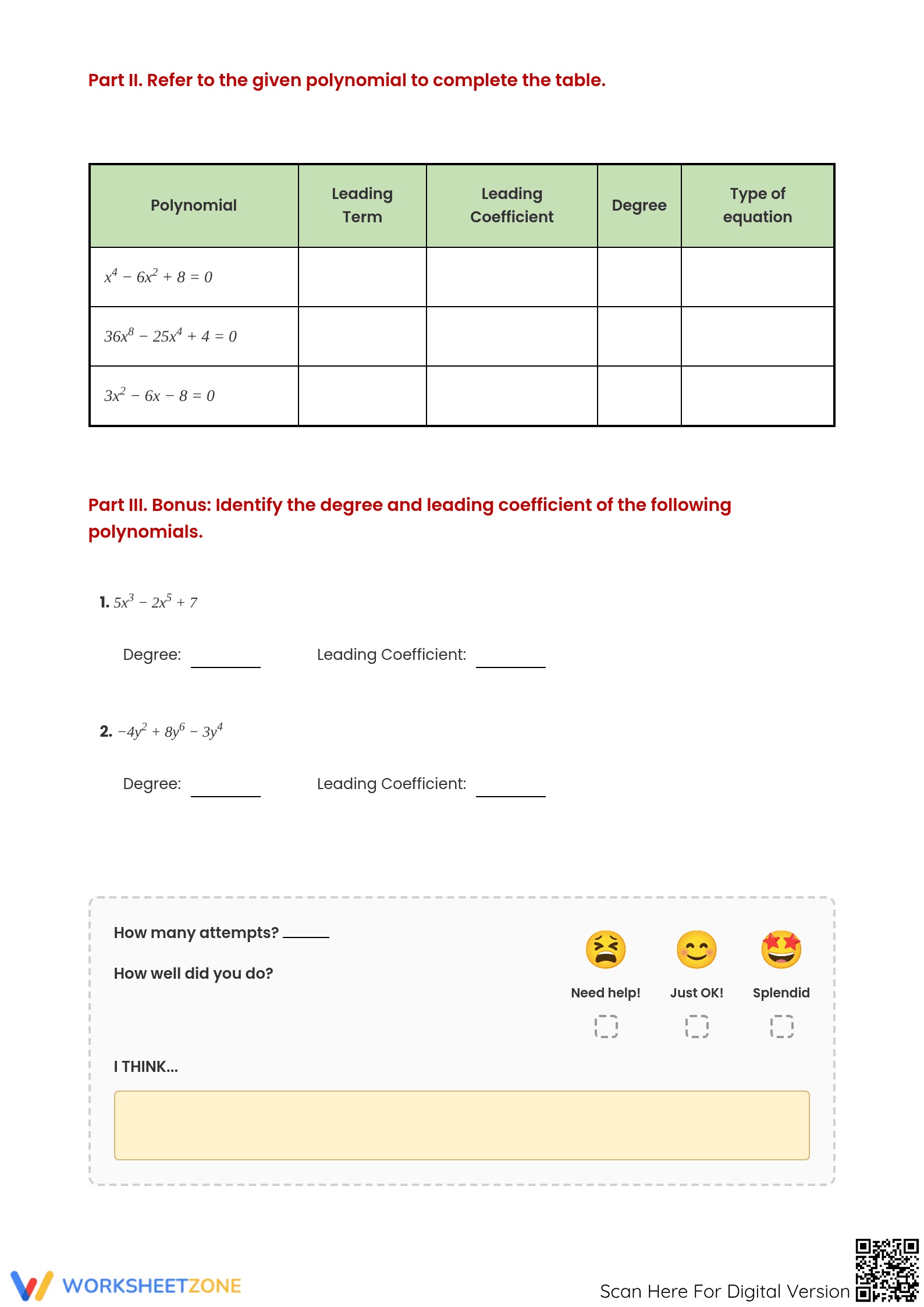

Essential Polynomial Equations Worksheet | Grade 9 Math
Paste this activity's link or code into your existing LMS (Google Classroom, Canvas, Teams, Schoology, Moodle, etc.).
Students can open and work on the activity right away, with no student login required.
You'll still be able to track student progress and results from your teacher account.
This Grade 9 math worksheet provides essential practice for students illustrating and analyzing polynomial equations. By identifying the degree, leading coefficient, and constant term of various expressions, learners develop the foundational algebraic fluency required for more complex factoring and graphing tasks later in the curriculum.
At a Glance
- Grade: Grade 9 · Subject: Math
- Standard:
HSA-SSE.A.1.A— Interpret parts of an expression, such as terms, factors, and coefficients- Skill Focus: Identifying degree, leading coefficients, and constant terms
- Format: 2 pages · 20 problems · Answer key included · PDF
- Best For: High school algebra introductory lessons and review
- Time: 25–35 minutes
What's Inside
The worksheet contains two comprehensive pages featuring a total of 20 polynomial equations organized in a clear, tabular format. Each page presents equations ranging from simple quadratics to higher-degree polynomials. Students are tasked with populating a table for each equation, specifically extracting the degree, the leading coefficient, and the constant term. A full answer key is provided to facilitate quick grading and self-correction.
Skill Progression
- Guided Practice: The first five problems feature standard polynomial forms with integer coefficients, helping students recognize basic structure without added complexity.
- Supported Practice: Problems 6 through 12 introduce non-sequential terms and varying variable positions, requiring students to identify the highest degree and its coefficient.
- Independent Practice: The final set includes polynomials with zero coefficients for certain degrees, challenging students to maintain accuracy in identifying terms.
This structured approach follows the gradual-release model, transitioning students from simple recognition to mastery of structural analysis.
Standards Alignment
This resource is directly aligned to `HSA-SSE.A.1.A`, which requires students to interpret parts of an expression. Specifically, it focuses on identifying the degree and coefficients that define the behavior of polynomial functions. This standard code can be copied directly into lesson plans, IEP goals, or district curriculum mapping tools.
How to Use It
Use this worksheet as a primary practice activity immediately following direct instruction on polynomial definitions. It serves as an excellent formative assessment tool; teachers should observe if students confuse the leading coefficient with the first term's coefficient. Most students will complete the activity within 30 minutes.
Who It's For
Designed for Grade 9 students in Algebra 1, this resource is particularly beneficial for learners who require visual scaffolding to organize mathematical data. It pairs naturally with a guided lesson on polynomial vocabulary or an anchor chart displaying 'Anatomy of a Polynomial' for reference.
According to the RAND AIRS 2024 framework for algebra readiness, the ability to decompose complex expressions into constituent parts—such as identifying the degree and coefficients of a polynomial—is a critical precursor to advanced function analysis. This worksheet provides structured practice aligned to CCSS.MATH.CONTENT.HSA-SSE.A.1.A, ensuring students develop the fluency required for solving higher-order equations. By isolating the leading coefficient and constant term, learners build a conceptual bridge between symbolic manipulation and graphical interpretation. Research from ScienceDirect (2024) indicates that repetitive, high-alignment practice with polynomial structure significantly reduces cognitive load during subsequent factoring and root-finding tasks. This resource effectively scaffolds that transition by requiring students to systematically categorize each term before proceeding to calculation. Educators can utilize these findings to justify the use of targeted drills in Grade 9 classrooms as a means of establishing the rigorous foundational knowledge necessary for success in college-track mathematics sequences.


