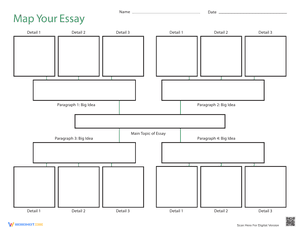
Informational writing printable worksheets for 6th grade give teachers a way to break apart one of the most demanding writing tasks in middle school and teach each component as a distinct, repeatable move. The set covers the full writing process—from narrowing a topic and selecting a text structure through drafting paragraphs, revising for clarity, and editing for conventions. Each worksheet isolates one part of the task so students can practice it deliberately before combining everything in a finished piece.
What Each Worksheet Targets
Sixth grade informational writing demands more than accurate facts. Students must frame a topic for a reader, choose how to organize their explanation, supply relevant evidence, and signal connections between ideas with precise language. Each worksheet in the set addresses one of those demands directly.
- Topic development: Students identify a main focus, name two to four subtopics, and list potential facts before writing a single sentence—front-loading the thinking that weak drafts typically skip.
- Text structure selection: Students match their topic to one of five structures—description, sequence, compare and contrast, cause and effect, or problem and solution—and sort their information into the matching organizer.
- Paragraph construction: Students practice writing topic sentences that frame an idea rather than simply announce it, then add supporting details and a closing sentence that connects back to the main point.
- Transition language: Students pull from a word bank specific to their chosen structure, which prevents every paragraph from opening with Also or Another.
- Revision for meaning: Students check whether each paragraph stays on topic and whether their evidence actually explains something rather than restating a fact.
- Editing for conventions: A separate checklist handles capitalization, punctuation, spelling, and sentence completeness—applied after the ideas are in order, not before.
The sequence organizers deserve particular attention. Students understand that sequence means time order, but they underestimate how much explanatory work belongs between steps. A worksheet that asks them to label each step and write one sentence explaining why that step matters pushes them past simple enumeration. That habit transfers directly to science lab reports and social studies timelines.
Frequent Student Errors Worth Catching Early
The most persistent problem in sixth-grade informational writing is fact-listing. A student will write: "There are many things about photosynthesis. Plants need sunlight. They also need water. They also make food." The information is accurate. The writing explains nothing. The drafting worksheet addresses this directly by asking students to write what each fact means for the reader, not just what the fact is. That single prompt shift produces noticeably more developed paragraphs.
Two other patterns show up consistently. First, students write topic sentences that mirror the prompt instead of framing their own idea—"This essay is about the water cycle" rather than "The water cycle moves water through three connected stages that affect weather patterns." Second, students treat the revision worksheet as an editing task and focus on spelling before checking whether their paragraphs stay on topic. Keeping revision and editing on separate worksheets forces students to address content before conventions, which is the order that produces stronger final drafts.
How to Work These Worksheets Into Your Week
Informational writing printable worksheets for 6th grade fit naturally into a five-day process cycle. Assign the topic development worksheet on Monday, note-taking and text structure selection on Tuesday and Wednesday, the drafting worksheet on Thursday, and the revision checklist on Friday. That rhythm gives students a predictable framework and gives teachers a concrete checkpoint at each stage—so a problem with organization surfaces on Wednesday, not after students have already drafted three paragraphs in the wrong direction.
In whole-group instruction, project the worksheet and model completing one section with a shared class topic—something neutral like "How does a bill become a law?" or a science process from the current unit. Students see the thinking before applying it independently. In small group pullout, use the same worksheet with partially completed sections or bolded sentence starters to reduce the amount of blank space that stops struggling writers before they begin.
One routine worth building: save the same cause-and-effect organizer and run it across three different topics during a quarter. Students who spend less mental energy figuring out the form start putting more energy into their explanations. That reuse also makes revision conversations more productive, because students and teacher share a common language about what strong entries in each box look like.
Standard Alignment
The worksheets align to CCSS.ELA-LITERACY.W.6.2, which requires students to write informative and explanatory texts by examining a topic and conveying ideas through selection, organization, and analysis of relevant content. Sub-standards W.6.2a through W.6.2f map directly to specific skills in this set: introducing a topic clearly (a), organizing ideas logically (a–b), developing ideas with facts and details (b), using precise language and domain-specific vocabulary (d), establishing a formal style (e), and providing a concluding statement (f).
The revision and editing worksheets also support W.6.5, which asks students to develop and strengthen writing through planning, revising, editing, and rewriting. Because each worksheet makes one stage of that process visible and actionable, teachers can meet W.6.5 in a concrete and documentable way rather than through informal feedback alone.
Differentiating the Set for a Range of Writers
Informational writing printable worksheets for 6th grade work across a range of ability levels when teachers adjust output requirements without changing the writing goal. Every student can explain how volcanoes form or compare two historical governments—the amount of evidence, the length of the explanation, and the degree of independence are what vary within the same lesson.
- Students who need more support: Provide a graphic organizer with labeled boxes and a sentence frame for the topic sentence. Limit the organizer to two subtopics instead of four. A shorter revision checklist—three items rather than six—keeps the focus manageable without removing the revision step entirely.
- English learners: Add a domain-specific vocabulary list at the top of the drafting worksheet, paired with a short definition or image. Explicit transition lists sorted by structure—sequential transitions listed separately from compare-and-contrast transitions—reduce language guesswork during drafting.
- On-level writers: Use the full planning-to-revision sequence with independent organization choices. These students benefit most from the revision worksheet's prompt to check whether their details explain or merely list.
- Advanced writers: Require at least two distinct sources of evidence per body paragraph, ask for domain-specific vocabulary in five or more places throughout the draft, or assign a second text structure within the same piece—for example, a sequence explanation embedded inside a problem-and-solution frame.
Differentiating by output length—rather than by writing purpose—keeps the class working on the same task with the same set of worksheets. A student writing one strong body paragraph and a student writing four are doing the same intellectual work at different scales. That approach makes sharing and discussion easier because everyone can compare their choices without feeling like they completed a different assignment.
Frequently Asked Questions
Which text structure should I introduce first?
Start with description or sequence. Students encounter both frequently as readers and find them most intuitive to imitate in their own writing. Cause and effect and problem and solution require students to make logical connections rather than organize information chronologically or categorically—those structures are more demanding and work better once students have practiced the basic organizational habits first.
Can these worksheets be used in science or social studies, not just ELA?
They transfer cleanly to content areas. A science class can use the sequence worksheet for any process explanation—cell division, the rock cycle, digestion. A social studies class can run the compare-and-contrast organizer for political systems, historical figures, or geographic regions. When the form is familiar, students direct more attention toward the content itself.
How do I use individual worksheets for assessment without grading every piece as a finished essay?
Use individual worksheets as formative checkpoints rather than summative grades. The topic development worksheet shows whether students can narrow a focus. The revision checklist, completed independently, reveals whether students can identify weaknesses in their own writing. These smaller samples often tell teachers more about what students actually understand than a polished final draft does. Informational writing printable worksheets for 6th grade lend themselves to this kind of stage-by-stage monitoring precisely because each worksheet captures one moment in the process rather than the whole product at once.
How many times should students work through the complete process in a year?
Three to four complete cycles per year produces measurable growth in most sixth-grade classrooms. Spacing those cycles across science, social studies, and ELA topics keeps the structure familiar while changing the content—which is how students build genuine flexibility rather than memorizing one response format.















 Interactive Worksheet Maker
 Quiz Maker
 Word Search Maker
 Crossword Puzzle Maker
 Word Scramble Generator
 Sentence Scramble Generator
 Handwriting Worksheet Generator
 Name Tracing Generator
 Fill In The Blank Generator