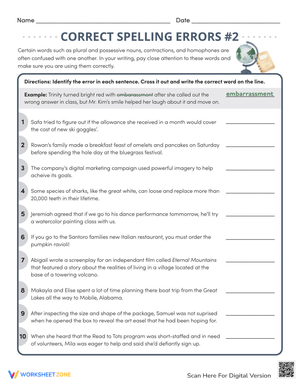
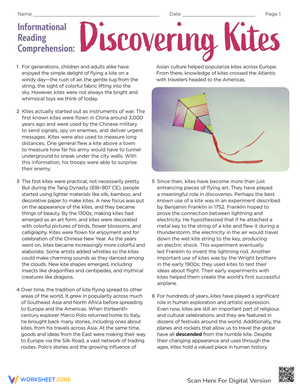
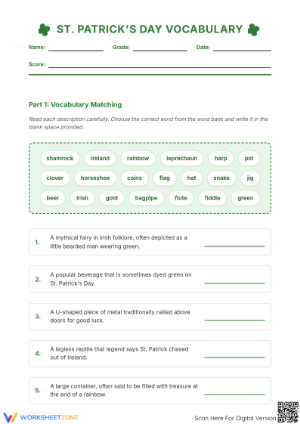
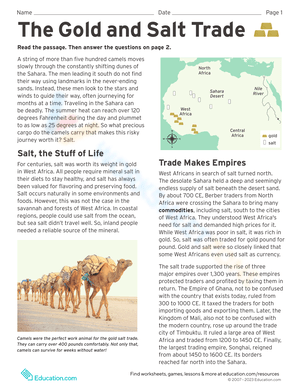
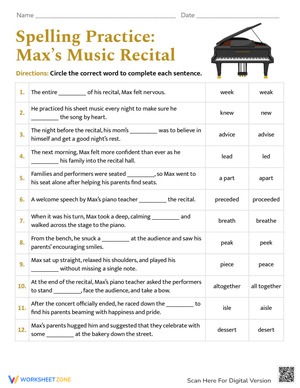
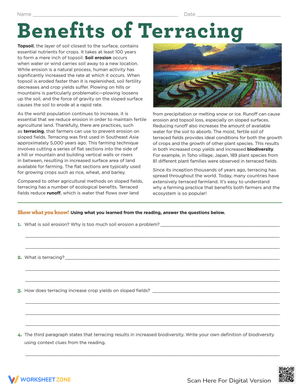
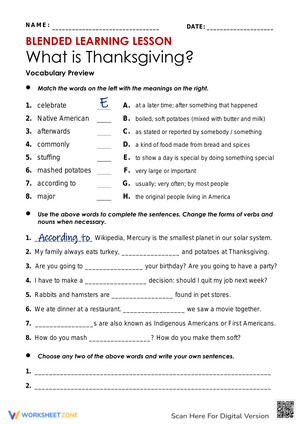
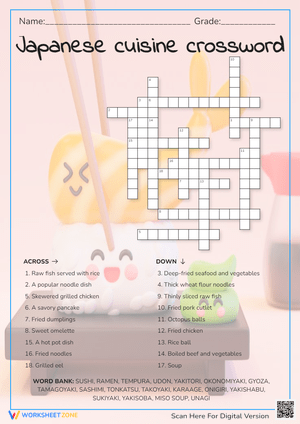
These context clues printable worksheets for 6th grade address a specific instructional gap that becomes visible around mid-fifth grade and sharpens in sixth: students learned to scan a single sentence for a nearby synonym hint, but they stall when the relevant clue sits two sentences back, requires combining details across a paragraph, or depends on a contrast signal they've never been explicitly taught to notice. This set gives ELA teachers passage-based practice built around academic vocabulary and multi-sentence items—work that reflects what students actually encounter in middle school texts rather than the word-in-a-sentence drills that belong in third grade.
The Specific Clue Types These Worksheets Target
Each worksheet rotates through the clue categories sixth graders need to name and apply before the skill transfers reliably to independent reading.
- Definition clues: the passage restates the term directly, often with signal phrases like which means or defined as. Students underline the restating phrase and write the meaning in their own words.
- Synonym clues: a nearby word or phrase carries a parallel meaning. Students who rush here tend to grab the first familiar word rather than checking whether it fits the sentence grammatically.
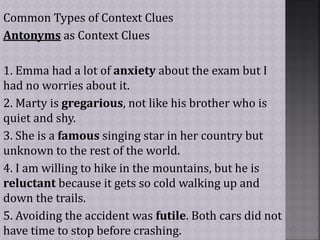
- Antonym and contrast clues: signal words such as however, unlike, and on the other hand require students to flip meaning rather than borrow it. This clue type trips up more sixth graders than teachers expect.
- Example clues: a list or descriptive detail narrows the meaning of the target word. Students learn to ask what the examples have in common before committing to a definition.
- Logic and inference clues: no single sentence contains the answer; students piece together two or three details to form a reasonable inference. This is the most transfer-heavy skill in the set.
- Syntax clues: the grammatical position of the unknown word signals whether it names a thing, describes a quality, or indicates an action—useful information even before students read surrounding context.
A worksheet that mixes these patterns gives more diagnostic information than one that runs ten synonym items in a row. When a student gets all the definition clues right and stumbles on the logic clues, you know exactly where to focus during small-group work.
Mistakes Students Make That These Worksheets Help You Catch
The most consistent error pattern at sixth grade: students lock onto the first unfamiliar word near the target term and declare it the meaning. In a sentence like The scientist was known for her meticulous, painstaking attention to every detail, a student who hasn't learned to evaluate clues systematically will write "painstaking" as the definition of meticulous—they identified proximity, not meaning.
Antonym clues generate a second reliable error. Students see unlike or but and understand intellectually that meaning reverses, yet they record the hint word rather than defining the target. After reading unlike the immense hall, the study was small, they write "small" as the definition of immense. That is the antonym—not the definition. The target question is always what the unknown word means, not which word in the text provided a hint.
Multiple-choice formats hide both errors. Written justification surfaces them reliably.
How to Work These Worksheets Into Your Week
The most efficient entry point is a two-day rhythm. Use one worksheet on Monday for teacher-led modeling—project the first item, read aloud, underline the clue phrase, name the clue type, and draft the meaning in front of students before checking it against the sentence. Return on Thursday with a second worksheet as independent review before weekly reading work. That spacing keeps the skill active without giving it more than 8–10 minutes of instructional time on either day.
For intervention blocks, narrow each worksheet to three or four items and build in a mandatory pause after each one. Ask students to read their chosen clue phrase aloud and explain their reasoning before writing anything down. That verbal step surfaces thinking that silent seatwork never will. One honest limitation: students whose reading anxiety runs high tend to disengage at the moment of unfamiliar vocabulary instead of rereading. For those students, reducing passage length before the lesson—rather than after confusion sets in—keeps the strategy practice intact.
For homework, assigning one worksheet at a time works well when each item is passage-based rather than isolated sentence strips. Students can annotate the clue words themselves, which gives the next day's class discussion a concrete starting point.
Standard Alignment
Context clues printable worksheets for 6th grade in this set align to CCSS ELA-Literacy L.6.4 and its sub-standard L.6.4a, which asks students to use context as a clue to the meaning or tone of a word or phrase. The broader L.6.4 standard calls for "a range of strategies"—students are expected to select an approach based on what the text offers, not apply one method mechanically. That is why tasks requiring students to name the clue type they used produce stronger evidence than tasks that ask only for the definition.
Because L.6.4 sits in the Language strand, it pairs naturally with the Reading Literature and Reading Informational Text standards that ask students to determine word meaning in context. Teachers using these worksheets as formative checkpoints can connect written student responses directly to L.6.4a when documenting intervention needs or preparing small-group reteach plans.
Adjusting the Worksheets for a Range of Learners
Context clues practice tends to reveal a wider skill spread than teachers expect in sixth grade. When selecting which context clues printable worksheets for 6th grade to assign each group, the deciding variables are passage length, the ratio of harder clue types to easier ones, and whether the response format requires written justification or allows students to circle an answer.
- Below grade level: start with definition and synonym clue items before introducing contrast or logic items. Add a printed prompt—"Underline the clue phrase before you write your answer"—to give students a first move rather than an open question. Shorter passages with familiar syntax let students practice the strategy without stalling on the reading itself.
- English learners: preteach two anchor words from the passage before distributing the worksheet. Where possible, write a native-language synonym in the margin so students can focus on locating clue structure rather than bridging two separate vocabulary gaps at once.
- On-level students: require a written explanation of both the inferred meaning and the specific phrase in the text that supported it. A circled answer alone doesn't generate enough evidence for reliable progress monitoring.
- Advanced readers: assign items with multiple-meaning words and ask students to write two plausible definitions, then identify which context clue in the passage eliminates one of them. That task is genuinely harder and closer to what close reading looks like at the honors level.
Keeping three labeled folders—one with easier items, one at grade level, one with extended tasks—takes minutes to organize and holds the classroom routine stable across all groups. Every student is practicing context clues; the reading complexity and response expectations are what differ.
Frequently Asked Questions
Which clue types give sixth graders the most consistent trouble?
Logic and inference clues produce the most errors because no single sentence holds the answer—students have to piece together two or three details. Students who rely on one-sentence scanning fail these items repeatedly until they practice deliberate rereading. Antonym clues are the second most missed: students identify the signal word but copy the hint word rather than defining the target term.
How do these worksheets fit alongside direct vocabulary instruction?
Use direct instruction to introduce each clue type first—teacher modeling, think-alouds, and whole-class discussion. Then assign the worksheets as structured independent practice to see who can transfer the strategy without teacher direction. The worksheets don't replace explicit teaching; they show you who retained it.
Can these worksheets be used in science or social studies classes?
Yes, with some selection. Content-area teachers benefit most from worksheets that use informational passages with domain-specific vocabulary. A science teacher previewing a unit on ecosystems, for instance, can assign a matching worksheet as a vocabulary warm-up the day before students encounter those terms in their reading.
Why does written justification matter more than circled answers for this skill?
A student who writes "the text says 'unlike the arid region, this area receives heavy rainfall,' so arid must mean dry or lacking moisture" gives you something to work with instructionally. A circled letter tells you only whether the answer is right or wrong. These context clues printable worksheets for 6th grade are most valuable when the response format asks students to show their reasoning—that is where the real evidence for monitoring progress lives.












 Interactive Worksheet Maker
 Quiz Maker
 Word Search Maker
 Crossword Puzzle Maker
 Word Scramble Generator
 Sentence Scramble Generator
 Handwriting Worksheet Generator
 Name Tracing Generator
 Fill In The Blank Generator