These 6th grade root words printable worksheets give teachers a repeatable, device-free method for building the morphological awareness students need before the academic vocabulary wall hits — and in most grade 6 classrooms, that wall arrives hard by October. The set covers high-frequency Greek and Latin roots tied directly to middle school reading and content demands, with task formats that move students from recognizing a root in isolation to applying it inside an actual sentence.
The Specific Skills These Worksheets Build
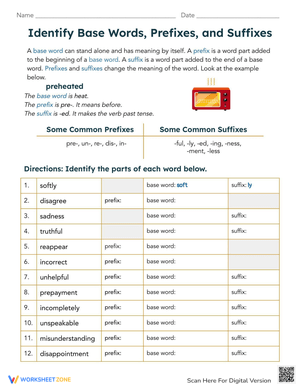
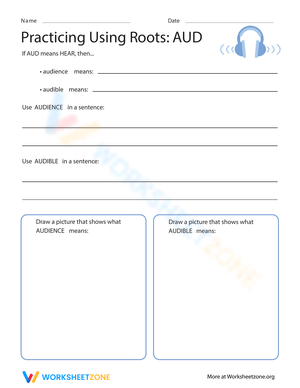
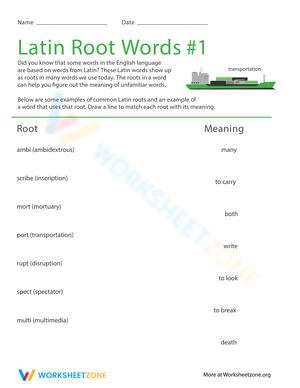
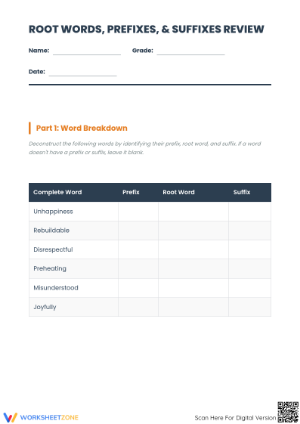
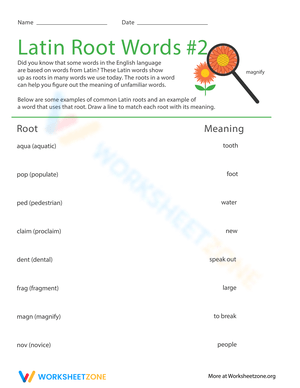
Each worksheet targets a cluster of related skills rather than asking students to memorize a list. Core tasks include root-to-meaning matching — students work with roots like rupt (break), dict (say or tell), and terr (land) — followed by word-building tasks where they attach prefixes and suffixes and identify how the addition changes the word's meaning or grammatical function. Moving from the root scrib to prescribe, inscription, and transcribe in a single task sequence is a representative example.
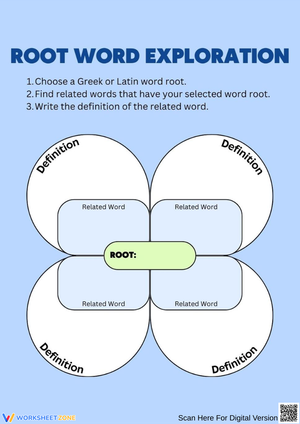
Word family work is where the compounding benefit shows up in student performance. When students see that struct (build) runs through construct, destruction, infrastructure, and restructure, they stop treating each as a separate vocabulary word to memorize. Context verification closes each sequence — students read a sentence and confirm whether their meaning prediction holds. That step separates students who recognized the root from those who can actually use it. The 6th grade root words printable worksheets in this set are built around that move from recognition to transfer.
Where Root Instruction Fits in Sixth Grade
The vocabulary jump between fifth and sixth grade is steep. Science units bring in terms like photosynthesis, geology, and convection. Social studies introduces governance, economics, and cultural exchange vocabulary. ELA texts ask students to infer meaning from context in ways that require strategies, not just prior knowledge. Root instruction gives students a transferable tool — not a word list to memorize but a method for breaking apart unfamiliar language on the spot, across every class period.
The efficiency argument for morphology instruction is real. A lesson on port meaning "carry" creates a shared meaning clue for transport, portable, import, export, and deportation simultaneously. That compounding return is why root work belongs in year-round instruction at this grade level, not just during a vocabulary unit. Students who internalize even a small bank of roots enter standardized reading tasks with a decoding strategy that works across content areas, not just in ELA.
Frequent Student Errors Worth Watching For
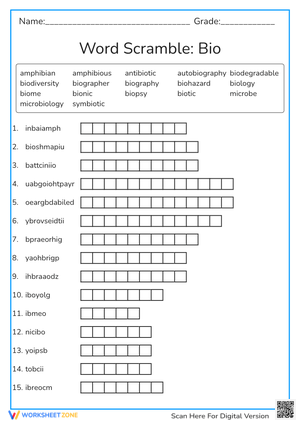
The most common error pattern at this grade level is root-only thinking — students focus on the root meaning and ignore the prefix. A student who correctly links bio to "life" in biology and biome will still mark antibiotics as "supporting life." The prefix anti drops out of their reasoning because they anchor on the familiar part. Naming this pattern explicitly in class — with that exact example — helps students slow down and read the full word before committing to an answer.
Homograph confusion is a separate problem worth anticipating. Students routinely write that import relates to "entering a port," thinking of a harbor, rather than "carrying goods in." The root port meaning "carry" competes with the everyday word port meaning a place for ships, and the context sentence is often not enough to settle the confusion without direct discussion. A third pattern appears when spelling shifts between forms: students who handle erupt and disrupt correctly often stall on rupture because the suffix changes the visible pattern of the root. A brief note before students encounter those forms independently prevents a lot of frustration.
Standard Alignment
These resources align directly with Common Core State Standards ELA, Grade 6, Language Standard L.6.4b, which asks students to use common, grade-appropriate Greek or Latin affixes and roots as clues to the meaning of a word. In classroom terms, that standard positions root work not as enrichment but as core language instruction — a skill students are expected to demonstrate when they encounter unfamiliar words during reading and writing tasks. The 6th grade root words printable worksheets in this set address that standard through the full sequence the standard implies: identify the root, infer meaning, and verify it in context, rather than stopping at the recognition step most drill exercises reach.
Building These Worksheets Into Your Weekly Routine
The most efficient use of this set is a distributed practice model rather than a standalone root-word unit. Teachers who spend one week on morphology and then move on see limited transfer. Teachers who return to one worksheet every few days — a bell ringer Monday, a partner task Wednesday, a short review Friday — see students begin applying root knowledge during independent reading without being prompted. That spaced-return approach matches what research on vocabulary retention supports and what most grade 6 schedules can actually sustain.
- Monday: run one worksheet as a guided bell ringer, spending the first 8–10 minutes modeling a few items before students complete the rest on their own
- Wednesday: use the same task format during a literacy center rotation, where partners explain their reasoning aloud before writing an answer
- Friday: a mixed-review worksheet as a 10-minute formative check — no collaboration, no devices — tells you quickly who still needs reteaching on specific roots
These worksheets also travel well outside ELA. A social studies teacher reinforcing terms like democracy or migration can hand one off without needing to explain a new format. Because the task structure stays consistent across the set — root, prediction, verify in context — students spend time on the word work itself rather than figuring out what they are supposed to do. The 6th grade root words printable worksheets are especially effective in intervention blocks for exactly this reason: the predictable routine holds cognitive load steady while the vocabulary challenge stays rigorous.
Adjusting the Set for a Range of Learners
The set works across entry points when teachers are intentional about sequencing. For students still building basic morphological awareness, start with worksheets that focus on a single root per task and include a meaning bank. The immediate feedback of matching — seeing the root and its definition side by side — builds confidence before students move into cold application. Students who freeze on open-ended prediction tasks often succeed in the matching format first and transfer to sentence-level work within a few sessions.
For students who are ready for more challenge, choose worksheets that ask them to sort words by root family when no labels are provided, or to explain in writing why two similar-looking words — manual and manage, for example — do not share the same root. Asking students to generate their own examples of root-based word families pushes beyond the task structure into genuine vocabulary production. That extension does not require a different worksheet; it requires a different prompt layered onto the same worksheet, which keeps planning manageable on a busy week.
Multilingual learners whose home language is Spanish, Portuguese, Italian, or French often hold an advantage with Latin-rooted terms because many of the same roots appear in their first language. Naming that connection explicitly — pointing out that the root terra is the same root in Spanish tierra — turns a vocabulary task into a language pattern observation and builds on knowledge those students already carry into the room.
Frequently Asked Questions
What Greek and Latin roots are typically covered at the 6th grade level?
Grade 6 root instruction usually targets roots that appear frequently in academic and content-area language: rupt (break), dict (say), port (carry), struct (build), scrib/script (write), bio (life), geo (earth), chron (time), graph (write), and terr (land), among others. The strongest sets prioritize roots that appear across multiple subjects, since those give students the widest cross-content return on their practice time.
How do these worksheets align with Common Core L.6.4b?
Standard L.6.4b asks students to use grade-appropriate Greek or Latin affixes and roots as clues to word meaning. Each worksheet in this set addresses that directly — students identify the root, predict its meaning, and confirm that meaning in sentence context. That three-step sequence mirrors what the standard describes rather than stopping at the recognition step that most drill-style exercises treat as sufficient.
Can these worksheets work for homework or independent center rotations?
Yes. Because the task structure stays consistent across the set, students can work through a worksheet independently once they have seen the format modeled one or two times in class. That predictability makes the 6th grade root words printable worksheets a practical choice for homework nights, technology-free centers, and any rotation where students need to stay on task without direct teacher support.
What is the difference between a root and a base word?
A base word is a complete English word that can stand alone and take affixes — help, play, read. A root is typically a Greek or Latin form that carries meaning but does not function as a standalone English word — rupt, scrib, terr. At the grade 6 level, most root word instruction focuses on Greek and Latin roots because they appear so frequently in academic, scientific, and literary vocabulary. Students benefit from knowing the distinction, and both types of meaningful word parts get addressed across the set.












 Interactive Worksheet Maker
 Quiz Maker
 Word Search Maker
 Crossword Puzzle Maker
 Word Scramble Generator
 Sentence Scramble Generator
 Handwriting Worksheet Generator
 Name Tracing Generator
 Fill In The Blank Generator