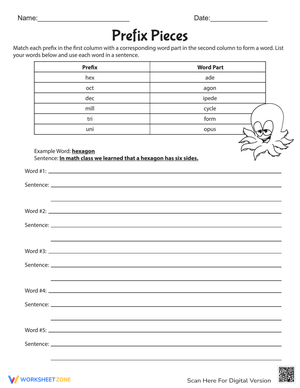
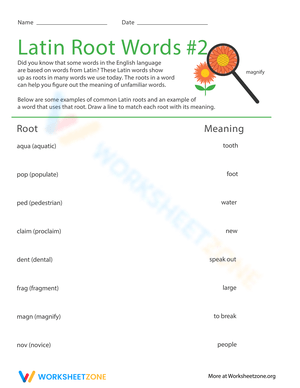
These roots prefixes and suffixes pdf worksheets for 6th grade address a specific reading problem: sixth graders encounter polysyllabic, abstract vocabulary in every subject, and context clues alone stop working once the words get dense enough. The set moves students through word-part identification, meaning prediction, and sentence-level confirmation — three moves that, practiced consistently, start carrying over into how students read independently.
What Students Practice in Each Worksheet
The worksheets use four distinct task types, each targeting a different level of morphological understanding:
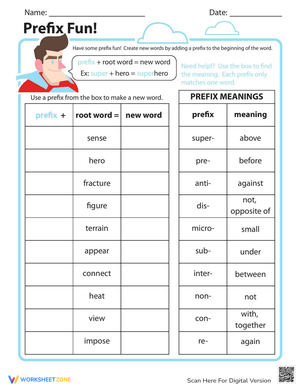
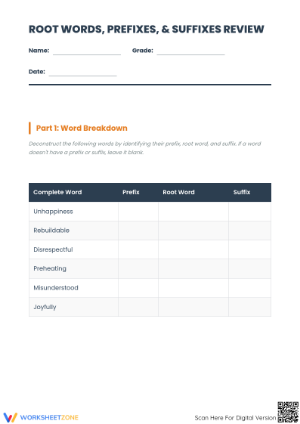
- Identification: students underline the root, circle the prefix or suffix, and label what they found.
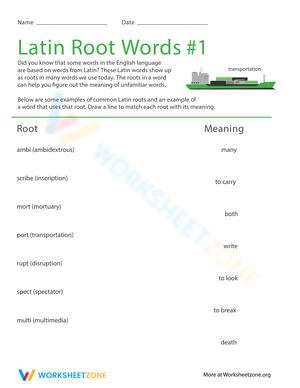
- Meaning: students write what the word part contributes — not a full definition, but the directional weight the affix or root carries.
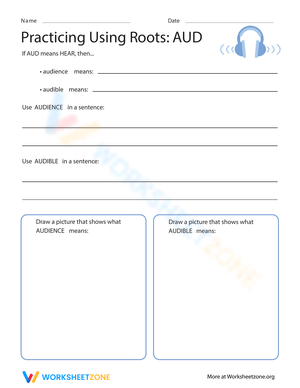
- Context: students use the surrounding sentence to confirm or revise their initial prediction.
- Application: students sort words by shared root, choose the most accurate form to complete a sentence, or generate a new word using a given base.
That variety matters because it reveals which part of the skill is actually missing. A student who labels "pre-" in predictable correctly might write a definition that ignores "dict" entirely — they've identified an affix but haven't analyzed the root. Another student reads the sentence and guesses accurately while skipping the structural clue. The mix of task types makes those two gaps visible separately, which changes what a teacher does next.
Errors That Show Up Repeatedly in Student Work
The most persistent pattern is suffix-only analysis. Students learn that "-tion" signals a noun and apply that knowledge confidently — but then write a whole-word meaning that never touches the root. Ask a class to analyze transformation and you'll hear "a kind of change." That's not wrong, but it shows "trans-" (across) and "form" (shape) both got skipped. The suffix did all the work the student allowed morphology to do.
Negative prefixes produce a similar collapse. Students know "un-" means not, mark it immediately in unprecedented, and write "not precedented." That follows the rule but falls apart if they've never encountered "precedent" as a standalone word. When the root itself is unfamiliar, affix knowledge alone doesn't carry the analysis. The identify-predict-confirm sequence built into these worksheets interrupts that shortcut: students have to say something about the root before they can move on — and the context step makes it impossible to coast on a partial answer.
Standard Alignment
CCSS.ELA-Literacy.L.6.4b expects students to use common Greek or Latin affixes and roots as clues to the meaning of words they haven't encountered before. That is a step beyond what fifth grade requires, where the standard focuses on familiar affixes applied to known words. At sixth grade, the task is applying morphological knowledge to unfamiliar academic vocabulary — harder, and more transferable to real reading.
When teachers need documentation of this skill, roots prefixes and suffixes pdf worksheets for 6th grade provide a paper trail that a vocabulary quiz doesn't. A completed worksheet separates three distinct competencies the standard implies: whether the student can identify the relevant word part, interpret it accurately, and confirm the meaning using sentence context. Those three things don't always develop in the same order, and a single matching exercise won't tell you which one is lagging.
Fitting These Worksheets Into Your Instructional Week
The most consistent use these worksheets get is as a short structured opener — five to eight minutes at the start of class, one or two items projected and modeled aloud before students complete two or three independently. That routine keeps morphology instruction distributed across weeks rather than stacked into one vocabulary lesson that students half-remember by Friday. Spaced repetition is the mechanism; these worksheets are the low-prep vehicle for it.
In a small-group or intervention setting, roots prefixes and suffixes pdf worksheets for 6th grade work best when the printed worksheet drives a conversation rather than silent independent practice. Ask each student to explain the root meaning aloud before writing anything. That step surfaces the exact moment understanding breaks down — usually at the root level, not the affix level — and gives the teacher a specific place to re-teach rather than a vague sense that students "didn't get it."
Teachers also pull individual worksheets for content-area preparation. A quick review of Greek roots before a life science reading, or a focused warm-up on Latin prefixes before a primary source in social studies, lowers the vocabulary barrier before students hit the text. These are not curriculum overhauls — they're five minutes of targeted word work that reduces the number of words that stop comprehension cold. That combination of low prep and genuine instructional payoff is what keeps this kind of resource in a sub folder or literacy center rotation year after year.
Working With a Range of Student Readiness Levels
Students who need more support do better with fewer items and a printed reference strip listing the word parts the worksheet covers. That structure directs cognitive effort toward applying the strategy rather than holding several new morphemes in working memory simultaneously. Allowing oral responses before written ones also helps — saying "trans means across, form means shape, so transformation means a change in shape" is a legitimate first step toward writing it down, and it shows whether the student has the concept before the handwriting and spelling demands get in the way.
For students who move quickly through the identification items, the application tasks are where the real difficulty lives. Asking a student to write two sentences in which the same root appears in different word forms — portable and transport, for example — tests whether they've internalized the root's meaning or simply memorized its label. That distinction matters at sixth grade, where content-area reading will keep generating unfamiliar words from the same Latin and Greek roots for the next several years.
Frequently Asked Questions
What prior knowledge should students have before starting these worksheets?
Students should have basic familiarity with common prefixes like "un-", "re-", and "pre-", and common suffixes like "-tion", "-ful", and "-less." Sixth grade is where that surface-level affix recognition deepens into Greek and Latin root work. Teachers should expect gaps — many students can name a prefix they've seen before but have never been asked to explain what a root independently contributes to a word's meaning.
How does a completed worksheet function as a formative assessment?
Look at patterns across the task types rather than a total score. If a student completes every identification item correctly but writes shaky meaning predictions, the gap is at the interpretation level, not the recognition level. If meaning predictions are strong but context items are off, the issue may be reading the sentence rather than morphology knowledge. That diagnostic detail doesn't come from a vocabulary list quiz — it comes from a task format that separates the steps.
How frequently should students work with morphology practice during a unit?
Two to three short sessions per week tends to produce better retention than one longer block. The goal is to make word-part analysis habitual — something students reach for automatically when they hit an unfamiliar term — rather than a skill they practice for one lesson and then set aside. Brief and frequent beats long and occasional every time for this kind of procedural knowledge.
Do these worksheets support ELL students and heritage language speakers?
For students whose home language is Spanish, French, Italian, or Portuguese, the Latin-root content often activates cognate knowledge they already carry. A Spanish speaker who knows transformar will catch transform faster than a native English speaker who has never analyzed the root. When using roots prefixes and suffixes pdf worksheets for 6th grade with multilingual learners, add a brief printed list of the affixes covered in each worksheet — that small addition shifts cognitive effort from remembering the word parts to applying them, which is where the real practice happens.












 Interactive Worksheet Maker
 Quiz Maker
 Word Search Maker
 Crossword Puzzle Maker
 Word Scramble Generator
 Sentence Scramble Generator
 Handwriting Worksheet Generator
 Name Tracing Generator
 Fill In The Blank Generator