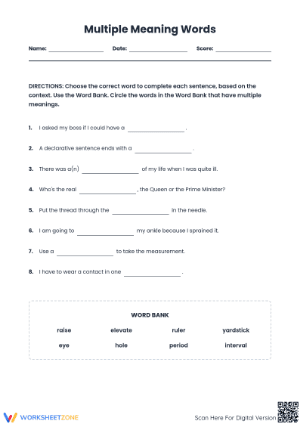
These language and vocabulary printable worksheets for 6th grade give teachers targeted practice across the full range of word study skills students need at this level—context clues, morphology, figurative language, word relationships, and sentence revision. The set is built around the reality that sixth graders face dense academic text in ELA, science, and social studies simultaneously, and they need flexible strategies, not just a longer word list.
What's Inside the Set
Sixth grade is the year students are expected to combine three distinct meaning strategies: using surrounding context, analyzing word parts, and consulting reference materials. Each worksheet targets one of those strategies with enough depth to reveal whether students are actually reasoning or just pattern-matching. The skills covered across the set include:
- Inferring word meaning from context clues embedded in short paragraphs—with tasks that require students to underline the specific evidence they used
- Analyzing Greek and Latin roots, prefixes, and suffixes to predict meaning before checking a definition
- Using a dictionary or glossary to select the appropriate sense for a given sentence, not copy the first definition listed
- Distinguishing synonyms by shade of meaning (irritated, furious, livid) rather than treating related words as interchangeable
- Interpreting figurative language in context, connecting word choice to author tone and meaning
- Revising flat or repetitive sentences for precision and clarity
- Working with multiple-meaning words in short passages where context shifts the intended sense
The revision tasks carry more instructional weight than they might appear to. Students who can define concise or vivid on a list will still write sentences that are padded or vague. Asking them to rewrite—not just identify an error—surfaces that disconnect and gives teachers something concrete to address in the next lesson.
Student Errors to Anticipate and Address
The most consistent error at this grade level is knowing a word in isolation and losing track of its meaning mid-passage. A student who correctly defines ambiguous on a vocabulary list will sometimes misread it in a paragraph where two competing meanings are possible. That gap shows up most with academic vocabulary and multiple-meaning words—terms students encounter regularly in content-area reading but haven't yet internalized as active meaning-making tools.
Two other patterns are worth watching for. First, students treat context clues as confirmation rather than evidence. They form a guess based on topic familiarity, find a phrase nearby that seems to support it, and stop there—without reading closely enough to see whether the clue actually does the work they think it does. Worksheets that require students to quote or underline the specific words that informed their thinking make this habit visible before it carries into standardized reading assessments. Second, students conflate near-synonyms. They understand that sad and devastated are related but treat them as equivalent choices. Shade-of-meaning tasks—where students rank or sort words along a scale instead of simply matching them—make the distinction concrete in a way that teacher explanation alone rarely achieves.
Building These Worksheets Into Your Lesson Plans
The most reliable approach is a short daily routine rather than a concentrated weekly review block. Five to eight minutes at the start of a reading period is enough for one focused worksheet, and that positioning works well—students are transitioning into academic thinking, and a morphology or context clues task brings attention to language just before the day's text arrives. When language and vocabulary printable worksheets for 6th grade are placed at the front of instruction rather than appended to the end of it, students carry that word awareness into their reading instead of treating vocabulary practice as a separate event.
- Bell-ringers: rotate across skill areas through the week—context clues Monday, roots Tuesday, figurative language Wednesday, sentence revision Thursday
- Small-group reteach: pull a targeted worksheet when assessment data shows a specific gap in a group of four to six students, rather than re-teaching the same concept to the whole class
- Partner center work: synonym and figurative language tasks work especially well when students talk through their reasoning aloud before committing to an answer in writing
- Exit tickets: use the final two items on a revision worksheet to check who understood a word choice mini-lesson before dismissal
- Homework: send one targeted worksheet home when a student needs extra repetition on a specific skill—not a full set, just the one that matches the identified gap
Implementation also improves when teachers resist assigning too much at once. One tightly focused worksheet reviewed the next morning does more for retention than a longer set completed and filed. If the goal is transfer, follow any printable with a brief discussion prompt or two-sentence writing task so students use the same skill in a different mode before the lesson closes.
Standard Alignment
The set addresses three Grade 6 Language Standards under the Common Core State Standards. L.6.4 covers determining word meaning using context clues, word parts, and reference materials. L.6.5 addresses figurative language, word relationships, and shades of meaning. L.6.6 targets acquisition and use of grade-appropriate general academic and domain-specific vocabulary. In classroom terms, these standards belong inside reading and writing instruction—not in a separate vocabulary period bolted onto the end of the day. The language and vocabulary printable worksheets for 6th grade in this set are built around those three standards, so teachers can connect each worksheet directly to a lesson objective without digging through documentation to establish fit.
Adjusting the Worksheets for a Range of Learners
Students reading significantly below grade level often struggle most with paragraph-length context clue passages. The surrounding text is dense enough that meaning-making breaks down before they can locate a clue. For those students, working through each worksheet's sentence-level examples before moving to the passage questions gives them a foothold. Limiting the number of figurative language items on a given worksheet—replacing the more layered examples with direct, literal-language versions of the same structure—keeps the format familiar while reducing the linguistic load enough to make the task productive rather than frustrating.
For students who move through the material quickly, the sentence revision worksheets offer the most room to push further. Ask them to revise the same sentence twice—once for formal academic tone and once for conversational tone—then write one sentence explaining what changed and why. That metalinguistic task is genuinely demanding at sixth grade. It also surfaces whether a student's vocabulary knowledge is flexible or just memorized, which is exactly what strong word study instruction tries to develop.
Frequently Asked Questions
What skills should these worksheets cover at sixth grade?
The core areas are context clues, morphology (Greek and Latin roots, prefixes, suffixes), reference material use, word relationships and shades of meaning, figurative language, multiple-meaning words, and sentence revision. A useful set balances vocabulary knowledge with practical language application—students should not only know what a word means but be able to use it accurately in their own sentences and recognize it when it appears in unfamiliar text.
How can teachers use these without turning vocabulary into a disconnected drill block?
Connect each worksheet to the text students are reading that day or week. A context clues task works best when the passage topic connects to something students are already discussing. A revision task works best when students apply the same thinking to a sentence from their own writing draft. The printable introduces the skill; the reading or writing task that follows makes that skill meaningful and transferable.
Are these appropriate for intervention groups and homework?
Yes, and the same worksheet often works in both settings. In an intervention group, the teacher can pause mid-worksheet to ask students to explain their reasoning aloud—which reveals misunderstandings that a completed answer choice won't show. For homework, the format is predictable enough that students can work independently without needing directions explained again. Teachers evaluating language and vocabulary printable worksheets for 6th grade for intervention use should check whether each task requires students to explain their thinking, not just select an answer, because that distinction determines whether the worksheet surfaces the actual gap or just records a correct mark.
How do these worksheets support grade 6 language standards without becoming rote grammar exercises?
The connection stays strong when worksheets place grammar and vocabulary inside real sentence and passage contexts rather than in isolated fill-in-the-blank formats. A sentence revision task that asks students to replace a vague word with a more precise one connects directly to both L.6.6 and the writing standards. Practice becomes rote when students complete it mechanically—the strongest tasks require judgment, not just recall, so there is always something worth discussing when the class reviews answers together.















 Interactive Worksheet Maker
 Quiz Maker
 Word Search Maker
 Crossword Puzzle Maker
 Word Scramble Generator
 Sentence Scramble Generator
 Handwriting Worksheet Generator
 Name Tracing Generator
 Fill In The Blank Generator