


























0
Views
0
Downloads

0.0
0
Save
0 Likes
Share
Non-Renewable Energy Resources Worksheet
0 Views
0 Downloads
Paste this activity's link or code into your existing LMS (Google Classroom, Canvas, Teams, Schoology, Moodle, etc.).
Students can open and work on the activity right away, with no student login required.
You'll still be able to track student progress and results from your teacher account.
Information
Description
What It Is:
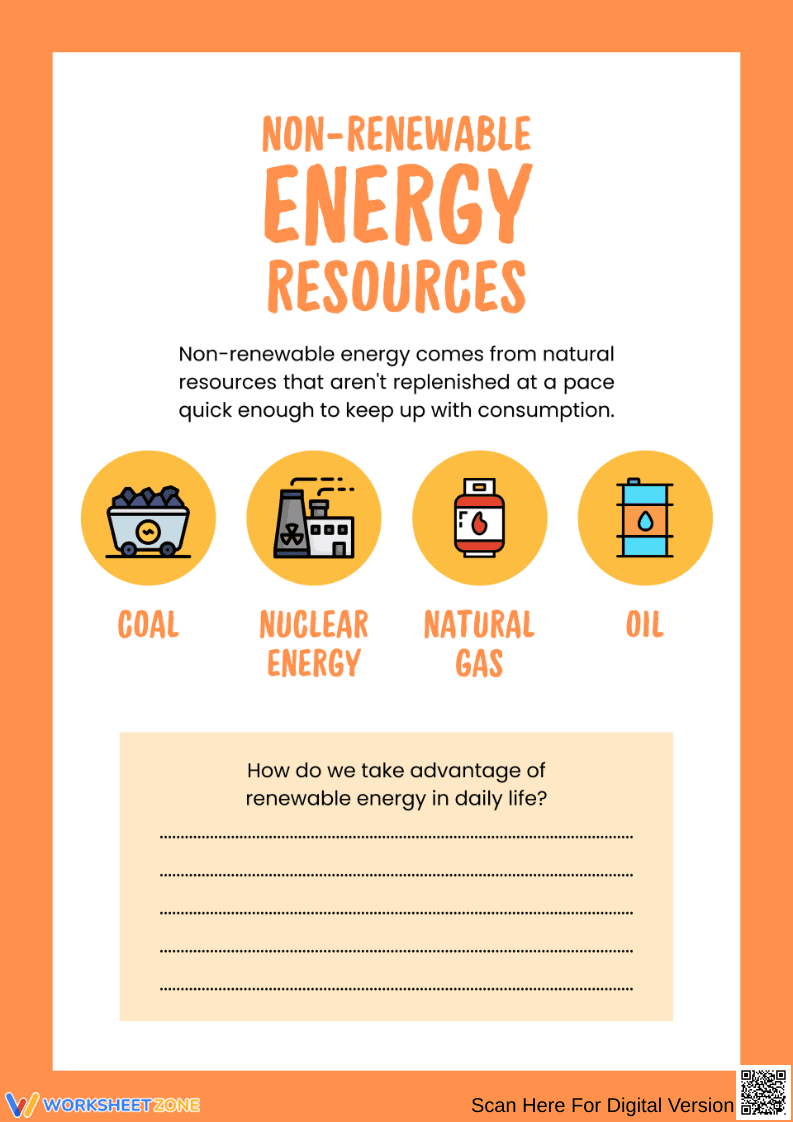
A printable science worksheet introducing major non-renewable energy resources, including coal, nuclear energy, natural gas, and oil. Students review what makes an energy source non-renewable and respond to a prompt about using renewable energy in daily life.
Why Use It:
This worksheet helps students build foundational understanding of energy systems and resource limitations. It encourages critical thinking about sustainability, environmental impact, and why society depends on certain fuels despite long-term challenges.
How to Use It:
• Use as part of an energy, Earth science, or environmental science unit.
• Introduce key non-renewable resource types and their characteristics.
• Have students respond to the writing prompt to connect knowledge to real-world energy choices.
• Extend for high school by requiring comparisons between renewable and non-renewable energy or by analyzing global consumption trends.
Grade Suitability:
Best suited for Grades 5–10.
• Middle school students can use it to understand energy categories and definitions.
• High school students can use it as a warm-up, review, or introduction to deeper environmental science topics.
Target Users:
Teachers, tutors, homeschool parents, and students studying energy resources, sustainability, and environmental impact.
A printable science worksheet introducing major non-renewable energy resources, including coal, nuclear energy, natural gas, and oil. Students review what makes an energy source non-renewable and respond to a prompt about using renewable energy in daily life.
Why Use It:
This worksheet helps students build foundational understanding of energy systems and resource limitations. It encourages critical thinking about sustainability, environmental impact, and why society depends on certain fuels despite long-term challenges.
How to Use It:
• Use as part of an energy, Earth science, or environmental science unit.
• Introduce key non-renewable resource types and their characteristics.
• Have students respond to the writing prompt to connect knowledge to real-world energy choices.
• Extend for high school by requiring comparisons between renewable and non-renewable energy or by analyzing global consumption trends.
Grade Suitability:
Best suited for Grades 5–10.
• Middle school students can use it to understand energy categories and definitions.
• High school students can use it as a warm-up, review, or introduction to deeper environmental science topics.
Target Users:
Teachers, tutors, homeschool parents, and students studying energy resources, sustainability, and environmental impact.


