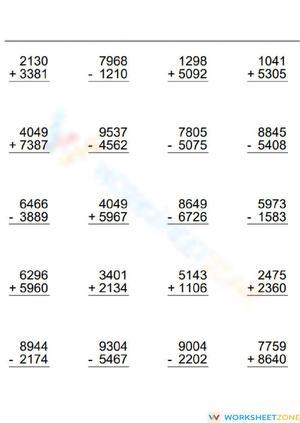
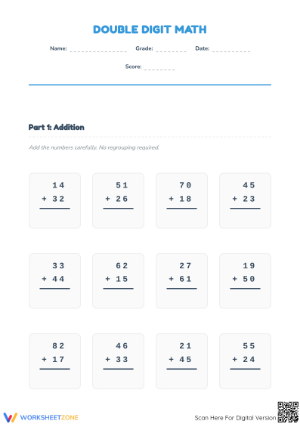
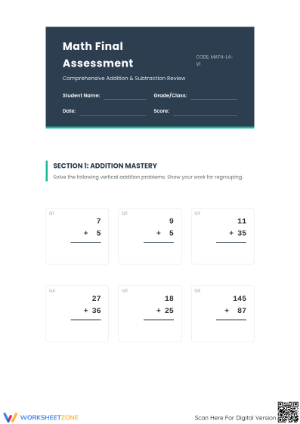
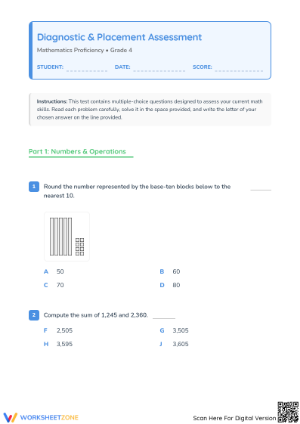
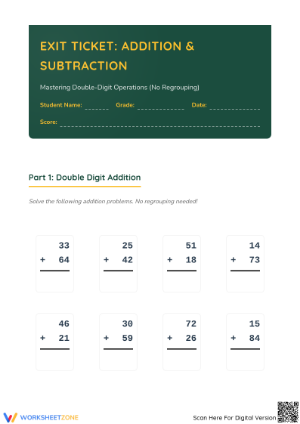
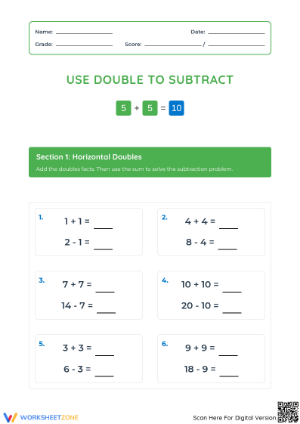
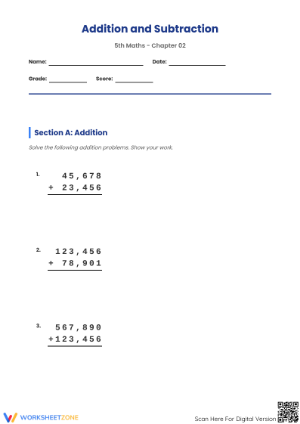
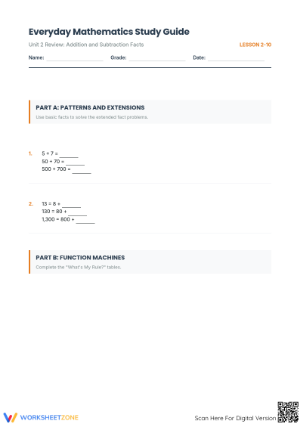
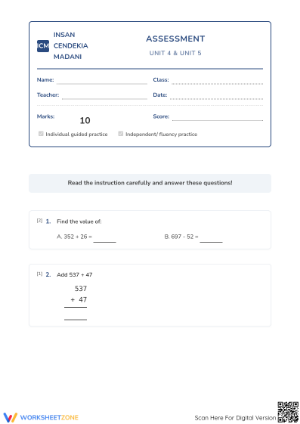
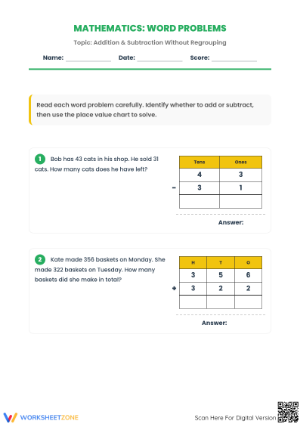
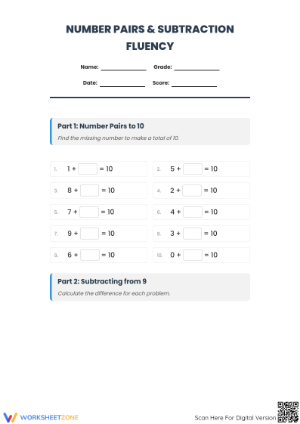
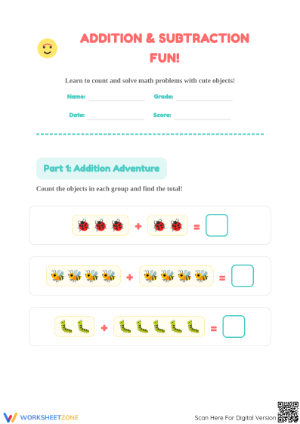
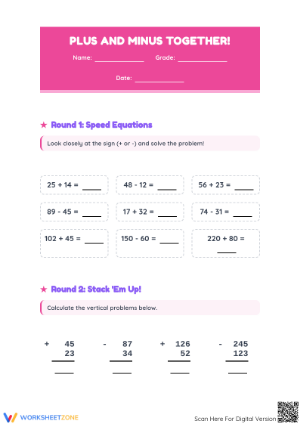
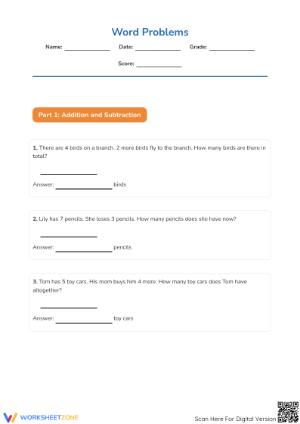
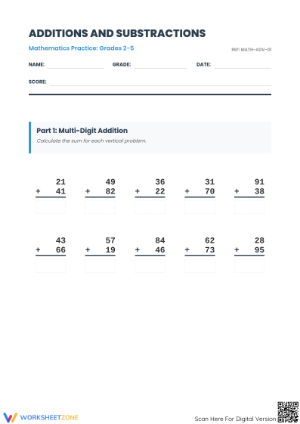
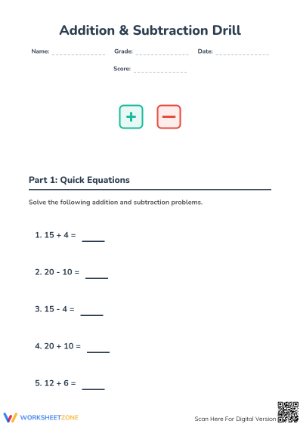
These addition subtraction worksheets for 5th grade keep each number type in its own worksheet — whole numbers, decimals, and fractions handled separately — so the error patterns from a class set are readable rather than tangled. Fifth grade is the year the operation stays familiar while the number representations multiply, and practice materials that separate those representations early make it easier to see where a student's accuracy holds and where it breaks.
What Each Worksheet in the Set Targets
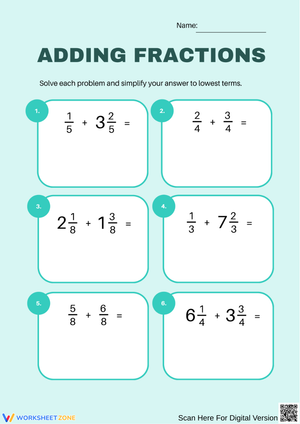
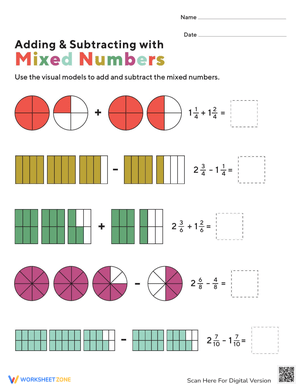
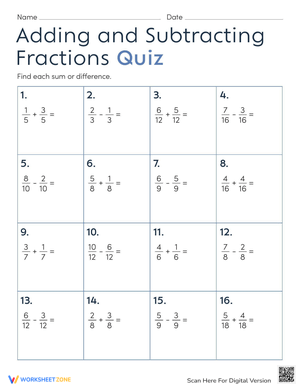
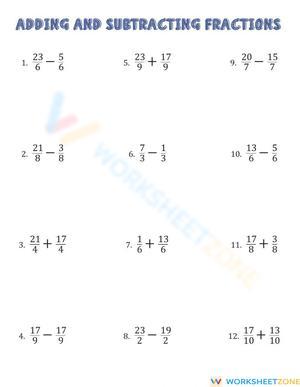
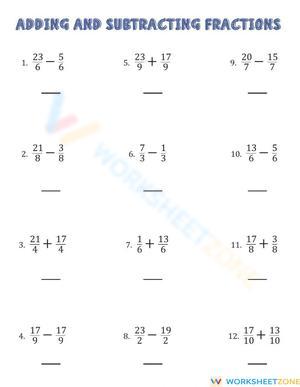
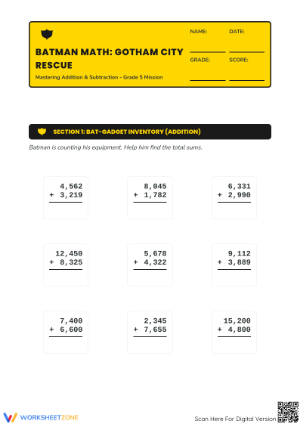
The whole-number worksheets push into five- and six-digit problems that require regrouping across multiple columns. By 5th grade most students have encountered this territory before, but accuracy with larger numbers still varies, and these worksheets surface that variation quickly. Decimal worksheets address addition and subtraction through the hundredths place, with deliberate inclusion of problems where the two numbers don't share the same number of decimal places — because that structural difference is exactly where errors concentrate. Fraction worksheets cover addition and subtraction with unlike denominators, including word-problem contexts that require students to identify the operation before they compute.
Mixed-review worksheets close the set. They cycle through all three number types, asking students to shift their reasoning as the number representation changes. That decision-making step — reading a problem, recognizing the number type, selecting a strategy — is different from simply repeating a computation, and it's what makes mixed review useful for retention rather than just additional exposure.
Frequent Student Errors Worth Watching For
Decimal subtraction produces the most consistent error pattern in 5th-grade computation work. When students see a problem like 5.4 − 2.67, some align the digits flush right the way they would for whole numbers, treating the rightmost digit as the anchor instead of the decimal point. The answer they generate doesn't immediately read as an alignment problem — it can look like a random miscalculation — but on a focused decimal worksheet where every problem involves unequal decimal places, the same error surfaces again and again, and the cause becomes obvious across the class set.
Fraction errors follow a different logic entirely. A student who handles 3/8 + 1/8 without hesitation may look at 3/4 + 1/3 and add numerators and denominators separately, writing 4/7. That's not a computation failure; it's a conceptual misunderstanding about what a common denominator does. A worksheet that isolates unlike-denominator fraction addition makes that distinction clear because the problem structure demands the correct procedure on every item, leaving no ambiguity about whether the error was procedural or representational.
With whole numbers, the error that still shows up at 5th grade involves regrouping through zeros. In a problem like 40,003 − 17,846, students sometimes borrow from the ten-thousands place correctly and then fail to continue regrouping through the intermediate zeros, leaving a wrong digit in the thousands column. Several problems of that type on a focused whole-number worksheet catch the pattern before it becomes a longer-term gap.
Fitting These Worksheets Into the Instructional Week
The most reliable weekly sequence places targeted practice early and mixed review late. A focused decimal or fraction worksheet used on Monday or Tuesday — after direct instruction and at least one worked example — keeps the cognitive demand on the computation itself rather than splitting attention across multiple number types at once. By Thursday or Friday, students who have shown accuracy on the focused work are ready for a mixed-review worksheet that asks them to choose the correct approach before solving. That shift from "just compute" to "read, decide, then compute" is where retention gets tested.
For morning work, three to four problems pulled from a whole-number worksheet reactivate prior knowledge in the first minutes without requiring the teacher to reteach. For intervention groups, the skill-specific worksheet is the right tool because it keeps the practice narrow enough that a teacher can tell within five or six problems whether the reteach is working. The addition subtraction worksheets for 5th grade structure also makes sub plans more reliable — a substitute can distribute the worksheet labeled "decimals" or "fractions" without needing to understand the full instructional arc, because the label itself carries the job description.
Standard Alignment
The decimal worksheets connect directly to CCSS 5.NBT.B.7, which asks students to add and subtract decimals to hundredths using strategies grounded in place-value understanding and properties of operations. This standard marks the point where whole-number computation is extended — deliberately and explicitly — into the decimal system, which is why teachers need practice that targets the decimal-specific demands rather than treating decimal computation as interchangeable with whole-number work. The fraction worksheets address CCSS 5.NF.A.1, the standard requiring addition and subtraction of fractions with unlike denominators — a conceptual step that 4th-grade standards don't fully reach. Whole-number worksheets support the fluency expectations within the Number and Operations in Base Ten domain, functioning as maintenance practice for a skill that should largely be secured from prior years rather than as new instruction at the 5th-grade level.
Adapting This Set for Different Learner Levels
For students who still have gaps in whole-number computation, beginning with those worksheets and holding off on decimal and fraction work makes more sense than moving the whole class through all three number types simultaneously. In mixed-ability classrooms, this often means running two tracks at once: one group working on multi-digit regrouping while another starts decimal practice. Both groups draw from the same collection, which simplifies preparation considerably without requiring teachers to manage two entirely separate resource sets.
Students who have already secured all three number types benefit from the mixed-review worksheet used as a self-checking activity. One approach that works well in practice: students complete the worksheet, then mark each problem by number type in the margin and look at where their errors concentrate. That gives them a concrete self-assessment without requiring the teacher to run a separate diagnostic session.
One real limitation worth naming: these worksheets address procedural fluency, not conceptual gaps. A student who doesn't understand why decimal alignment works, or what finding a common denominator actually represents, needs instruction with models — number lines, area diagrams, place-value charts — before practice worksheets become productive. The practice works when the concept has already been taught. These resources are not a substitute for that initial instruction; they build on it.
Frequently Asked Questions
What computation skills are covered across the set?
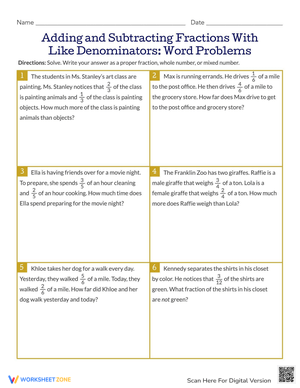
The set covers multi-digit whole-number addition and subtraction with regrouping, decimal addition and subtraction through the hundredths place, and fraction addition and subtraction with unlike denominators. Several fraction worksheets include word-problem contexts, which is consistent with how that skill appears on grade-level assessments and in standardized test formats.
How do skill-specific worksheets differ from a mixed practice packet?
A mixed packet — one that combines number types from the first problem — makes it harder to identify whether errors come from a procedural gap or from confusion about the number type itself. Each addition subtraction worksheets for 5th grade in this set keeps a single number type on one worksheet, which means a student who struggles only on decimal problems can be identified and given targeted reteaching without pulling them off work they've already consolidated.
Can these worksheets function as informal assessments?
Yes, with caveats. A short section from a skill-specific worksheet — four to six problems targeting one number type — gives useful formative data on whether a procedure has been consolidated after instruction. The addition subtraction worksheets for 5th grade format is most accurate for this purpose when students haven't already worked through the exact same numbers during practice, so rotating which worksheet each group receives across sessions helps prevent familiarity from distorting the results.
Are these worksheets useful for students who are behind grade level?
The whole-number worksheets serve 5th graders who still need regrouping practice, and they are also a reasonable starting point for 6th-grade intervention groups revisiting computation fluency early in the year. Decimal and fraction worksheets target content specifically placed at 5th grade in the Common Core progression, so students who are significantly below grade level in those areas typically need additional instruction before worksheet practice is productive on its own.














 Interactive Worksheet Maker
 Quiz Maker
 Word Search Maker
 Crossword Puzzle Maker
 Word Scramble Generator
 Sentence Scramble Generator
 Handwriting Worksheet Generator
 Name Tracing Generator
 Fill In The Blank Generator




 BACK TOSCHOOL