


























Views
Downloads

Printable Mixed Sums Word Problem Worksheet | Grade 3 Math
Paste this activity's link or code into your existing LMS (Google Classroom, Canvas, Teams, Schoology, Moodle, etc.).
Students can open and work on the activity right away, with no student login required.
You'll still be able to track student progress and results from your teacher account.
Mastering mental math requires students to move beyond numerical symbols and interact directly with the language of mathematics. This mixed sums worksheet focuses on addition and subtraction using number words, challenging learners to visualize and solve 20 distinct problems. By translating word forms into mathematical operations, students build deep operational fluency and stronger number sense.
At a Glance
- Grade: 3 · Subject: Math
- Standard:
CCSS.MATH.CONTENT.3.NBT.A.2— Fluently add and subtract within 1000 using place value strategies- Skill Focus: Mental addition and subtraction with number words
- Format: 3 pages · 20 problems · Answer key included · PDF
- Best For: Mental math fluency and word recognition
- Time: 15–20 minutes
What's Inside
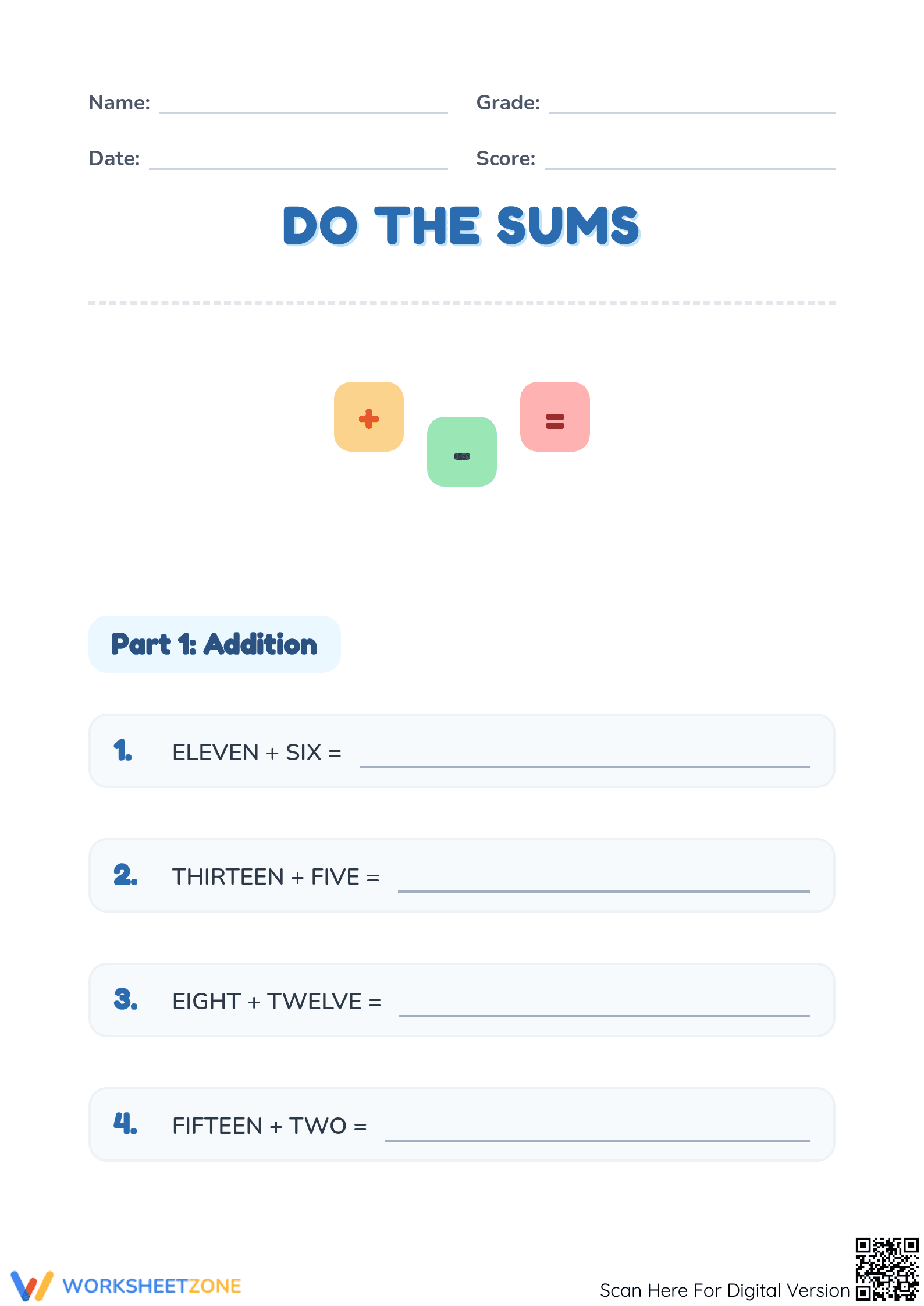
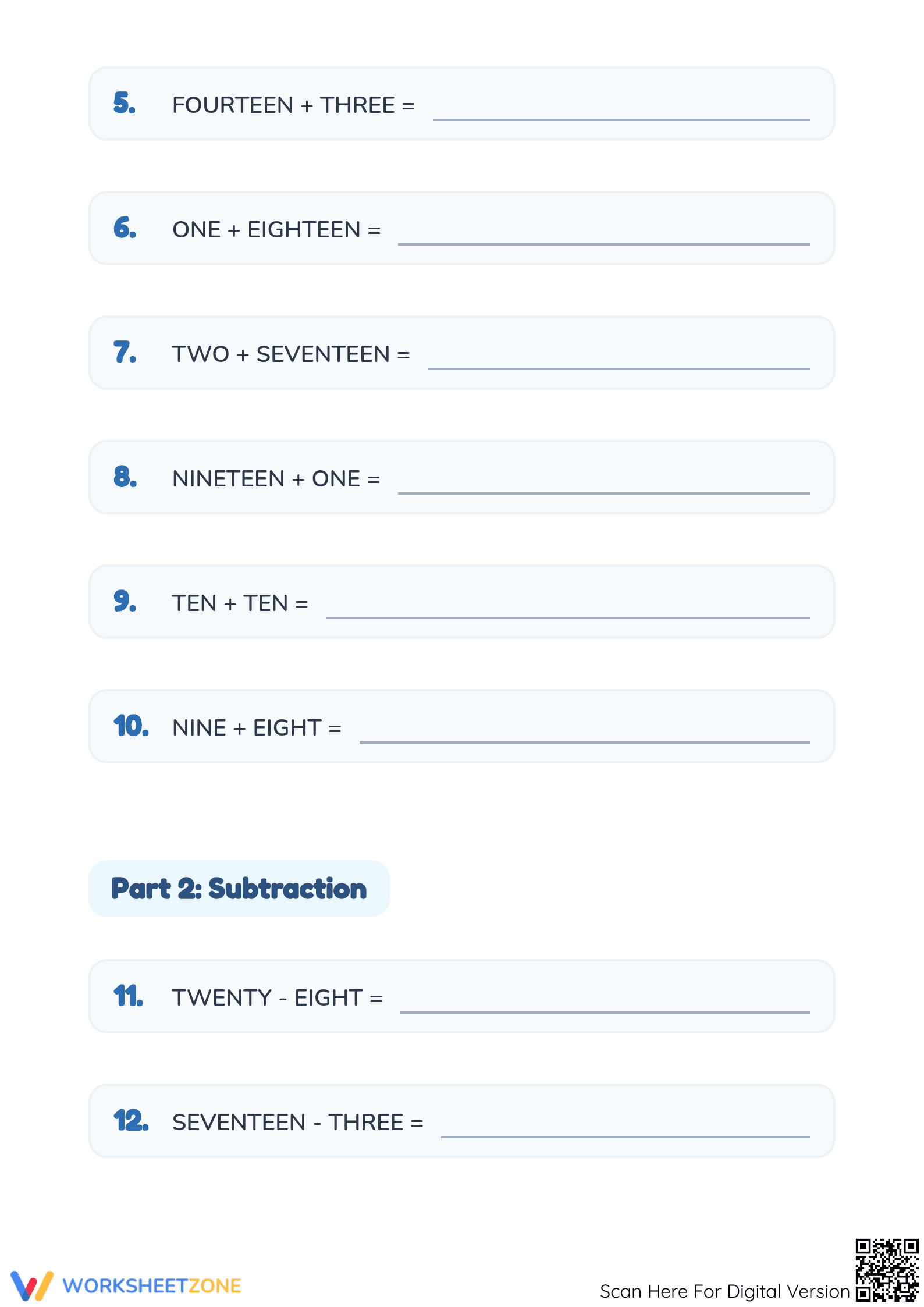
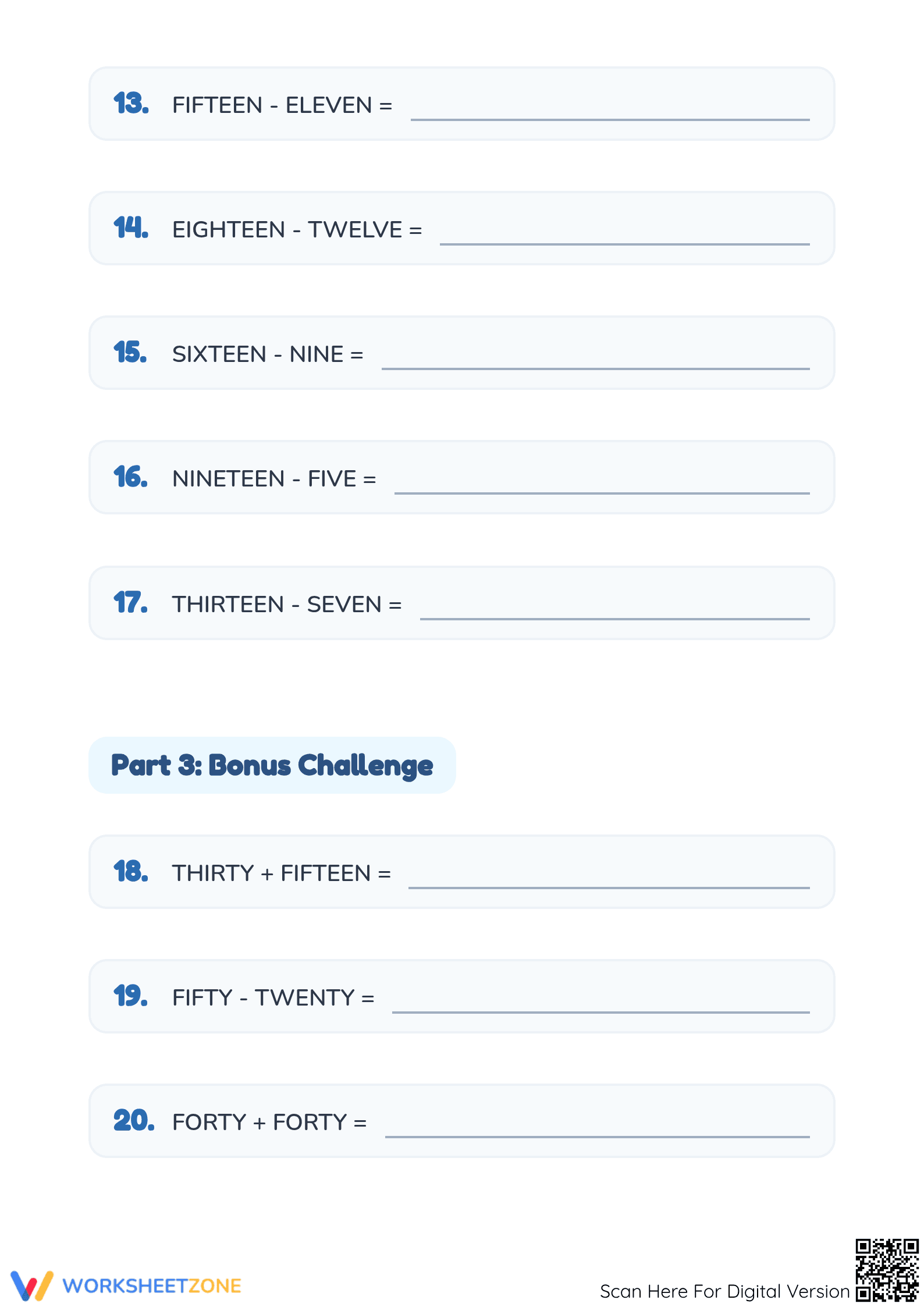
This comprehensive 3-page PDF features 20 tasks divided into three logical segments: Addition, Subtraction, and a Bonus Challenge. The worksheet utilizes large, clear typography for number words, such as 'FIFTEEN - NINE,' providing ample space for students to write their solutions. A full answer key is provided for immediate grading or student self-correction.
Skill Progression
- Guided Practice: The first section presents 10 addition problems using familiar number words within 20, allowing students to establish a baseline for verbal-to-numerical translation.
- Supported Practice: Part 2 introduces 7 subtraction tasks, shifting the cognitive load to inverse operations while maintaining the word-form format to ensure consistency.
- Independent Practice: The Bonus Challenge provides 3 problems with larger values like 'FORTY + FORTY,' testing the limits of mental calculation and multi-digit word recognition.
Standards Alignment
The primary standard addressed is CCSS.MATH.CONTENT.3.NBT.A.2, which requires students to fluently add and subtract within 1000 using strategies and algorithms based on place value or properties of operations. It also supports reading and writing number names. Both standard codes can be copied directly into lesson plans, IEP goals, or district curriculum mapping tools.
How to Use It
Utilize this worksheet as a warm-up activity during a math block to prime students for word problems, or assign it as a targeted homework task to reinforce mental math strategies. For formative assessment, observe if students use finger counting or if they can mentally translate words to digits instantly. Completion typically takes 15 to 20 minutes depending on proficiency.
Who It's For
This resource is ideal for Grade 3 and Grade 4 students who are transitioning from concrete to abstract representations of numbers. It provides excellent differentiation for English Language Learners who need practice with English number names. Pair this with a number word anchor chart or a reading passage involving data for a cross-curricular instructional approach.
The integration of literacy and mathematics is a cornerstone of modern educational research, particularly in the development of operational fluency. According to Fisher & Frey (2014), bridging the gap between numerical symbols and language helps students internalize mathematical concepts more deeply than rote calculation alone. This Grade 3 worksheet, aligned to CCSS.MATH.CONTENT.3.NBT.A.2, directly addresses this by requiring students to translate number words into mental operations. By processing terms like 'THIRTEEN + FIVE' without immediate digits, learners strengthen their internal number line and cognitive flexibility. Research from NAEP suggests that students who can fluidly switch between representations of numbers show higher proficiency in multi-step problem solving. This resource provides 20 structured tasks that scaffold from basic addition to complex mixed operations. It serves as an essential tool for teachers looking to verify that students have mastered both reading number names and executing accurate sums and differences across various instructional contexts.


