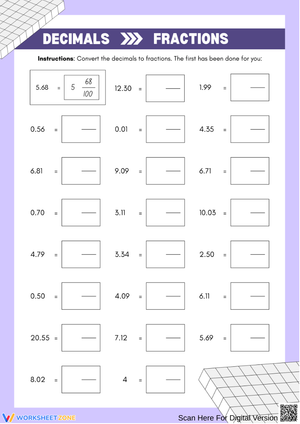
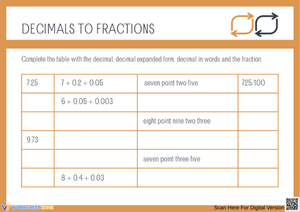
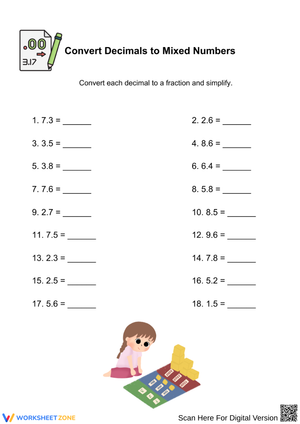
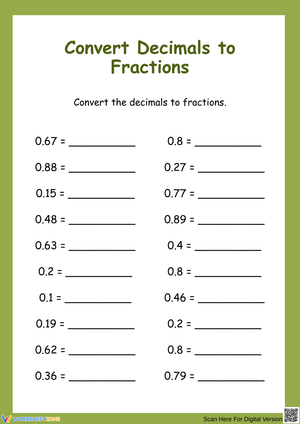
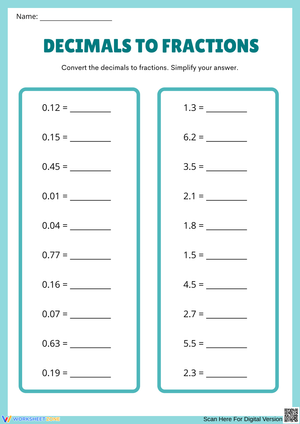
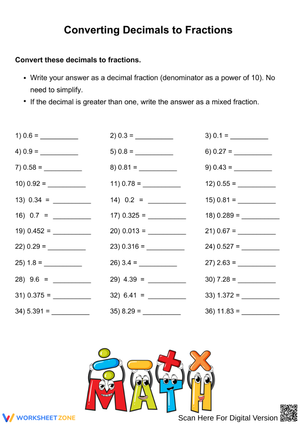
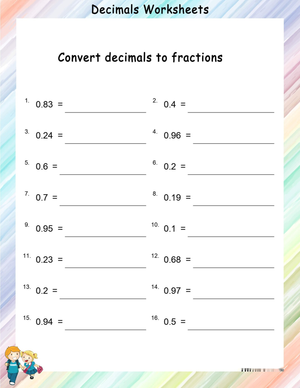
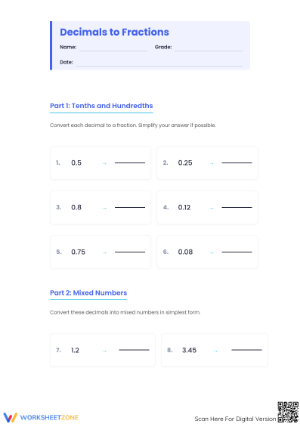
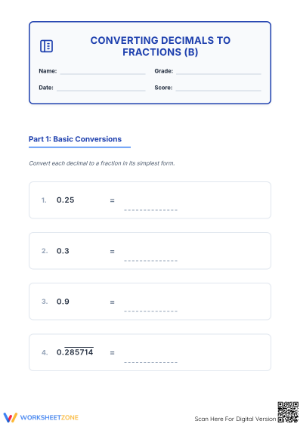
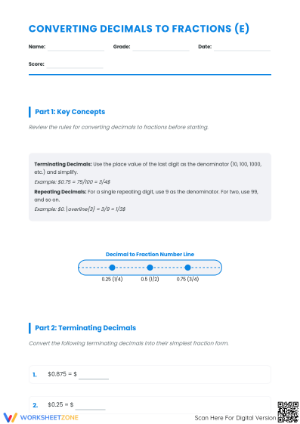
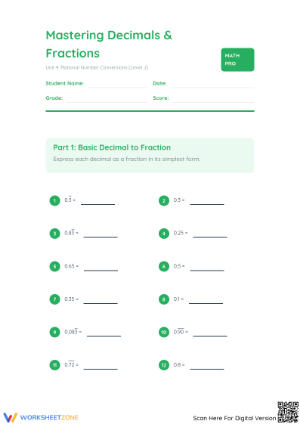
These converting decimals to fractions printable worksheets for 5th grade give teachers a focused set of practice resources that move students from reading decimal place value to writing equivalent fraction notation—and then to simplifying those fractions when a common factor exists. The set works because each worksheet keeps the reasoning visible, not just the answer format.
The Specific Skills Each Worksheet Builds
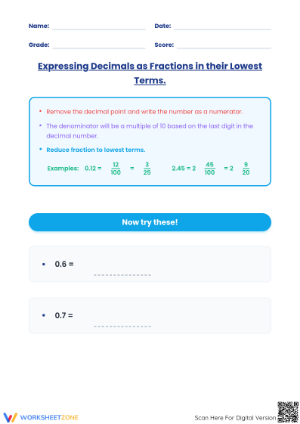
The progression runs in deliberate steps: tenths first, hundredths second, simplification third, written reasoning fourth. That order matters. When students convert 0.4 to 4/10, they lean on place-value language they already have, so the first step feels like naming a value rather than memorizing a procedure. Moving to hundredths such as 0.36 or 0.08 adds a layer—students must now distinguish between the tenths and hundredths columns before they can choose the correct denominator. Simplification comes after, once the fraction form itself is solid.
Each worksheet addresses one or more of these targets:
- Read a decimal to tenths and write the equivalent fraction with denominator 10.
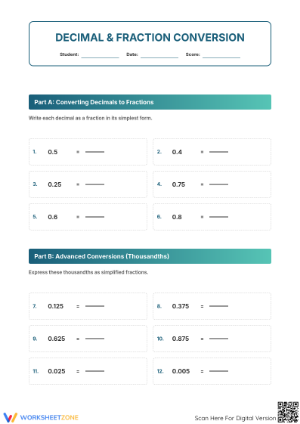
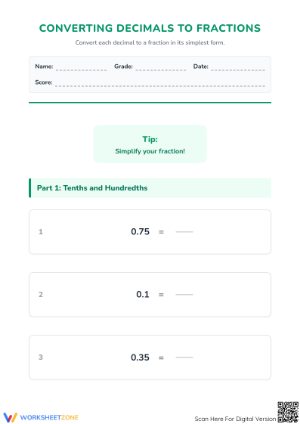
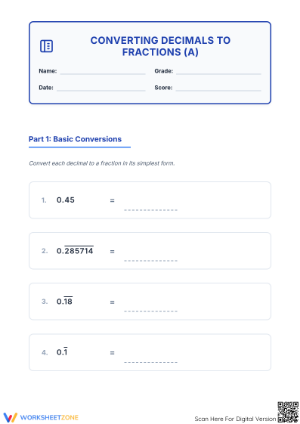
- Read a decimal to hundredths and write the equivalent fraction with denominator 100.
- Simplify fractions such as 20/100, 50/100, or 75/100 by identifying the greatest common factor.
- Match a decimal to a labeled grid or number-line model.
- Write a brief explanation of why the decimal and fraction name the same quantity.
The explanation task is not decorative. When a student writes "0.6 equals 6/10 because there are 6 tenths," the teacher learns whether the student understands the structure or is copying a surface pattern without knowing why it holds. That distinction matters heading into fraction equivalence work in the second half of fifth grade.
Mistakes Students Make That These Worksheets Help You Catch
The error that shows up most consistently is a denominator mismatch for decimals in the hundredths place. A student reads 0.08 correctly as "eight hundredths" but writes the fraction as 8/10 instead of 8/100. The decimal reading was right; the place-value translation broke. Students lose track of which column they are in, especially when a zero holds the tenths place and the significant digit sits one column further right. These worksheets surface that error quickly because several items are built around exactly that structure—0.03, 0.07, 0.09—so teachers see the pattern across a full set of student work rather than catching isolated mistakes one paper at a time.
A second error is more subtle: students who write 50/100 correctly and then simplify it to 5/10 rather than 1/2. They divided by 10 instead of finding the greatest common factor, so the fraction is still reducible and they stopped too early. Benchmark fraction fluency—knowing that 50 out of 100 is simply one half—resolves this faster than a formal algorithm, and teachers can use that conversation during small-group review with these resources as the discussion anchor.
A third pattern appears in the written explanation items: students write "I moved the decimal point" instead of naming the place value. That language signals a procedural shortcut with no underlying concept, and it tends to collapse when the same student encounters thousandths or mixed numbers later in the year. Catching it here costs less than reteaching it in a different context.
Building These Worksheets Into Your Weekly Lesson Plan
The most practical routine is a five-day cycle where each day targets one layer of the skill. Monday's worksheet stays in tenths with direct model support—students shade a ten-strip, then write the corresponding fraction. Tuesday moves to hundredths without the visual, so students rely on place-value language alone. Wednesday adds simplification. Thursday uses a partner format: one student reads the decimal aloud, the other writes and simplifies the fraction, then they switch roles. Friday's exit worksheet is a half-sheet—six to eight mixed items—so the teacher can scan every paper in the last four minutes of class and leave with a clear picture of where students are before the weekend.
For centers, a two-station setup works efficiently. One station handles basic tenths-and-hundredths conversion. The other gives students a completed conversion and asks whether the fraction is fully simplified, and if not, to correct it—that station catches the 50/100 = 5/10 gap without requiring a separate lesson. Teachers who integrate converting decimals to fractions printable worksheets for 5th grade into their rotation this way report fewer students needing reteaching before the unit assessment, because the daily cycle gives them multiple chances to catch and correct errors before they become fixed habits.
Standard Alignment
CCSS 5.NBT.A.3b requires students to read and write decimals to thousandths using base-ten numerals, number names, and expanded form, and to compare decimal values using inequality reasoning. The decimal-to-fraction connection these worksheets practice sits directly within that standard—students read the decimal, name its place value, and represent the same quantity as a fraction. The standard also underpins later work in the 5.NF cluster and prepares students for ratio and proportion reasoning in sixth grade.
CCSS 4.NF.C.6 establishes the foundational idea that decimal notation is another way to write fractions with denominators of 10 or 100. Teachers who see students struggling with the conversion step can treat that prior standard as a diagnostic: if a student cannot connect 0.5 to 5/10 at all, the gap predates fifth grade, and a short review of fourth-grade fraction-decimal equivalence helps more than additional fifth-grade conversion practice alone.
Adjusting the Set for a Range of Learners
Students who need additional support with place value work best starting with converting decimals to fractions printable worksheets for 5th grade that stay within tenths only. Those worksheets include fewer problems, more white space, and a visual reference—a labeled number line or place-value chart—built into the header. The reduced item count gives students time to read each decimal aloud, name the place, and write the fraction deliberately before moving forward. Rushing that sequence is where most errors begin for this group.
Mid-level worksheets bring in hundredths and require simplification to lowest terms. Students at this level usually understand the conversion step but need repeated work on the simplification check. The most useful format pairs each fraction with a short written prompt: "Can this fraction be simplified? If yes, show the step." That prompt prevents students from skipping the final check and gives teachers a quick way to identify who is stopping at 5/10 when 1/2 is correct.
For students who convert and simplify fluently, the strongest challenge items are error-analysis prompts. A student sees a completed conversion—say, 0.36 converted to 36/100, then incorrectly simplified to 18/5—and must identify and correct the mistake. That task requires understanding what went wrong conceptually, which is a different cognitive demand than producing a correct answer from scratch. It also transfers directly to the kind of reasoning asked for in fifth-grade performance tasks.
Frequently Asked Questions
Is this a fifth-grade skill, or should students already know it from fourth grade?
The foundational connection between decimals and fractions appears in fourth grade under 4.NF.C.6, but fifth grade is where students are expected to apply and extend that understanding—adding simplification, equivalence reasoning, and comparison. These worksheets assume basic decimal reading is in place and build toward the reasoning work that is fully fifth-grade standard.
What decimal range do these worksheets cover?
The set works with tenths and hundredths. Thousandths conversions introduce a level of complexity that benefits from separate practice materials once students are fluent with the first two place values. Teachers can use converting decimals to fractions printable worksheets for 5th grade focused on tenths and hundredths through mid-year, then move to thousandths after fraction equivalence is solid.
How many problems should an exit-ticket worksheet include?
Six to eight items works for a four-to-five-minute check. Three or four basic conversion problems plus two that require simplification gives the teacher a fast read on where each student stands without turning the last minutes of class into a timed test. The simplification items carry the most diagnostic weight—they reveal whether a student understands equivalence or is just following a memorized sequence.
Can these be used with students who have not yet learned the greatest common factor algorithm?
Yes. Simplification using benchmark fractions—knowing that 1/2, 1/4, 3/4, and 1/5 are common reduced forms for hundredths—works well before students have a formal GCF procedure. Teachers can frame it as "find an equivalent fraction you already recognize" rather than "divide both terms by the GCF," and most students handle that approach without confusion. The algorithm layer can be added once benchmark fluency is steady.














 Interactive Worksheet Maker
 Quiz Maker
 Word Search Maker
 Crossword Puzzle Maker
 Word Scramble Generator
 Sentence Scramble Generator
 Handwriting Worksheet Generator
 Name Tracing Generator
 Fill In The Blank Generator




 BACK TOSCHOOL