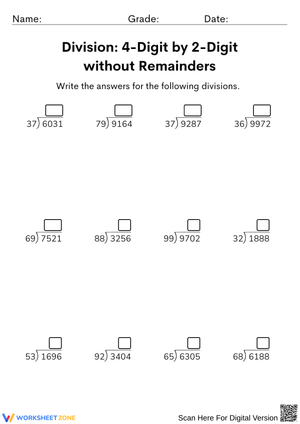
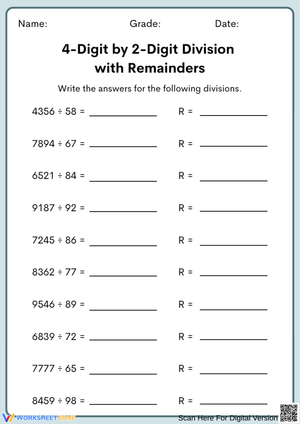
Printable 5th Grade Long Division Practice for 4-Digit by 2-Digit Problems
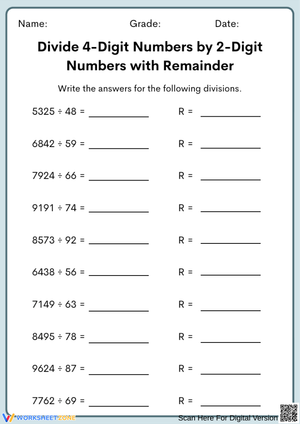
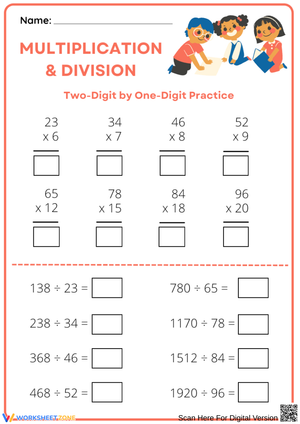
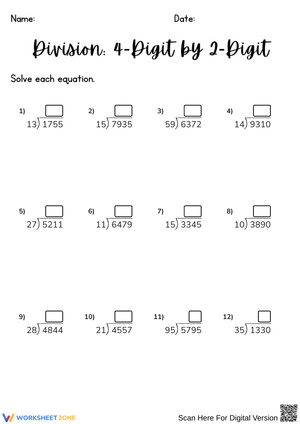
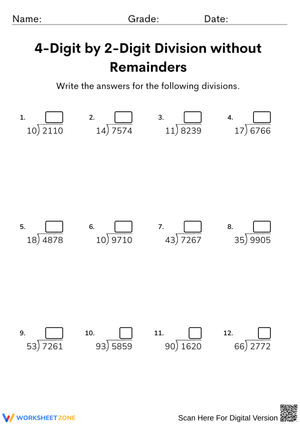
Teachers who download a 5th grade 4 by 2 worksheets are usually past the introduction stage — they need students to rehearse the full long division algorithm accurately and repeatedly. Each worksheet in this set narrows to one problem type: 4-digit dividends, 2-digit divisors, with a mix of exact quotients and remainder problems. That focus produces cleaner practice data than a broad mixed-operations review.
What These Worksheets Ask Students to Do
Long division with these numbers asks Grade 5 students to coordinate four mental moves at once: estimating how many times the divisor fits into the leading digits of the dividend, executing that multiplication, subtracting accurately, and then bringing down the next digit without losing their place. When the dividend has four digits, students repeat that cycle two or three times before arriving at a quotient — which is exactly where errors compound on each other.
- Estimating the partial quotient: Students decide how many groups of a 2-digit divisor fit into the first two or three digits of the dividend, a step that requires number sense, not just procedure.
- Multiplication at each step: Each estimated digit gets multiplied by the full divisor and written directly below the relevant portion of the dividend.
- Subtraction: An arithmetic slip here corrupts every step that follows. The algorithm is unforgiving at this point.
- Bringing down the next digit: This looks straightforward but breaks down regularly when students lose their visual position in the problem.
- Remainder handling: Students identify whether the final value is zero or a value less than the divisor, and record it correctly either way.
Because the problems recur in the same structural format across each worksheet, students build procedural fluency through repetition rather than through variety. A 5th grade 4 by 2 worksheets set used over two or three consecutive class days produces more durable accuracy than a single packet introduced the night before a quiz.
Mistakes Students Make That Teachers Should Watch For
The most common failure point isn't estimation — it's the subtraction that follows. A student who correctly estimates 3, multiplies 3 × 24 = 72, and subtracts from 85 will still write 23 instead of 13 under time pressure. That one-digit slip knocks every subsequent digit in the quotient out of position, and students without strong number sense won't recognize that the final answer is unreasonable.
A second consistent error: bringing down two digits instead of one. This happens when students lose their visual position in the dividend — often because the workspace is tight or because they're moving too fast. It's worth distinguishing this mistake from conceptual confusion. A student who brings down two digits has usually lost the visual thread of the layout, not the underlying logic. A margin model pointing exactly to where the arrow should land resolves it faster than a full reteach lesson.
The third error is quieter but consequential. When the divisor doesn't fit into a partial dividend at all, students must record a 0 in the quotient before bringing down the next digit. Many skip that zero, which shifts the entire quotient one position to the left and produces answers off by a factor of 10. Students rarely notice because they aren't checking quotients for reasonableness — that metacognitive habit takes deliberate instruction to build.
Getting These Worksheets Into Regular Classroom Routines
Each worksheet fits naturally into the 8–12 minutes before a transition — long enough to complete three or four problems carefully, short enough not to consume the whole math block. In the days following an initial division lesson, a single worksheet used as a warm-up gives teachers a fast read on which students have internalized the algorithm and which ones stall after the first subtraction step.
For small-group reteach, the same worksheet becomes a different tool. Instead of having students work independently through every problem, ask them to narrate each move aloud: estimate, multiply, subtract, bring down. Students who understand the algorithm in theory but lose their place in execution almost always self-correct when they hear themselves describe what they're doing. That verbal practice layer costs nothing — it just requires slowing the group down.
The printable format also holds up for spiral review. Long division accuracy tends to drop off if students don't revisit it for a few weeks. Returning to a single worksheet from this set during a Friday review block — even just three or four problems — keeps the skill active without displacing new content from the week.
Standard Alignment
These worksheets align directly to CCSS 5.NBT.B.6, which asks Grade 5 students to find whole-number quotients with up to 4-digit dividends and 2-digit divisors using strategies grounded in place value, properties of operations, and the relationship between multiplication and division. The 4-by-2 format isn't arbitrary — it reflects the exact numerical scope that standard specifies, which means teachers using these worksheets for formative checks or intervention planning are already working inside the standard's boundaries rather than approximating them.
In classroom terms, 5.NBT.B.6 typically receives focused attention mid-to-late in the Grade 5 number operations sequence, after students have developed fluency with multi-digit multiplication and earlier division work. Placing these practice materials in that instructional window — rather than front-loading them — gives students the multiplication recall they need to estimate and self-check accurately.
Adjusting These Worksheets for Different Student Readiness Levels
For students still building confidence with the algorithm, start with problems where the divisor connects to familiar multiplication facts — dividing by 24 when students know their fours and sixes keeps the estimation load manageable and lets attention stay on executing the procedure. A 5th grade 4 by 2 worksheets set that spans a range of divisors gives teachers room to assign problems selectively rather than handing the full worksheet to every student.
Students who move through the algorithm accurately but mechanically benefit from problems with less comfortable divisors — numbers like 37 or 53 that push them to round, estimate, and sometimes revise their first quotient digit. Those revision moments are where genuine understanding shows. A student who re-estimates without frustration has internalized the algorithm in a durable way; a student who erases and guesses again is still working on number sense.
In intervention settings, fewer problems with richer discussion almost always outperform a long worksheet completed in silence. Six carefully chosen problems — two straightforward, two mid-range, two with zero-quotient digits — give a teacher enough evidence to target reteaching without exhausting a student who already finds multi-step computation demanding.
Frequently Asked Questions
Do these worksheets include answer keys?
Answer keys matter more in long division practice than in many other topics because computation errors compound — a wrong answer at step one produces a wrong final quotient that can still look plausible at a glance. A reliable key helps teachers quickly identify whether students are making estimation errors, multiplication errors, or subtraction errors, rather than simply marking the final answer wrong and moving on.
What's the difference between exact-quotient problems and remainder problems in this set?
Exact-quotient problems help students concentrate on executing the algorithm cleanly without an extra decision at the end. Remainder problems confirm that students understand the process all the way through — many students stop after the final subtraction and forget to record or interpret what's left. A mix of both across each worksheet gives a clearer picture of actual mastery than either type alone.
How many problems should I assign at once?
It depends on the instructional goal. For warm-ups or exit checks, two to four problems are enough to see whether the algorithm is holding. For independent practice, a full worksheet gives students enough repetition to build fluency. For reteach, three to six problems with verbal narration produces more useful evidence than a longer worksheet completed in silence.
Can these worksheets be used for intervention, not just whole-class practice?
The printable format works especially well in small-group intervention because the teacher can annotate directly on the worksheet — circling the step where a student lost the quotient, writing a guiding question in the margin, or modeling the first problem before releasing the student to continue. Any teacher looking for a 5th grade 4 by 2 worksheets specifically for close intervention work will find the format better suited to that kind of real-time feedback than projected slides or shared digital tools.
Clear All