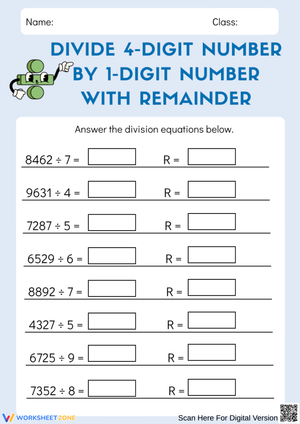
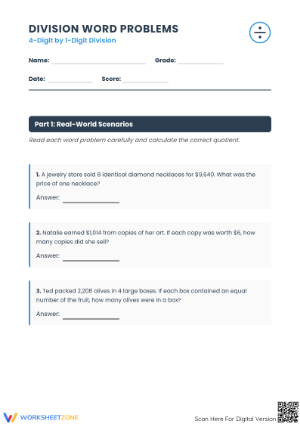
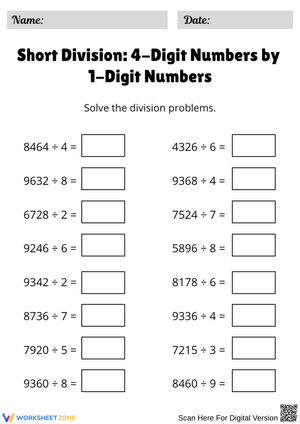
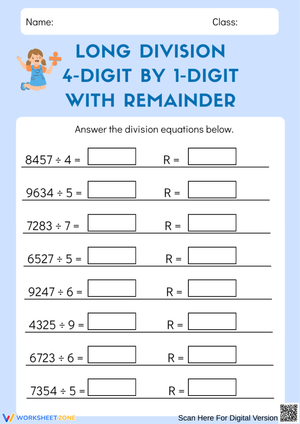
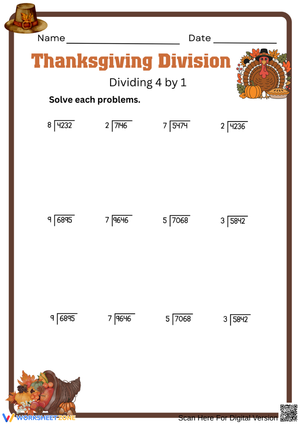
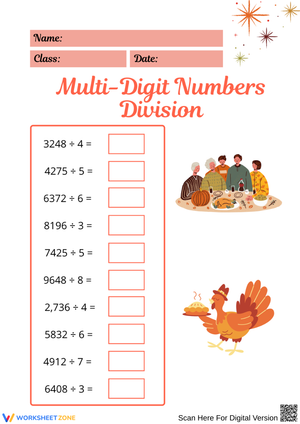
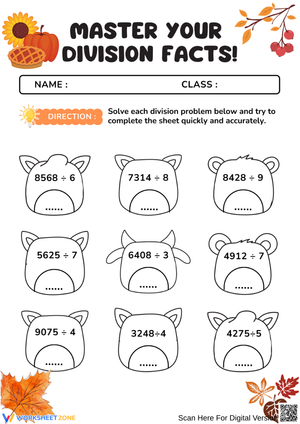
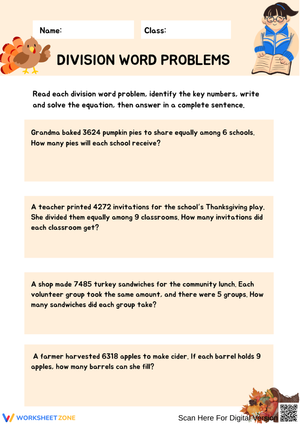
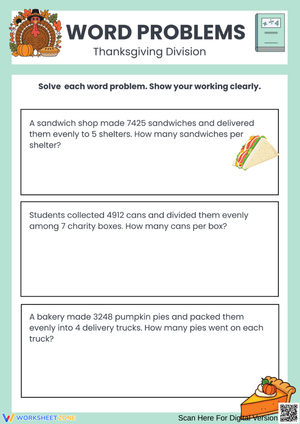
These 4 by 1 printable worksheets for 5th grade put students at the specific stretch of a division unit where 4-digit dividends meet 1-digit divisors — the exact point where place-value logic and written procedure have to work together. Each worksheet carries enough complexity to reveal real gaps without turning every problem into a stamina test. The set covers daily practice, small-group reteach, and pre-assessment before students push into harder multi-digit division.
The Specific Skills These Worksheets Build
Each worksheet moves students through all four place values — thousands, hundreds, tens, ones — requiring a decision at every step: divide, multiply, subtract, bring down. That sequence matters because students who have memorized the steps can still break down when the dividend shifts in an unexpected way, particularly when a zero must appear in the quotient because the divisor does not go into a particular place value on the first pass.
- Placing quotient digits accurately above the correct position in the dividend
- Regrouping from one place value to the next without losing track of the in-progress remainder
- Recognizing zero-in-the-quotient situations and writing a placeholder rather than skipping ahead
- Handling final remainders and verifying they are less than the divisor
- Organizing written work clearly so teachers can trace the error path at a glance
Teachers searching for 4 by 1 printable worksheets for 5th grade often focus on problem count, but the mix matters just as much. A set that combines clean quotients with remainder problems serves a more specific instructional purpose than one where every problem divides evenly — clean quotients let students consolidate digit placement, while remainder problems require them to interpret the leftover and check whether it is less than the divisor.
Standard Alignment
Common Core standard 5.NBT.B.6 calls for students to find whole-number quotients of whole numbers with up to 4-digit dividends and 1-digit divisors, using strategies based on place value, the properties of operations, and the relationship between multiplication and division. In classroom terms, that positions these worksheets in the middle of a Grade 5 division unit — after students have explored partial quotient models and basic fact relationships, but before instruction shifts to 2-digit divisors or division within fraction contexts. Teachers following a pacing guide tied to the Common Core progression can introduce the set at the moment when conceptual models are expected to give way to procedural fluency with the standard algorithm.
Where Students Break Down — and What Their Work Tells You
The error that appears most often in actual student work on these problems is a misplaced first quotient digit — and it is easy to miss on a quick scan because the steps below it may look orderly. A student dividing 3,472 by 4 will sometimes write the first quotient digit above the 3, not recognizing that 3 is less than 4 and the algorithm must start with 34 instead. The quotient ends up shifted one place to the left, landing in the thousands when it should be in the hundreds. Every subtraction and bring-down below it can look tidy and still produce a completely wrong answer.
A second predictable error involves the zero-in-the-quotient situation. When students divide 3,042 by 3, the tens-place step yields a value that cannot be divided further without a placeholder zero. Many students skip that quotient position entirely and write the ones digit directly next to the hundreds digit, shortening the answer by one place. They rarely notice the problem because the result looks like a plausible division answer. Focused worksheets surface both errors more clearly than mixed-review material because the problem type does not change across the set, so the same mistake repeats and becomes visible when you spread out a class set.
Where These Worksheets Fit Best in a Grade 5 Division Unit
The most efficient entry point is as an exit ticket at the end of a lesson where the algorithm has just been modeled. Three to five problems gives you a fast read on who internalized the steps and who is already losing quotient placement. Because student work is shown step by step, sorting a class set takes about five minutes: separate students who placed digits correctly and handled the subtraction from those who made algorithm errors, and pull both groups away from students who appear to be guessing.
For small-group instruction, use one worksheet as a gradual-release sequence inside a single 20-minute pull-out session. Model the first problem aloud while students annotate their copy — marking where you decide the first quotient digit goes, where you write the partial product, where you handle the remainder at each step. Work the second problem with student talk driving each decision. Release students to finish the remaining items independently while you watch where they slow down or start erasing. That arc gives a sharper picture of each student's breakdown point than whole-class instruction can reveal. These worksheets also function well as sub-plan material when you add a worked example at the top, keeping expectations consistent when a substitute is running the math block.
Using the Same Worksheets Across Different Readiness Levels
For students who are still shaky on the algorithm, reduce the item count and require them to solve two or three problems by writing every intermediate step — partial product, subtraction result, amount brought down — in clearly labeled rows. That format forces students to articulate each move rather than rushing toward a final number. Checking in after each problem, rather than at the end, catches errors before they repeat across the whole worksheet.
Students working above grade level can use the same resources to practice a second strategy alongside the standard algorithm. Asking them to solve each problem with partial quotients first, then verify with the standard algorithm, builds the kind of flexible reasoning that 5.NBT.B.6 is actually targeting — not just correct answers, but understanding of why the procedure works. A short written prompt asking what the remainder represents in a real-world context shifts the task from procedural drill toward conceptual justification without requiring different material entirely.
Students who struggle specifically with fact fluency — not the division process itself — can use a multiplication reference chart alongside the worksheets without removing the place-value challenge. That separation lets teachers identify whether the breakdown is in algorithm execution or basic multiplication recall, which points toward very different instructional next steps. The same 4 by 1 printable worksheets for 5th grade set can serve three different student groups in the same week when the support conditions around it change.
Frequently Asked Questions
What does "4 by 1" mean in Grade 5 division?
It describes the problem structure: a 4-digit number divided by a 1-digit number, such as 5,832 ÷ 6. In Grade 5, these problems are solved with written steps using either the standard long division algorithm or a partial quotients approach — both strategies are accepted under 5.NBT.B.6.
Is this worksheet format aligned to Common Core standards?
Yes. Standard 5.NBT.B.6 explicitly names 4-digit dividends and 1-digit divisors as the target problem type for Grade 5. These worksheets address that expectation directly, making them appropriate for core division instruction rather than only enrichment or remediation.
Do the problems include remainders?
A well-balanced set includes both remainder and non-remainder problems. Non-remainder items let students focus on quotient placement and regrouping. Remainder items require students to verify that the leftover amount is less than the divisor — a reasonableness check that often goes unpracticed when every problem in a set divides cleanly.
Can these resources support students who are currently below grade level in division?
These worksheets work best as structured practice after students have seen the algorithm modeled — they are not introductory instruction. For students who are below grade level, the most effective use of any 4 by 1 printable worksheets for 5th grade set is pairing it with a step-by-step reference card that mirrors the algorithm sequence, reducing the item count so each problem gets full written attention, and providing teacher support during the work session rather than only reviewing it afterward.














 Interactive Worksheet Maker
 Quiz Maker
 Word Search Maker
 Crossword Puzzle Maker
 Word Scramble Generator
 Sentence Scramble Generator
 Handwriting Worksheet Generator
 Name Tracing Generator
 Fill In The Blank Generator




 BACK TOSCHOOL