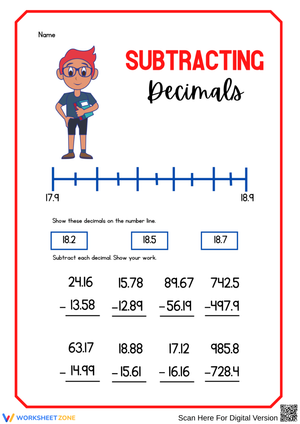
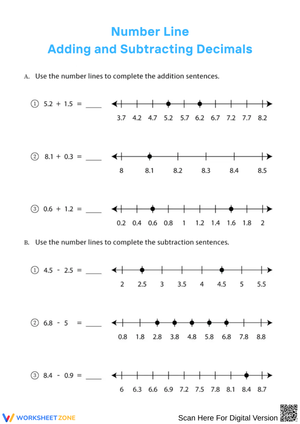
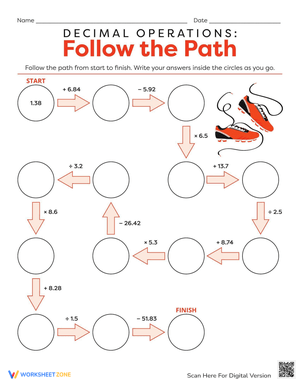
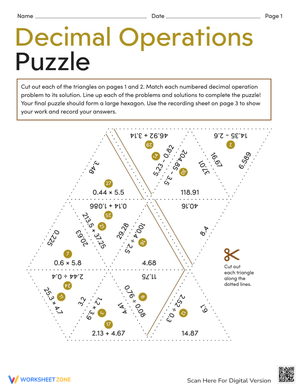
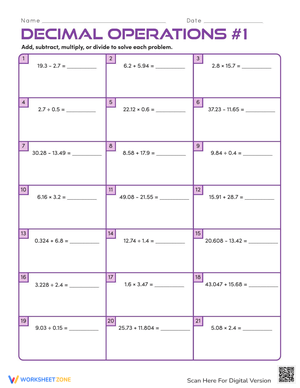
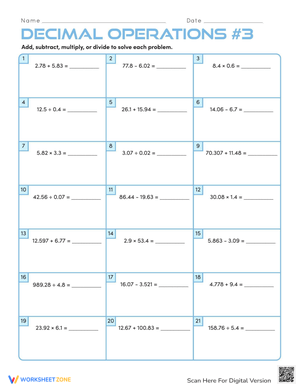
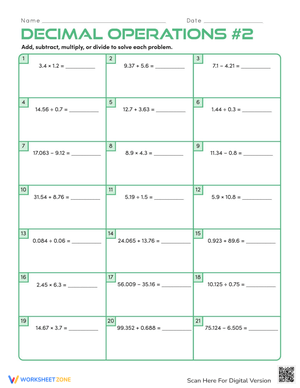
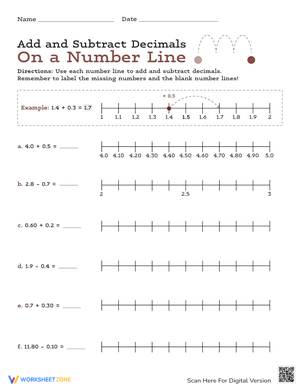
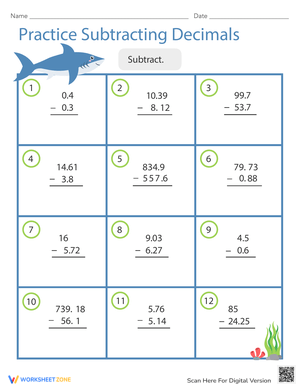
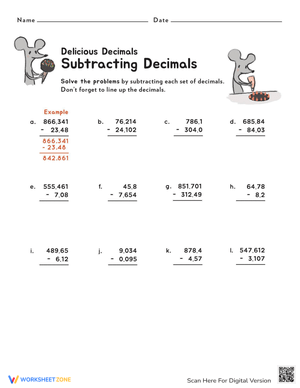
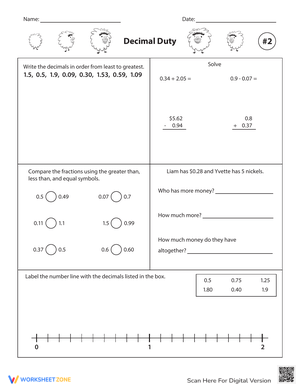
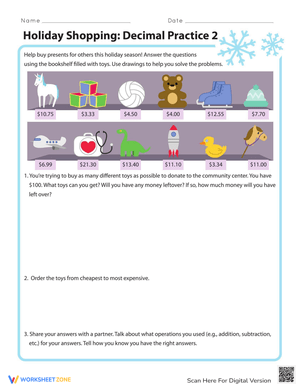
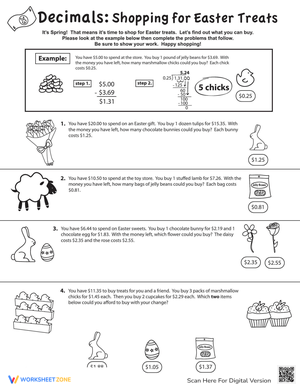
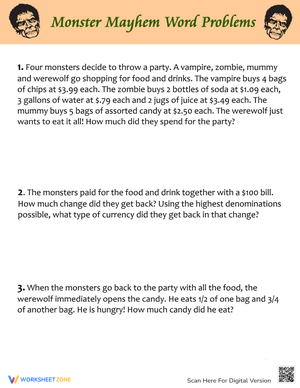
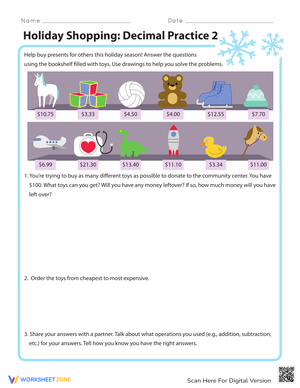
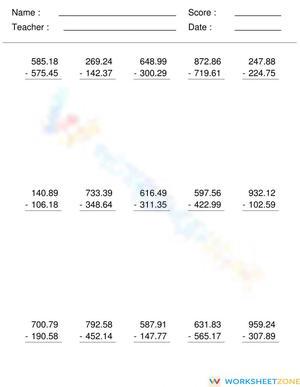
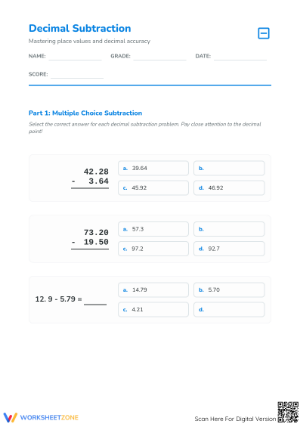
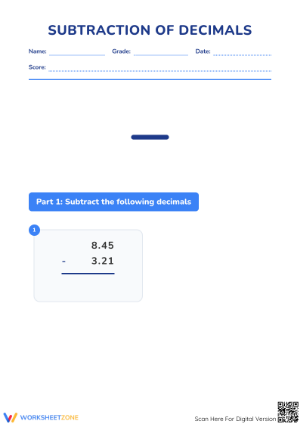
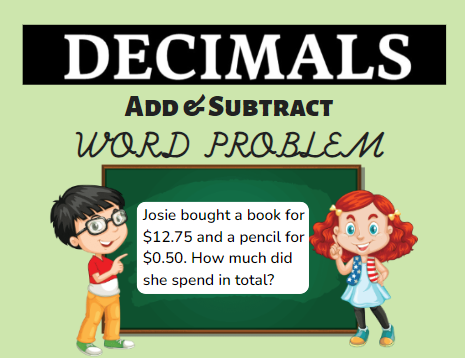
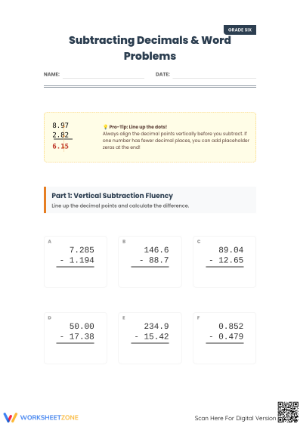
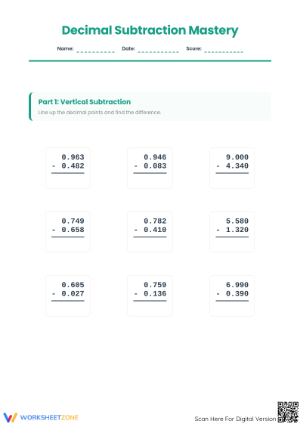
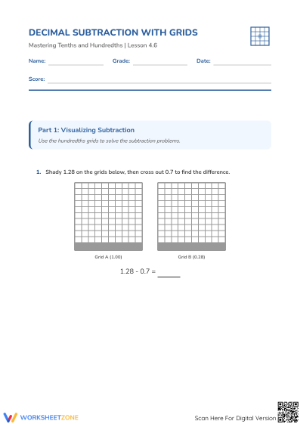
These 5th grade subtracting decimals printable worksheets give teachers a clear look at where each student's place-value reasoning holds up — and where it doesn't. The set covers the full range of what grade-5 instruction demands: vertical computation with regrouping, missing-number problems, and word problems drawn from money and measurement contexts. What makes them useful isn't just the content — it's the written work students produce, which makes misconceptions visible in a way that digital drill often does not.
The Specific Skills Targeted
Decimal subtraction in fifth grade sits at the intersection of two ideas students have been building for years: place-value structure and regrouping. Neither idea is new, but students now have to hold both simultaneously while working with digits that sit to the right of the ones place. Each worksheet isolates a piece of that work, making it easier to identify whether a breakdown comes from misunderstanding place value, mishandling regrouping, or failing to transfer the procedure into an applied context.
- Decimal point alignment: Students write problems in vertical form and name the place value of each digit before subtracting. This builds alignment into a reasoning step rather than a visual habit.
- Subtracting tenths and hundredths: Core grade-level work stays focused on two decimal places, consistent with the standard's explicit boundary.
- Regrouping across decimal places: Students borrow through the ones place into tenths and through tenths into hundredths — the moves that most often unravel in actual student work.
- Placeholder zeros: When a whole number or a decimal with fewer places appears in a problem, students insert zeros to keep columns aligned rather than guessing at placement.
- Word problem application: Students subtract in money and measurement contexts where the decimal point carries a concrete meaning they can use to check whether an answer is reasonable.
Frequent Student Errors Worth Watching For
The paper trail is the diagnostic value here. When a student submits a wrong answer on a digital platform, you see the wrong answer. When a student submits one of these worksheets, you see the setup, the crossing-out, the regrouping notation, and the exact point where the reasoning stopped working — which is a very different level of information.
The most persistent error at this level isn't regrouping — it's alignment. Students who handle whole-number subtraction without trouble will still line up 4.3 and 2.15 by the rightmost digit, subtracting tenths from hundredths as if the decimal point doesn't anchor the columns. The vertical format on each worksheet makes this visible at a glance. A second pattern involves regrouping through the ones place: students correctly borrow from tens into ones but then treat the decimal as a hard stop, failing to continue the chain into tenths. A third pattern — decimal point drift — happens when the computation is accurate but the decimal lands one place off in the final answer. The word-problem worksheets address this directly by asking students to estimate first, giving them a reference point for catching an obviously wrong answer before circling it as correct.
Lesson-Planning Ideas to Get the Most From These Worksheets
Each worksheet has enough focus to serve one specific role in the week, which makes planning rotation straightforward. There's no need to redesign the lesson around the resource — the goal is matching each worksheet to the right moment.
- Monday warm-up: Three to five tenths-only problems reactivate place-value alignment after the weekend without adding new cognitive load before instruction begins.
- Right after the mini-lesson: A vertical regrouping worksheet handed out immediately after modeling keeps students working with the exact moves just demonstrated while the example is still visible on the board.
- Small-group reteaching: Missing-number worksheets are particularly useful here. Students who can identify what the missing part must be understand the structure of subtraction; students who guess randomly don't — and that distinction shapes the next instructional step.
- Exit ticket: Two or three problems from any of these worksheets give a clear formative read on whether students can apply the day's strategy independently. Mark them before dismissal if possible.
- Homework: The mixed-review worksheets — computation plus one or two word problems — mirror class instruction closely enough that students don't need to relearn the format at home.
Standard Alignment
A well-chosen set of 5th grade subtracting decimals printable worksheets aligns directly to CCSS 5.NBT.B.7, which asks students to add and subtract decimals to hundredths using place-value understanding and written methods. The phrase to hundredths is the planning detail that matters most: it marks the line between grade-level core practice and enrichment. Worksheets that drift into thousandths without clearly labeling that shift as above grade level can quietly derail intervention planning, making on-grade students appear behind when they are actually performing at expectation.
In classroom terms, 5.NBT.B.7 asks for more than computation accuracy. Students are expected to connect their written method to place-value reasoning — which means the written work on each worksheet, the setup, the regrouping notation, the word-problem explanation, is the actual evidence of standard alignment. A circled final answer alone doesn't show it.
Differentiating the Set Across Ability Levels
The worksheets move between types rather than simply increasing problem count, which makes differentiation possible without extra preparation. For students who are still uncertain about alignment, start with a tenths-only worksheet and have them say the name of each place-value column aloud before writing anything. That oral step costs roughly thirty seconds per problem and eliminates most alignment errors before they're committed to paper — which keeps subsequent work cleaner and reteaching more targeted.
Students who have alignment and basic regrouping under control are ready for worksheets that mix tenths and hundredths problems with missing-number items. The missing-number format requires flexible thinking about the relationship between minuend, subtrahend, and difference — a meaningful step up from forward computation that stays well within grade-level expectations.
For students moving ahead, the word-problem worksheets include multi-step scenarios where students subtract and then interpret the result in a measurement or financial context. Checking a rainfall-total problem against a commonsense estimate is the kind of reasoning that 5th grade subtracting decimals printable worksheets at the high end of the set should develop — not just more columns, more regrouping, or larger numbers.
Frequently Asked Questions
What decimal subtraction skills do these worksheets address at the fifth-grade level?
The worksheets cover subtracting decimals in tenths and hundredths using vertical written methods, regrouping across place values, inserting placeholder zeros for alignment, and applying decimal subtraction in money and measurement word problems — the full scope of what CCSS 5.NBT.B.7 expects for grade-level mastery.
How do I help students who keep misaligning the decimal point?
Use a vertical worksheet and ask students to write the place-value label — ones, tenths, hundredths — above each column before copying the problem down. That single step makes alignment a reasoning decision rather than a visual guess. After two or three worksheets with this routine, most students stop misaligning without needing the labels.
Can these work as formative checks and graded homework in the same week?
Yes. The shorter, focused worksheets work as ungraded in-class checks or exit tickets. The mixed-review worksheets are clean enough for homework without requiring extra explanation. Teachers who use 5th grade subtracting decimals printable worksheets from this set often keep the shorter, focused ones for formative work during the lesson and reserve the mixed-review ones for assigned practice or graded review.
My students have mastered tenths and hundredths — what's the next step?
Moving into thousandths puts students above the grade-level boundary set by 5.NBT.B.7, which specifies to hundredths as the core expectation. The set's standard-aligned worksheets stay within that boundary. For students who are genuinely ready for more challenge, look for worksheets labeled as enrichment or extension so the work above grade level is intentional and clearly marked, rather than folded into core practice for the whole class.














 Interactive Worksheet Maker
 Quiz Maker
 Word Search Maker
 Crossword Puzzle Maker
 Word Scramble Generator
 Sentence Scramble Generator
 Handwriting Worksheet Generator
 Name Tracing Generator
 Fill In The Blank Generator




 BACK TOSCHOOL