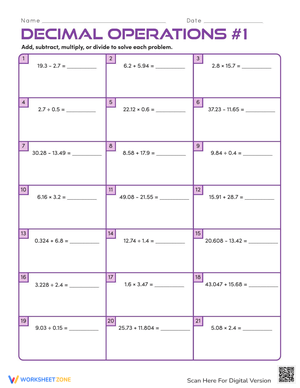
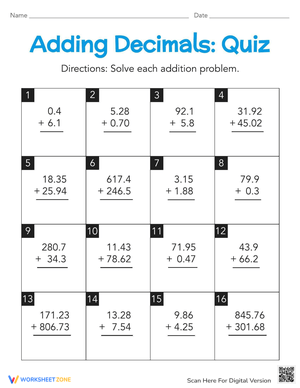
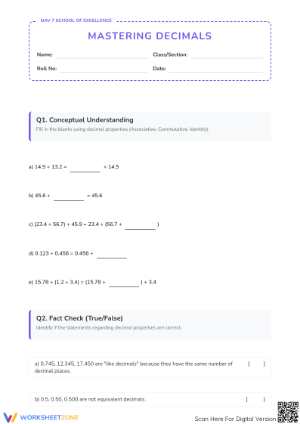
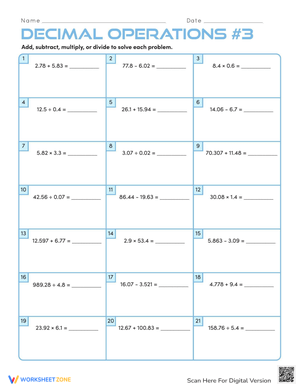
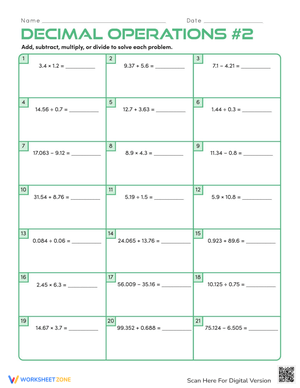
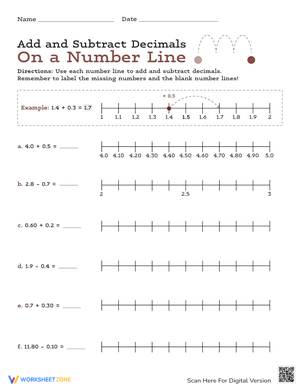
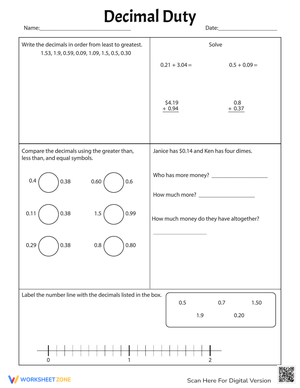
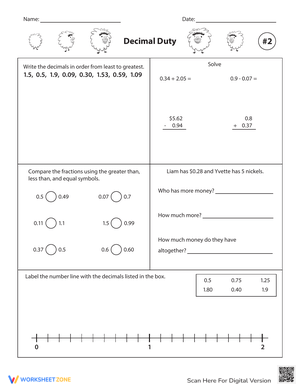
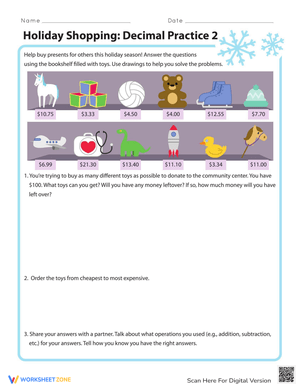
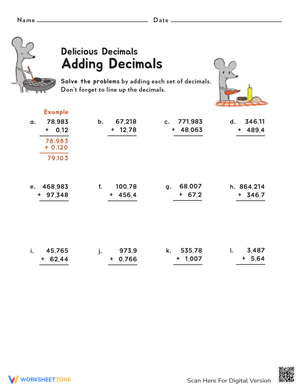
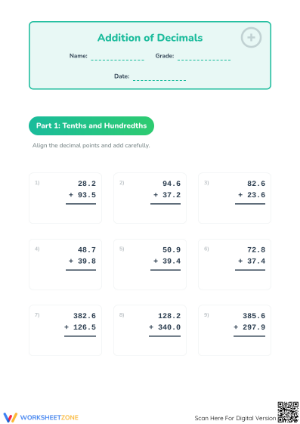
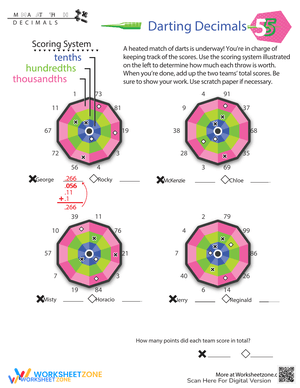
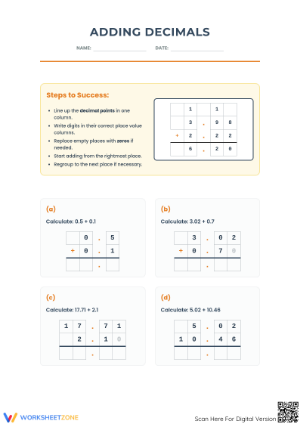
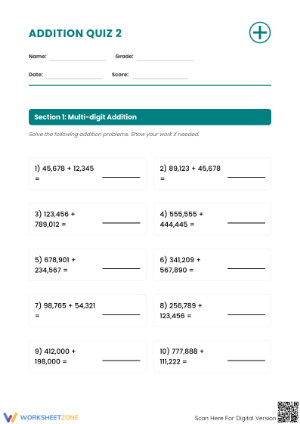
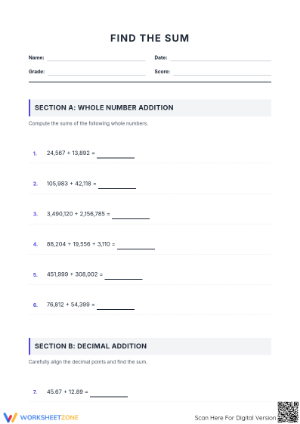
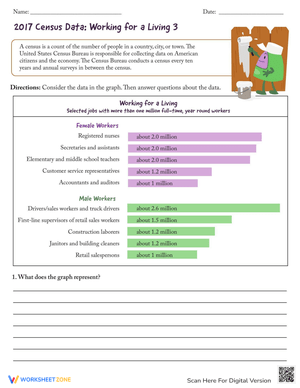
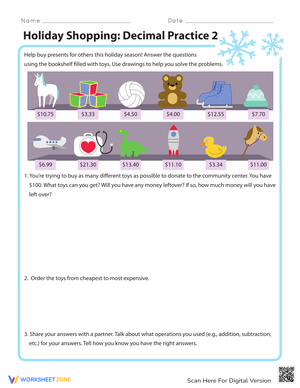
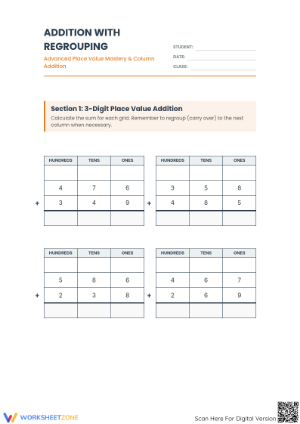
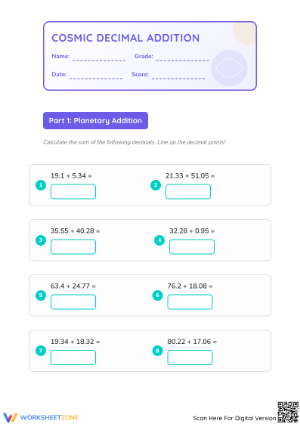
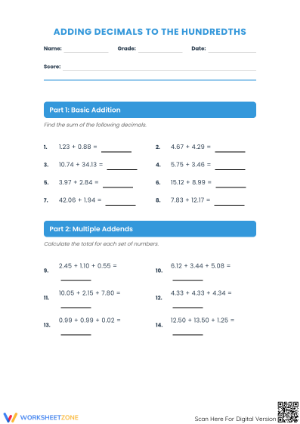
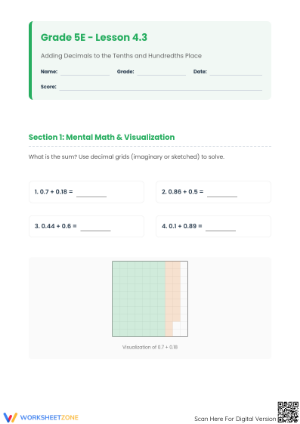
These 5th grade adding decimals printable worksheets resources give teachers a focused way to address one of the harder transitions in the Grade 5 math year: moving from whole-number addition into accurate computation with tenths and hundredths. The set covers vertical computation, place-value grid problems, and context-based word problems — enough variety that each worksheet can serve a different role in the same instructional week without feeling repetitive.
Skills Each Worksheet in This Set Builds
Decimal addition at the 5th grade level is place-value reasoning made visible — not just computation with a dot in it. Every worksheet in this collection keeps that distinction in view. Students work problems that require them to line up decimal points before they begin, write placeholder zeros in positions that would otherwise be blank, and treat tenths and hundredths as genuinely different-sized units rather than interchangeable digits.
The specific skills distributed across the set include:
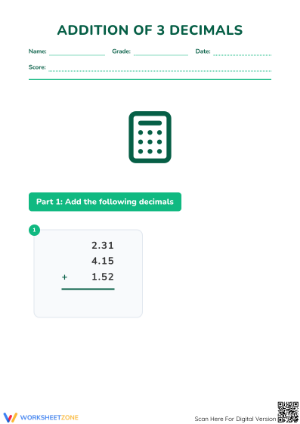
- Vertical addition with mixed decimal lengths: students add numbers like 3.4 and 2.67, where the digit counts differ and writing 3.40 first is the move that makes the alignment work.
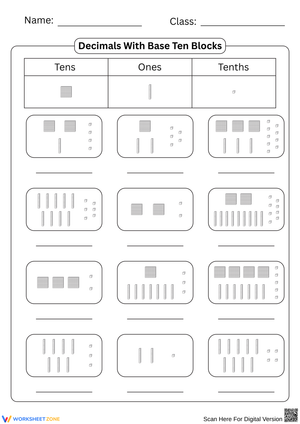
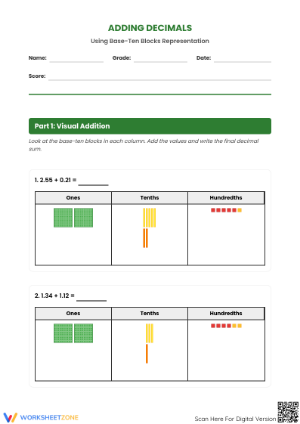
- Grid-based place-value problems: students record digits in a labeled tenths-hundredths chart before computing, keeping the connection between structure and arithmetic explicit.
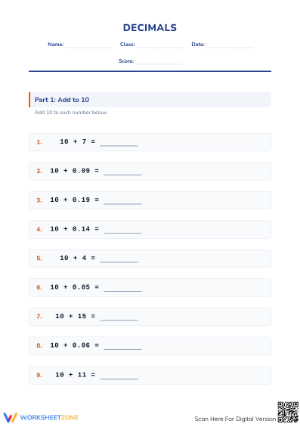
- Same-unit fluency practice: focused sets of tenths-only or hundredths-only addition build confidence and accuracy before the two units are mixed in the same problem.
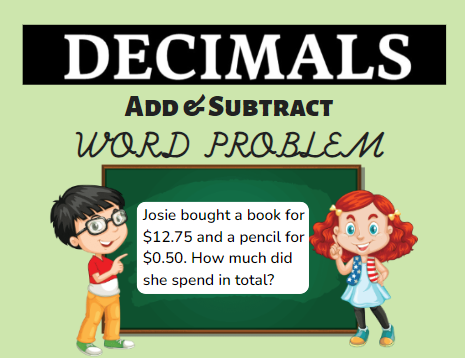
- Word problems requiring student setup: students extract numbers from a sentence, decide how to align them, and then compute — a step that quickly distinguishes students who understand the process from those following a vertical-format habit.
- Estimation and magnitude tasks: students decide whether a sum will land closer to one benchmark or another before computing, anchoring decimal quantities in real size rather than abstract digits.
Student Error Patterns Worth Diagnosing Before They Compound
The most persistent error in early decimal addition is right-edge alignment. Students treat a decimal number the way they treated whole numbers — stacking digits from the right side — and the result looks visually tidy while being wrong by an order of magnitude. Because the misaligned answer often contains every digit from the original problem, just displaced, there is no obvious visual warning. It carries forward undetected into multi-step problems and measurement work.
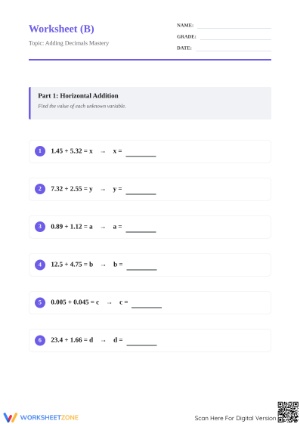
A second pattern shows up with mixed-length decimals. A student who handles 2.4 + 1.3 without difficulty will often stumble on 2.4 + 1.36 — not from poor fluency, but because they have never internalized that 2.4 and 2.40 are the same number. They have not built the concept that tenths and hundredths occupy distinct positions the way tens and ones do. Worksheets that ask students to write in the placeholder zero before computing, rather than offering it pre-printed, surface that gap in one problem.
- Right-edge stacking: digits aligned by position from the right rather than by decimal point, producing answers off by a factor of ten.
- Dropped decimal point in the answer: students complete the arithmetic correctly but treat the decimal point as optional — especially common on timed or rushed practice.
- Unit conflation: treating tenths and hundredths as the same size, so 0.3 + 0.07 becomes 0.10 instead of 0.37.
- Word-problem breakdown: students produce correct answers on vertical problems but cannot extract and set up the same calculation from a sentence — a conceptual gap masquerading as a reading problem.
The format variation across these worksheets creates a natural diagnostic. A student who gets every vertical problem right but fails the word problem is giving you specific information. A student who handles same-unit problems accurately but falls apart on mixed-unit items is showing a different gap. A long sheet of identical problems cannot make that distinction.
Fitting These Worksheets Into Your Planning Week
A 5th grade adding decimals printable worksheets set works best when each worksheet has one clear job in the lesson sequence rather than serving as generic extra practice. A grid-supported worksheet with labeled place-value columns fits naturally on the day after you introduce decimal alignment — students reinforce the structure they just saw modeled before moving to abstract notation. Later in the week, one worksheet that mixes vertical problems with a short word problem makes a strong exit ticket, because four or five problems are enough to show whether students can transfer the concept or only execute a memorized format.
The three-minute bell ringer slot — especially on the Monday after a weekend break — is a reliable home for two or three vertical problems pulled from any worksheet in the set. That short reactivation of alignment habits before students open their notebooks prevents the drift that happens over a two-day gap. For a small intervention group still shaky with place-value language, use the grid-model worksheet and work through one problem together before releasing students to finish independently. The visual structure of the labeled grid does the work that five minutes of re-explaining often fails to accomplish.
- Warm-up: 3–4 vertical problems to reactivate decimal alignment before the main lesson begins.
- Math center: one mixed-format worksheet with a partner discussion checkpoint built into the answer step.
- Exit ticket: one word problem and one vertical problem from the same worksheet — fast to scan, gives enough data for next-day grouping decisions.
- Homework: a shorter same-unit worksheet that families can support without needing to know grade-level written methods in advance.
- Sub plans: any worksheet with clean vertical problems and brief directions students already recognize from regular class routines.
Standard Alignment
Common Core State Standards for Mathematics, Grade 5: 5.NBT.B.7 requires students to add decimals to hundredths using concrete models or drawings and strategies grounded in place value, properties of operations, or the relationship between addition and subtraction. The key word in that standard is hundredths — not "multi-digit decimals" in the abstract, but specifically the range of tenths and hundredths where place-value structure is most visible and most teachable. A 5th grade adding decimals printable worksheets set that skips models entirely and moves straight to abstract vertical notation misses the standard's core intent, which pairs procedure with understanding. The strongest worksheets in this collection ask students to reason about why decimal points line up the way they do, not only to produce a correct sum. That matters most during initial instruction, when the habit of thinking about units — not just executing steps — is still forming.
Adjusting These Worksheets Across Ability Levels
For students still building confidence with decimal place value, the grid-based worksheets — where column headers label tenths and hundredths explicitly — lower the working-memory demand enough that students can actually attend to the addition. That labeled structure is not a shortcut; it removes one confusing visual decision so cognitive effort goes toward the arithmetic. Once students are accurate on a labeled-grid worksheet, moving to blank vertical problems is a natural and short step.
On the other end, students who move through vertical computation quickly benefit from the word-problem and estimation worksheets. Asking a student who finishes early to write a word problem that produces a specific sum — say, one where the answer rounds to 4.5 — shifts the task from answer-getting to mathematical construction without requiring a separate enrichment packet. Some teachers also ask advanced students to complete problems from this 5th grade adding decimals printable worksheets collection using two different strategies, then compare their work — a move that directly reinforces the standard's explicit emphasis on multiple solution methods.
Students who struggle specifically with the language in word problems, rather than with the computation itself, often do better when they are allowed to underline the relevant numbers before setting up the problem. Recognizing that distinction — reading comprehension versus decimal reasoning — keeps teachers from re-teaching place value when the real barrier is extracting information from a sentence.
Frequently Asked Questions
What should students already know before working on decimal addition at this level?
Students need a working understanding of decimal place value through hundredths — specifically, the ability to read 3.47 as "3 ones, 4 tenths, 7 hundredths" rather than as a sequence of digits. They also need enough addition fluency that carrying and regrouping does not take up all their attention when a decimal point is also present. If those two pieces are still shaky, the grid-supported worksheets in this set give students a concrete entry point before moving to abstract vertical format.
Do these worksheets include problems that require regrouping across the decimal?
Yes. Several worksheets include problems where the hundredths column sums to more than 9 and students must carry into the tenths place — for example, 3.76 + 2.54. This is a predictable sticking point, and the worksheets treat it as a direct extension of whole-number regrouping rather than as a new rule to memorize. Teachers find it useful to assign these problems after students are already accurate on non-regrouping decimal problems, so the carrying procedure is the only new demand.
How many problems per worksheet is reasonable for Grade 5 decimal addition practice?
For most practice sessions, 8 to 12 problems provides enough repetition to reveal a pattern without triggering the accuracy drop that comes with fatigue. Exit tickets can work with as few as 3 problems when those problems are well chosen and cover different formats. Longer sets of 20 or more items are better suited to same-unit fluency drills than to mixed-format practice, where each problem carries more cognitive weight and errors become harder to interpret at scale.
Can these worksheets be paired with manipulatives or other tools?
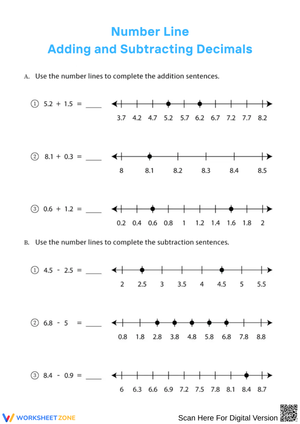
Easily. The grid-model worksheets pair naturally with base-ten blocks or decimal place-value mats — teachers sometimes use each worksheet as the written record after students build a problem with physical materials, keeping the concrete-to-abstract progression visible. The vertical-problem worksheets work well alongside a quick number-line estimate before computing, which gives students a magnitude check on their answer before they commit to it.














 Interactive Worksheet Maker
 Quiz Maker
 Word Search Maker
 Crossword Puzzle Maker
 Word Scramble Generator
 Sentence Scramble Generator
 Handwriting Worksheet Generator
 Name Tracing Generator
 Fill In The Blank Generator




 BACK TOSCHOOL