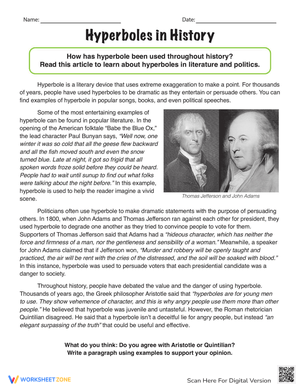
These 5th grade essay writing worksheets files cover opinion, informative, and narrative writing through focused, standalone worksheets that fit directly into Grade 5 lesson planning. Each worksheet targets one writing move — analyzing a prompt, building a body paragraph, revising a conclusion — so teachers can pull exactly what the class needs on any given day rather than working through a fixed sequence. The planning format stays consistent across all three writing types, which reduces the adjustment time students need each time the unit or writing mode changes.
The Writing Moves Each Worksheet Builds
Fifth grade essay instruction works best when students practice the individual parts of a composition before combining them into a full draft. Each worksheet in the set targets one of those parts, which also means teachers can use them in sequence across a writing unit or pull a single worksheet when one skill needs reinforcement. Skills covered across the set include:
- Prompt analysis: students underline key task words and identify whether the prompt calls for opinion, informative, or narrative writing
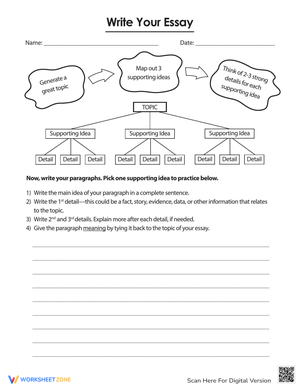
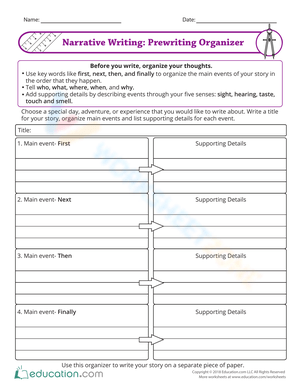
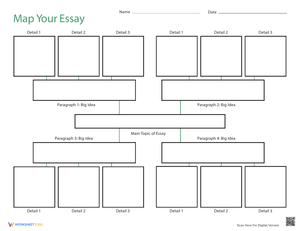
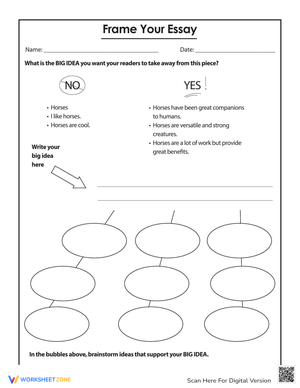
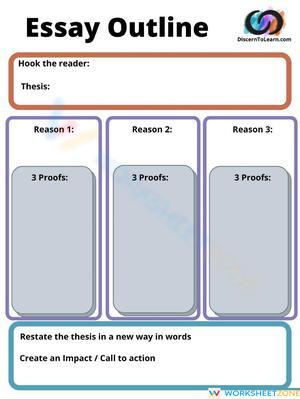
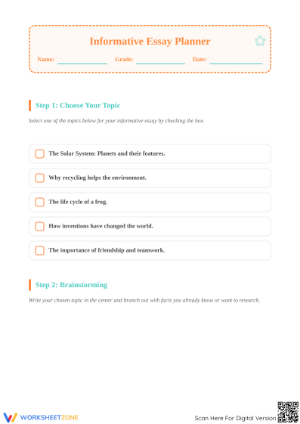
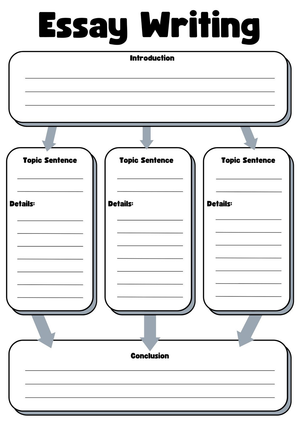
- Planning and organizing: brainstorming boxes and structured organizers that separate claims from supporting reasons, or main topics from subtopics and supporting facts
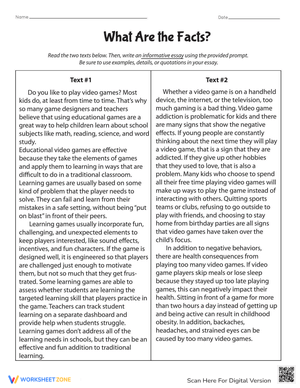
- Introduction writing: guided practice opening a piece with a clear position or topic — not a dictionary definition, not a question, and not a preview summary of everything that follows
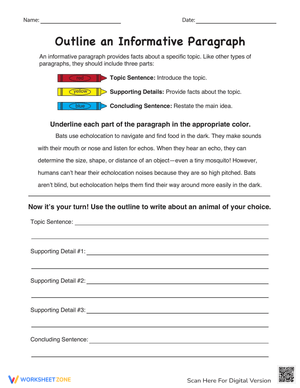
- Body paragraph development: structured space for a topic sentence, supporting detail, explanation, and a connecting statement
- Transitions and linking language: sentence starters grouped by function — adding information, signaling contrast, introducing an example, showing causation
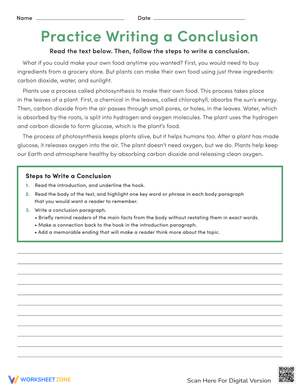
- Conclusion writing: prompts that push students toward restating the main point with intention rather than adding "In conclusion" and repeating the introduction
- Self-revision tasks: targeted questions students answer about their own draft before submitting
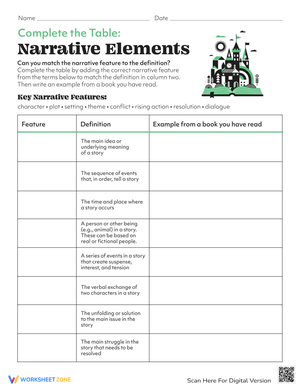
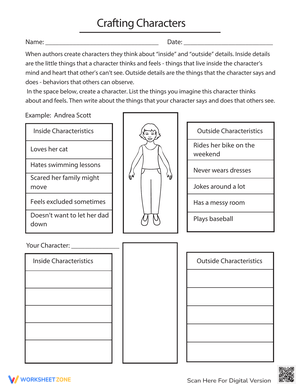
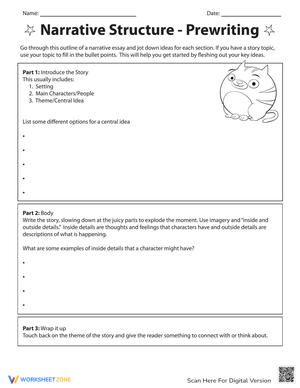
Narrative worksheets are structured differently from the opinion and informative ones — they guide students through sequence, setting detail, character action, and the reflection that makes a story feel resolved rather than cut off. That distinction matters because fifth graders often approach a narrative prompt the same way they approach informative writing, producing a timeline of events instead of a developed scene with momentum.
Student Error Patterns Worth Anticipating
The most common problem in fifth grade essay drafts isn't missing content — it's a body paragraph that loops. Students write a strong claim in the introduction, then spend the body restating it in slightly different language rather than developing it with reasons, evidence, or examples. The supporting sentences orbit the claim without building away from it. That pattern is easiest to catch before an on-demand assessment when teachers have already seen it in low-stakes practice drafts from these worksheets.
Conclusions are their own consistent problem. Students know the ending should "wrap up" the essay, so they introduce one final new reason in the last paragraph — as if they remembered a supporting point too late to move it into the body. The conclusion then reads like an underdeveloped third body paragraph with no sense of closure. One targeted worksheet that asks students to list what's already in the body, then draft a closing that restates without adding new claims, breaks this habit more reliably than a general reminder does.
Transitions are the third predictable weak spot. Even after explicit instruction, fifth graders default to "also," "and," and "another reason is" in nearly every draft. A worksheet that asks students to rewrite two of their own transitions using category-specific connectors — contrast, elaboration, causation — produces noticeably wider transition vocabulary within a few practice rounds. That's faster progress than any anchor chart delivers on its own.
Fitting These Worksheets Into Your Teaching Week
The most effective pattern is to match one worksheet to one teaching point rather than using a full organizer as an entire period's work. On the day you teach introductions, that worksheet is the practice — students draft, you circulate, you collect. By the end of class you have a concrete set of student samples showing exactly who needs more time before the class moves into full drafting. Apply the same logic to body paragraphs, transitions, and conclusions in separate sessions. Narrow tasks produce cleaner formative data than full drafts do mid-unit, when you still have time to adjust instruction before the on-demand write.
Bell ringers work well for the 5-to-8-minute window at the start of a writing block. Students draft a claim or write a conclusion, two volunteers share, the class identifies what feels specific versus generic, and the lesson launches from a real example in the room. For centers, pairs complete a planning organizer together before moving into independent drafting — the collaborative step reduces the freeze that hits students sitting down to a blank page. Intervention teachers who need a 5th grade essay writing worksheets set for pulled small groups benefit from the narrow skill focus: one worksheet on writing a strong claim, one on adding a concrete example, one on closing a paragraph keeps a 15-minute pull-out session manageable and produces a writing sample to review immediately after.
For sub plans, the structure of each worksheet does the explanatory work. A teacher who leaves a planning worksheet, a drafting worksheet, and a revision check has handed off a coherent writing block without complicated verbal instructions. Students who already know the worksheet format move through it with minimal guidance.
Standard Alignment
These worksheets align with Grade 5 writing standards in the Common Core State Standards for English Language Arts. The set directly supports W.5.1 (opinion/argument writing), W.5.2 (informative or explanatory writing), and W.5.3 (narrative writing) — together representing the full range of essay writing fifth graders are expected to handle across a school year. Grade 5 is the final year of the K–5 writing progression, which is part of why the demands feel sharper here: standards at this level expect multi-paragraph compositions with developed elaboration, purposeful organization, and intentional conclusions, not just completed drafts. Teachers who want printable 5th grade essay writing worksheets materials that connect to those expectations will find each worksheet addresses a specific part of the W.5.1–W.5.3 progression — prompting, planning, drafting, or revising — rather than treating essay writing as a single undifferentiated task.
The revision and self-check worksheets also connect to W.5.5, which addresses the writing process itself: planning, drafting, revising, and editing with guidance. Teachers who use these during writing workshop can document student engagement with process steps as part of ongoing formative assessment, which matters when writing portfolios or progress conferences are part of the grading structure.
Adjusting the Set for a Mixed-Ability Classroom
Fifth grade writing classes almost always include students at very different levels of fluency — some still building paragraph structure, and some ready for more complex organizational work. These worksheets support both groups without requiring teachers to build separate materials from the ground up.
For students who need more support, the planning worksheets provide enough internal structure — labeled sections, sentence-starter options, and a step-by-step format — that students can focus their energy on the thinking rather than on figuring out the task itself. Limiting the number of body paragraphs expected also keeps the completion target realistic within the available time. For students working at an advanced level, the revision worksheets become more demanding when those students evaluate a peer's draft against the criteria rather than only their own — a shift that requires analytical reading alongside writing skill and that pushes toward the editorial thinking they'll need in middle school.
The 5th grade essay writing worksheets format makes quick differentiation practical: print two versions of the day's task — one with more sentence support, one with fewer cues — and distribute before the writing block begins. The skill expectation stays the same; the amount of structural support changes. That adjustment takes roughly two minutes to implement and requires no extra planning beyond deciding which students need which worksheet.
Frequently Asked Questions
Do these worksheets cover all three essay types fifth graders are expected to write?
Yes. The set includes worksheets for opinion writing, informative or explanatory writing, and narrative writing. Each type has dedicated planning organizers and drafting support, though the planning format stays consistent across all three so students don't have to relearn the worksheet structure every time the writing mode changes.
Can individual worksheets be used for intervention or small-group instruction?
Each worksheet stands alone for a focused small-group session. Intervention teachers regularly pull a single targeted worksheet — one on writing a strong topic sentence, one on adding concrete evidence, one on revising a conclusion — because the task is narrow enough to complete in 15 to 20 minutes and specific enough to produce a usable writing sample for follow-up planning.
How do these worksheets hold up when students are at very different writing levels?
The built-in structure helps lower-level writers access the task, while the revision and self-check worksheets offer enough analytical challenge for students working above grade level. Teachers can also pull different worksheets from the same set for different groups — one group works on organizing a body paragraph while another revises a full draft against the self-check criteria — without disrupting the whole-class writing lesson or creating additional prep.
Are these worksheets useful for standardized test preparation?
Prompted writing tasks are a consistent feature of fifth grade assessments, and students who have practiced analyzing a prompt, organizing a multi-paragraph response, and developing evidence-backed claims are building the same skills those tests measure. The revision check worksheets also mirror the independent review students need to manage under timed conditions — reading back through a draft, checking for completeness, and making targeted edits without teacher prompts.












 Interactive Worksheet Maker
 Quiz Maker
 Word Search Maker
 Crossword Puzzle Maker
 Word Scramble Generator
 Sentence Scramble Generator
 Handwriting Worksheet Generator
 Name Tracing Generator
 Fill In The Blank Generator