


























Views
Downloads
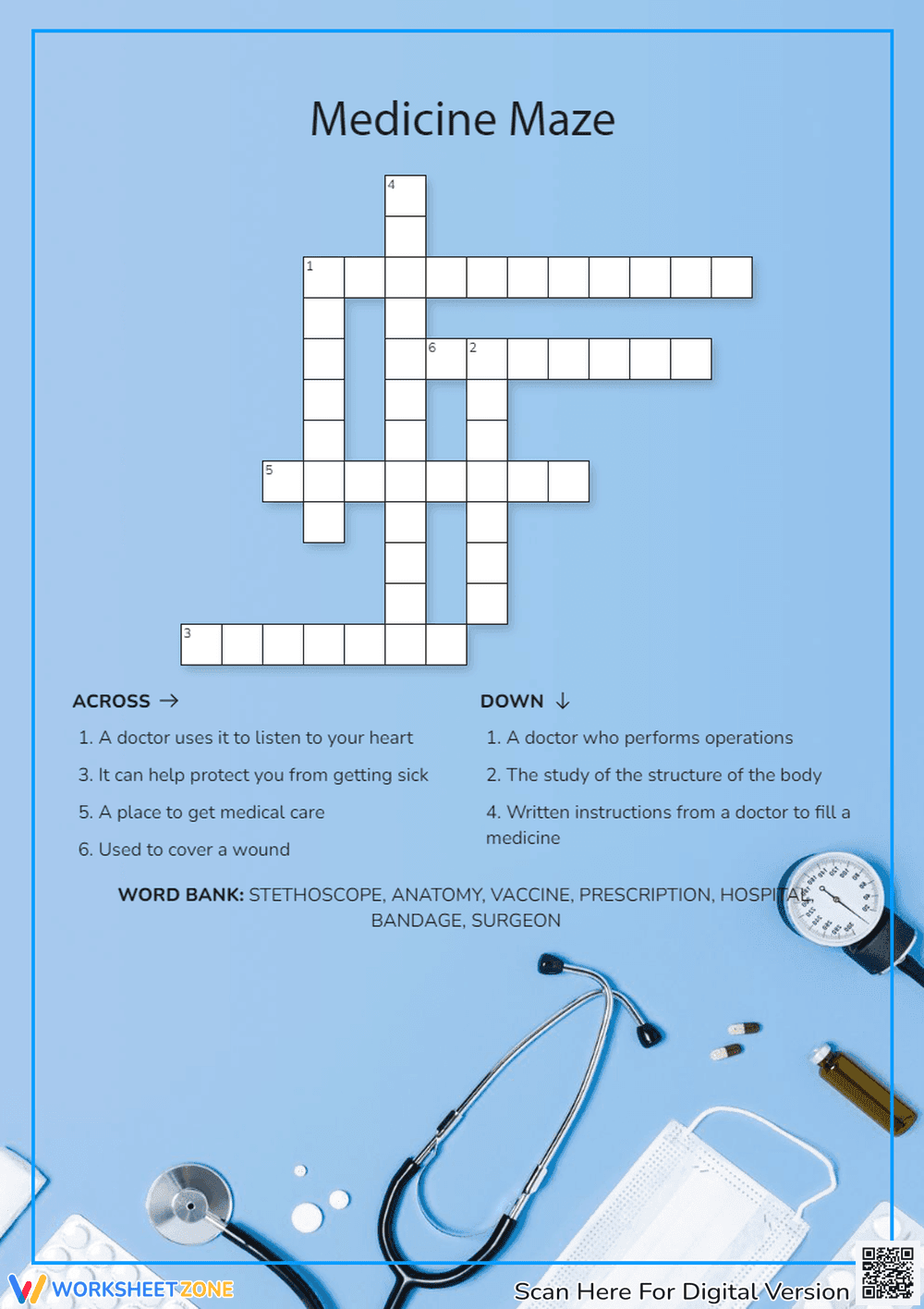

Medicine Maze Crossword | Grade 3-5 Essential Worksheet
Paste this activity's link or code into your existing LMS (Google Classroom, Canvas, Teams, Schoology, Moodle, etc.).
Students can open and work on the activity right away, with no student login required.
You'll still be able to track student progress and results from your teacher account.
This Grade 3-5 medical vocabulary worksheet helps students master essential health-related terminology through an engaging crossword format. By matching descriptive clues to domain-specific words like "stethoscope" and "anatomy," learners strengthen their reading comprehension and spelling skills. It provides a clear, structured way to introduce or review healthcare concepts in any elementary classroom.
At a Glance
- Grade: 3-5 · Subject: Health & ELA
- Standard:
CCSS.ELA-LITERACY.L.4.6— Acquire and use accurately grade-appropriate general academic and domain-specific words- Skill Focus: Medical Vocabulary & Context Clues
- Format: 1 page · 7 problems · Answer key included · PDF
- Best For: Vocabulary reinforcement or early finishers
- Time: 15–20 minutes
What's Inside
This single-page PDF features a 7-entry crossword puzzle focused on medical professions, tools, and locations. To support diverse learners, the worksheet includes a clear word bank containing all necessary terms such as "prescription" and "surgeon." The layout is clean and professional, featuring high-quality medical-themed imagery to provide visual context for the vocabulary being studied.
Zero-Prep Workflow
The Medicine Maze is designed for immediate classroom implementation with a three-step workflow. First, print the single-page PDF (30 seconds). Second, distribute the sheets to students as a warm-up or independent center activity (1 minute). Finally, review the answers using the included key to provide instant feedback (5 minutes). Total teacher preparation time is under 2 minutes, making it an ideal emergency sub plan.
Standards Alignment
This resource aligns with `CCSS.ELA-LITERACY.L.4.6`, which requires students to acquire and use accurately grade-appropriate general academic and domain-specific words and phrases. By identifying terms like "vaccine" and "bandage" through context clues, students demonstrate mastery of technical vocabulary. Both standard codes can be copied directly into lesson plans, IEP goals, or district curriculum mapping tools.
How to Use It
Use this worksheet during a health unit or as a literacy center activity to reinforce spelling and word recognition. It works best after a direct instruction lesson on community helpers or the human body. For a formative assessment, observe if students can correctly identify the "stethoscope" clue without relying solely on the word bank. Expected completion time is 15 to 20 minutes.
Who It's For
This activity is tailored for students in Grades 3, 4, and 5 who are developing their academic vocabulary. It is particularly effective for English Language Learners (ELLs) who benefit from the scaffolded support of a word bank. Pair this crossword with a non-fiction passage about doctors or a labeled diagram of a hospital for a comprehensive lesson.
According to the RAND AIRS 2024 report on literacy interventions, the use of scaffolded vocabulary tools like crosswords with word banks significantly improves retention of domain-specific terminology in elementary learners. This worksheet targets CCSS.ELA-LITERACY.L.4.6 by requiring students to synthesize clue descriptions into specific medical terms such as "anatomy" and "prescription." Fisher & Frey (2014) emphasize that providing students with multiple exposures to technical words in varied formats—such as puzzles and direct instruction—is critical for moving vocabulary from short-term recognition to long-term mastery. By integrating 7 targeted tasks within a 20-minute window, this resource provides the high-frequency practice necessary for students to confidently use medical language in both written and oral contexts. This evidence-based approach ensures that students are not just memorizing words but are understanding their functional roles within the healthcare field.


