


























Views
Downloads

Essential Context Clues: Synonyms Worksheet | Grades 4-5
Paste this activity's link or code into your existing LMS (Google Classroom, Canvas, Teams, Schoology, Moodle, etc.).
Students can open and work on the activity right away, with no student login required.
You'll still be able to track student progress and results from your teacher account.
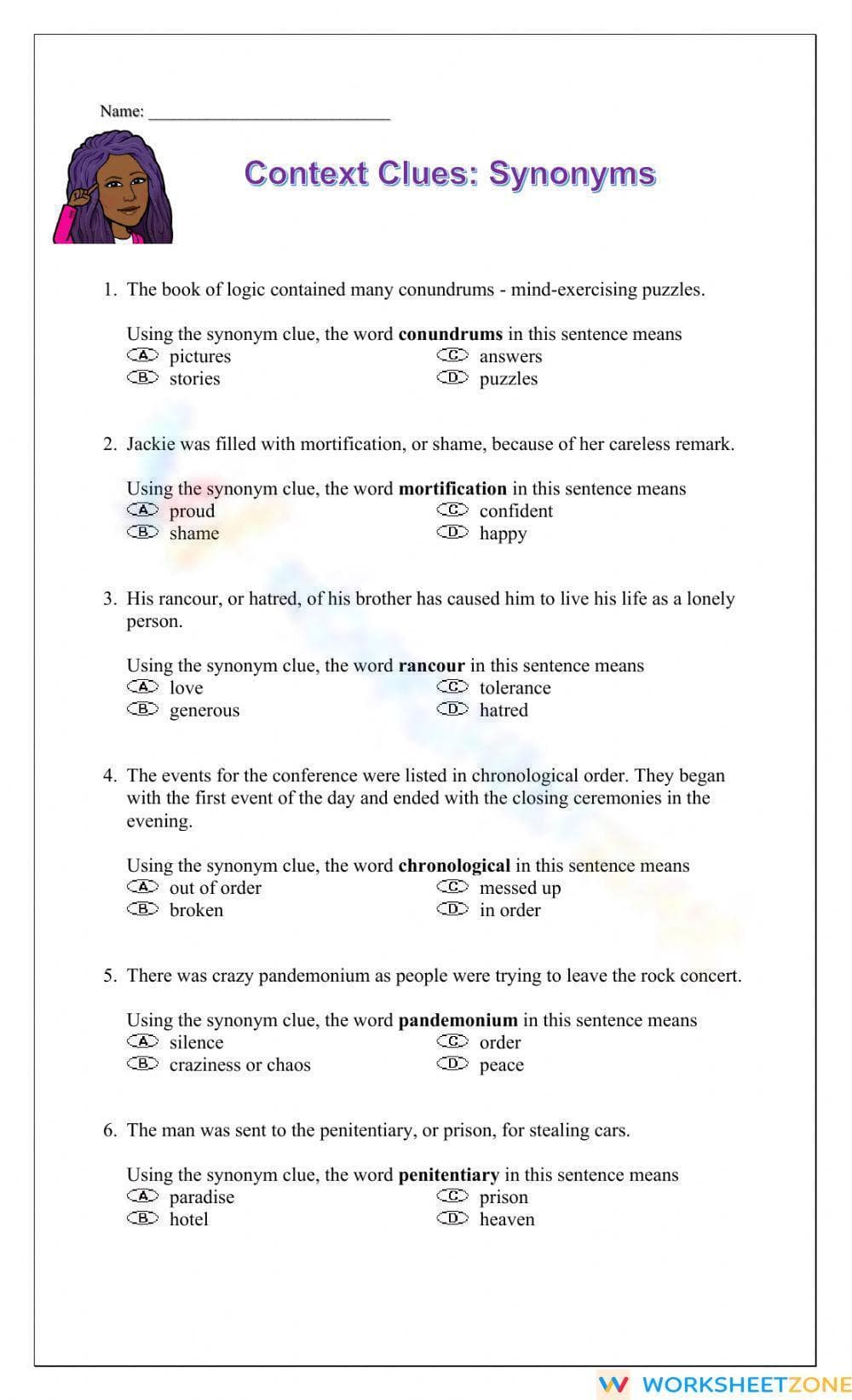
This Grade 4 and 5 English Language Arts worksheet focuses on identifying word meanings using synonym-based context clues. Students read sentences containing challenging vocabulary and use the provided synonym restatements to select the correct definition from multiple-choice options. This targeted practice builds essential reading comprehension and vocabulary acquisition skills necessary for mastering complex texts.
At a Glance
- Grade: 4–5 · Subject: ELA
- Standard:
L.4.4— Use context clues like synonyms to determine meanings of unfamiliar words- Skill Focus: Context Clues (Synonyms)
- Format: 1 page · 6 problems · Answer key included · PDF
- Best For: Vocabulary practice and formative assessment
- Time: 10–15 minutes
The worksheet features six carefully crafted sentences that embed a synonym or restatement for a difficult target word, such as "conundrums," "mortification," and "pandemonium." Each task is presented in a clear, consistent format: a sentence followed by a question that prompts the student to identify the meaning of the bolded word from four multiple-choice options. This single-page PDF includes a full answer key for rapid grading.
Integrating this resource into your lesson requires less than two minutes of teacher preparation. Simply print the single-page document and distribute it to your students. Because the instructions are self-explanatory and the synonym clues are explicitly highlighted within the text, students can begin working immediately with minimal guidance. The clear layout also makes it an ideal no-prep resource for substitute folders or unexpected schedule shifts.
This resource is directly aligned with `CCSS.ELA-LITERACY.L.4.4.A`, which requires students to use context—such as definitions, examples, or restatements in text—as a clue to the meaning of a word or phrase. By focusing specifically on synonym restatements (e.g., "conundrums - mind-exercising puzzles"), students practice a high-frequency strategy found in standardized testing and rigorous informational texts. This standard code can be copied directly into lesson plans or IEP goals.
Use this worksheet as a focused exit ticket or formative assessment after a direct instruction lesson on types of context clues. It is most effective when assigned during the independent practice phase of a gradual-release model. Teachers should observe whether students are successfully identifying the specific punctuation marks (like commas or dashes) that often signal a synonym restatement. Completion typically takes between 10 and 15 minutes.
This resource is designed for Grade 4 and 5 students who are developing their tier-two vocabulary and reading stamina. It is particularly useful for English Language Learners (ELLs) and students requiring IEP accommodations, as the explicit restatements provide a high level of scaffolding. Pair this worksheet with a short informational passage to allow students to apply their context clue strategies to a broader reading context.
Effective vocabulary instruction emphasizes the strategic use of context clues to bridge the gap between known and unknown words. This worksheet targets the synonym-restatement strategy, which is a foundational component of the CCSS.ELA-LITERACY.L.4.4 standard for Grades 4 and 5. Research from Fisher & Frey (2014) indicates that explicit instruction in context clue types—specifically synonyms, antonyms, and definitions—significantly improves student independence when navigating complex informational and literary texts. By providing 6 structured problems, this resource allows students to practice the specific cognitive task of identifying a synonym within a sentence and mapping it to a formal definition. This process mirrors the evidence-based gradual release of responsibility model, moving students from guided identification to independent mastery. The inclusion of an answer key ensures that both teachers and students receive immediate feedback on performance, a critical factor in successful vocabulary acquisition.


