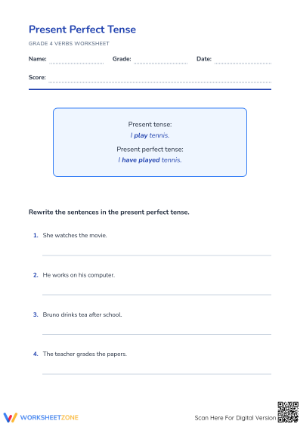
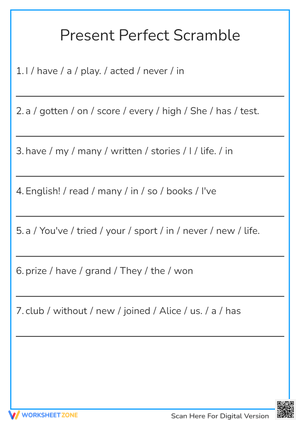
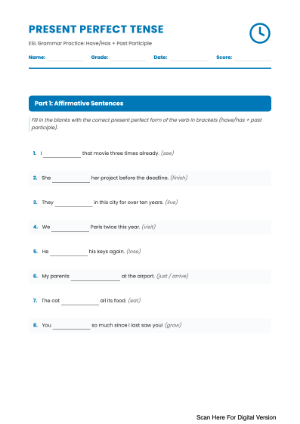
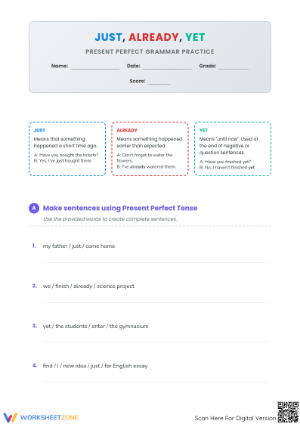
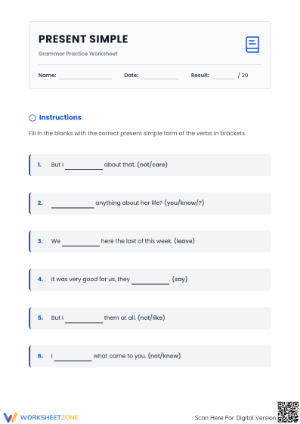
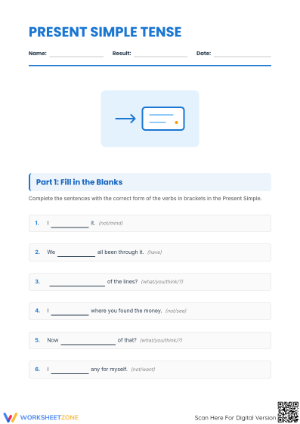
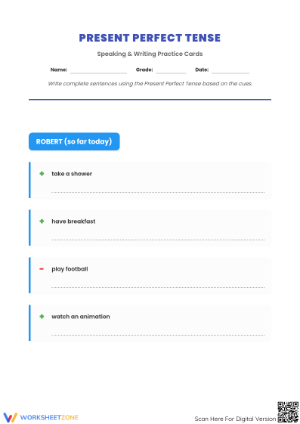
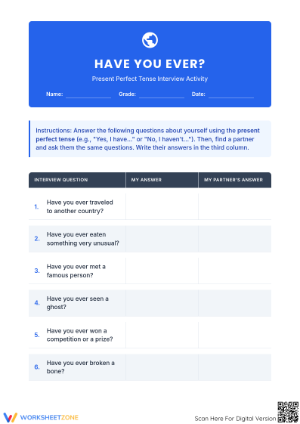
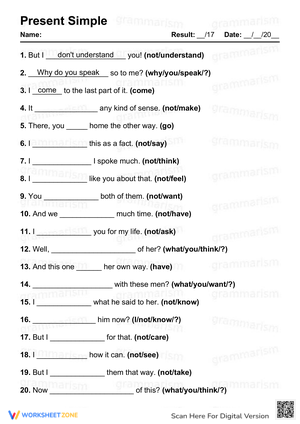
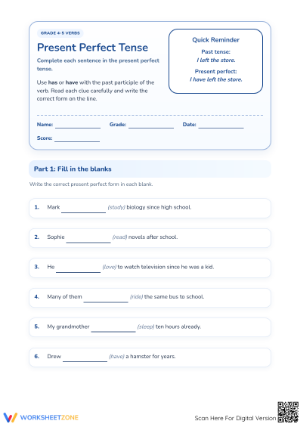
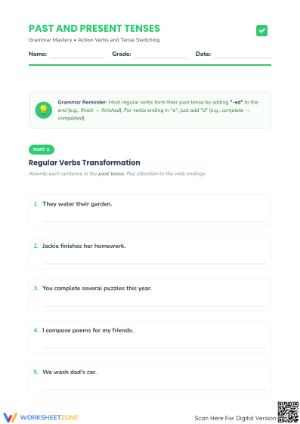
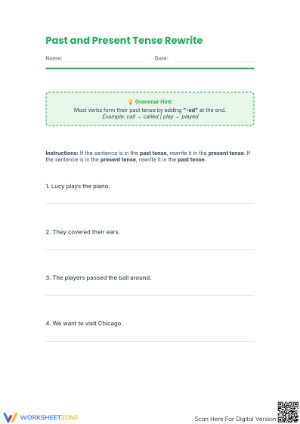
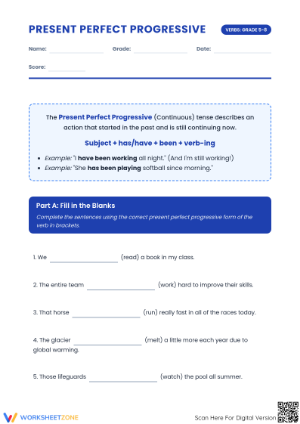
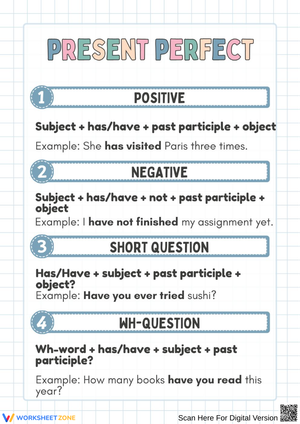
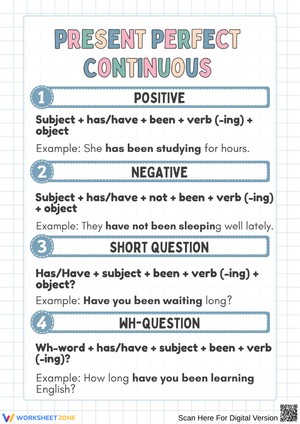
5th grade present perfect tense worksheets give teachers a direct way into one of Grade 5's messier grammar decisions — the verb form students reach for when they mean this action still matters now rather than this action is finished and sealed. The resources cover affirmative sentences, negatives, question forms, and irregular past participles, with tasks that move from recognition to editing to short constructed response.
The Specific Skills Each Worksheet Addresses
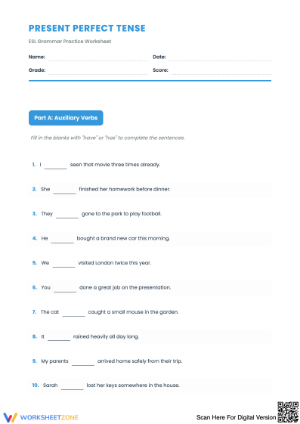
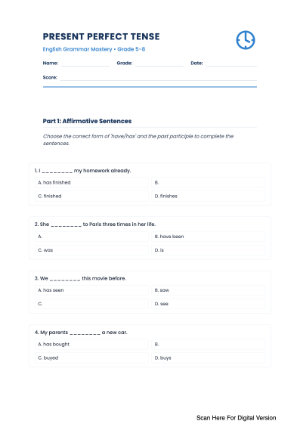
Each worksheet targets a distinct slice of the tense. The set opens with subject-auxiliary agreement — matching has or have to a range of subjects before students ever touch the participle. That sequencing matters because fifth graders often collapse those two requirements into one vague pattern: just use "has." A student who writes My teacher and her assistant has graded our papers is showing exactly that collapse, and a focused matching task surfaces it in thirty seconds.
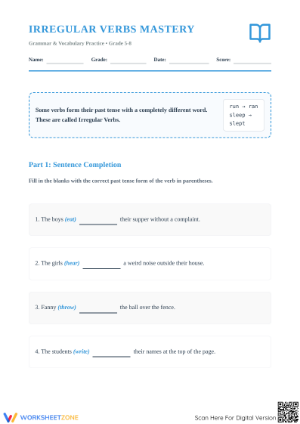
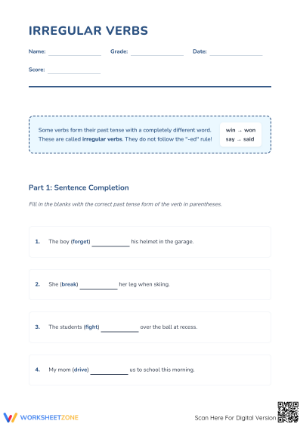
Later worksheets move into meaning. Students compare present perfect and simple past in context — not just choose between them, but briefly mark why one fits. Irregular past participles get their own targeted practice: students see and rewrite errors like has went and have saw. The final tasks ask for original sentences or short passage editing. A set of 5th grade present perfect tense worksheets that spans recognition, correction, and production gives teachers more than one data point on where a student actually stands — something a ten-item fill-in-the-blank sheet cannot do.
Student Errors Worth Anticipating Before You Assign Practice
Three error patterns show up consistently. The most common is irregular past participle substitution: students write has went, have saw, and has took because those simple past forms are what they hear in conversation. Correcting them requires more than telling students the right answer — repeated exposure to the error alongside the correct form is what makes the fix stick. Error-correction tasks, where students underline the wrong participle and rewrite, outperform word banks here because students must produce the correct form rather than just recognize it.
The second pattern is defaulting to simple past because it sounds more natural in speech. Students who correctly say I went to the museum last week carry that familiarity into writing and resist swapping it for I have been to the museum, even when the intended meaning shifts to experience rather than a single past trip. The third error is pairing present perfect with a closed-time marker: She has finished her project yesterday blends the present-connection meaning of the tense with an adverb that signals the action is done and dated. Sentence sorting tasks — where students decide whether yesterday or before changes which tense is correct — make that mismatch visible in a way that isolated drills miss entirely.
Fitting These Worksheets Into Your Planning Week
The narrower the focus, the more useful each worksheet becomes as a formative tool. In a mini-lesson, put two model sentences on the board — one present perfect, one simple past — and let students explain the difference before they pick up a pencil. The worksheet then confirms what they built together rather than introducing the grammar cold. That sequence matters especially for students who freeze when a task format is unfamiliar: oral rehearsal before writing significantly reduces the number of students who stall on item one.
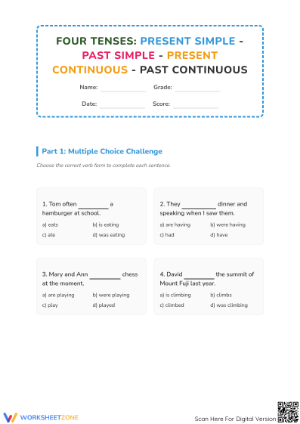
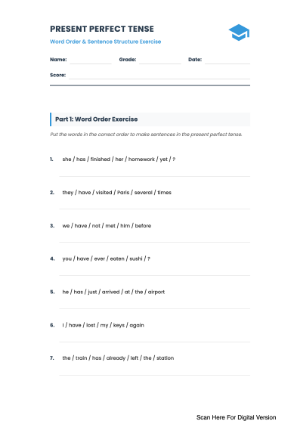
5th grade present perfect tense worksheets hold up well in centers because each worksheet has a single defined task type — sorting, error correction, or constructed response — rather than mixing several formats into one long worksheet. Teachers can assign different worksheets to different groups without building separate materials. For exit tickets, a three-item check works well: one sentence requiring has or have agreement, one tense-choice item, and one sentence the student rewrites in their own words. That combination takes about eight minutes and surfaces structure knowledge, meaning-level thinking, and transfer in a single pass.
- Mini-lesson companion: model two sentences, then assign the worksheet as independent confirmation.
- Centers: assign different worksheets by error pattern — irregular participles for one group, tense comparison for another.
- Intervention: return to the same has/have + participle frame across several short sessions before adding meaning-level tasks.
- Homework: choose worksheets with predictable directions so families are not left trying to teach the grammar from scratch.
Standard Alignment
CCSS.ELA-LITERACY.L.5.1.B requires students to form and use the perfect verb tenses. In most fifth-grade pacing guides, that standard lands in the second or third quarter — after students have reviewed simple past and before they move into extended revision in the writing block. Placing targeted verb tense practice at that point, between grammar instruction and applied writing, is where these worksheets do their clearest work. The standard does not call out irregular past participles separately, but students who cannot produce gone, seen, and taken reliably cannot demonstrate the standard in their actual writing. Treating participle work as part of the same instructional window — not a separate grammar detour — is where teachers get the most return.
Scaling the Worksheets Across a Range of Learners
Students who are still building confidence with the basic structure benefit from worksheets that reduce item count and pair the task with a reference chart showing base form, simple past, and past participle side by side. That resource is not the same as a word bank — it does not give the answer away, but it offloads participle retrieval so students can direct their working memory toward the agreement and meaning decisions where the real learning happens. Once the structure feels automatic, they move into the same comparison and editing tasks as the rest of the class.
For students ready to push further, the extension move is explanation. After correcting an error or choosing a verb form, they write one sentence describing what the tense communicates — about time, present connection, or the difference between an experience and a completed event with a named date. 5th grade present perfect tense worksheets generate that kind of reasoning when teachers add a single written-response prompt to the bottom of any worksheet in the set. Students who can explain their choice in their own words are far more likely to carry the tense into their own writing than students who only practiced selecting between two options.
Frequently Asked Questions
What should students already know before working with these worksheets?
Students need to identify the two-part tense structure — has or have plus a past participle — and understand in plain terms when it's used: for actions, experiences, or changes connected to the present, as opposed to actions named at a finished past time. A few teacher-modeled examples, like She has finished her reading log compared to She finished her reading log yesterday, usually give enough orientation. Students who cannot yet identify a past participle reliably need that groundwork before they begin.
How do teachers explain the difference between present perfect and simple past at this grade level?
The most useful classroom explanation focuses on time markers. If the sentence names a closed past time — yesterday, last month, in 2019 — simple past is the right choice. If the time is unspecified, the point is current relevance, or the sentence describes an experience rather than a specific event, present perfect fits. Writing those two signals on an anchor chart and keeping it visible while students work significantly reduces the mid-task "which one do I use?" question.
Which worksheets work best for intervention groups?
Start with subject-auxiliary agreement and irregular participle worksheets before introducing tense comparison tasks. Intervention groups build confidence faster when they return to the same sentence frame — has/have + participle — across several short sessions rather than covering every skill area at once. Once students produce the structure automatically with familiar subjects, they're ready for meaning-level comparison work.
Can these worksheets function as formative assessments?
Yes, particularly the editing and constructed-response items. A student who corrects has went to has gone and writes a reason shows more genuine understanding than a student who fills in a blank by elimination. Teachers get stronger diagnostic evidence by keeping two or three items that require a written justification — the explanation reveals whether students are thinking about meaning or pattern-matching their way through the task.












 Interactive Worksheet Maker
 Quiz Maker
 Word Search Maker
 Crossword Puzzle Maker
 Word Scramble Generator
 Sentence Scramble Generator
 Handwriting Worksheet Generator
 Name Tracing Generator
 Fill In The Blank Generator