


























Views
Downloads

Printable Present Perfect Progressive Worksheet | Grade 5-8
Paste this activity's link or code into your existing LMS (Google Classroom, Canvas, Teams, Schoology, Moodle, etc.).
Students can open and work on the activity right away, with no student login required.
You'll still be able to track student progress and results from your teacher account.
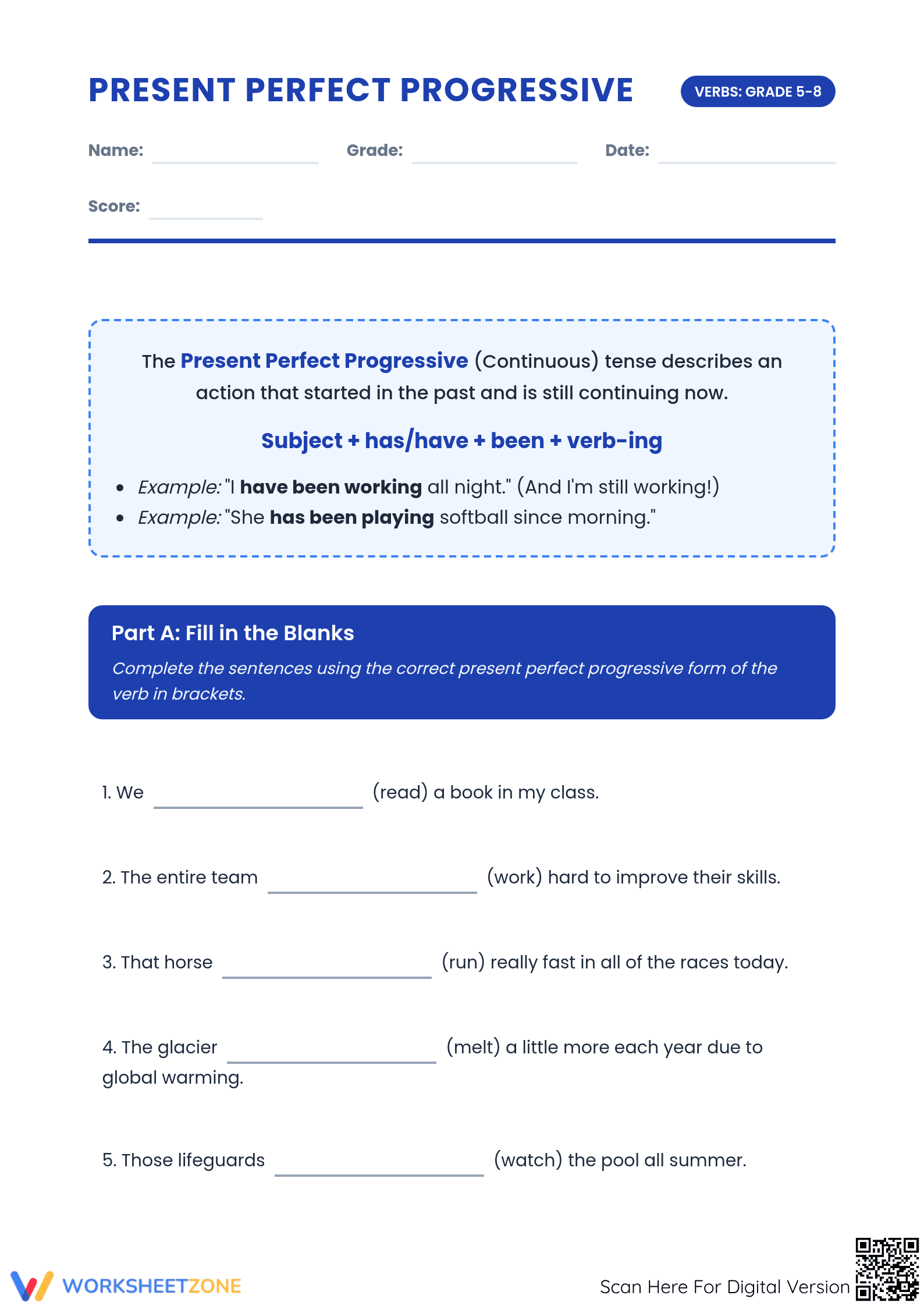
This 3-page grammar worksheet empowers Grade 5-8 students to master the present perfect progressive tense. Through structured fill-in-the-blank tasks, sentence construction exercises, and real-world dialogue, learners develop a deep understanding of ongoing actions. Students will move from basic formation to complex negative and question structures with high accuracy.
At a Glance
- Grade: 5-8 · Subject: English Grammar
- Standard:
CCSS.ELA-LITERACY.L.5.1.B— Form and use perfect verb tenses accurately in writing and speech- Skill Focus: Present Perfect Progressive formation and usage
- Format: 3 pages · 26 problems · Answer key included · PDF
- Best For: Independent practice or formative assessment
- Time: 25–35 minutes
What's Inside
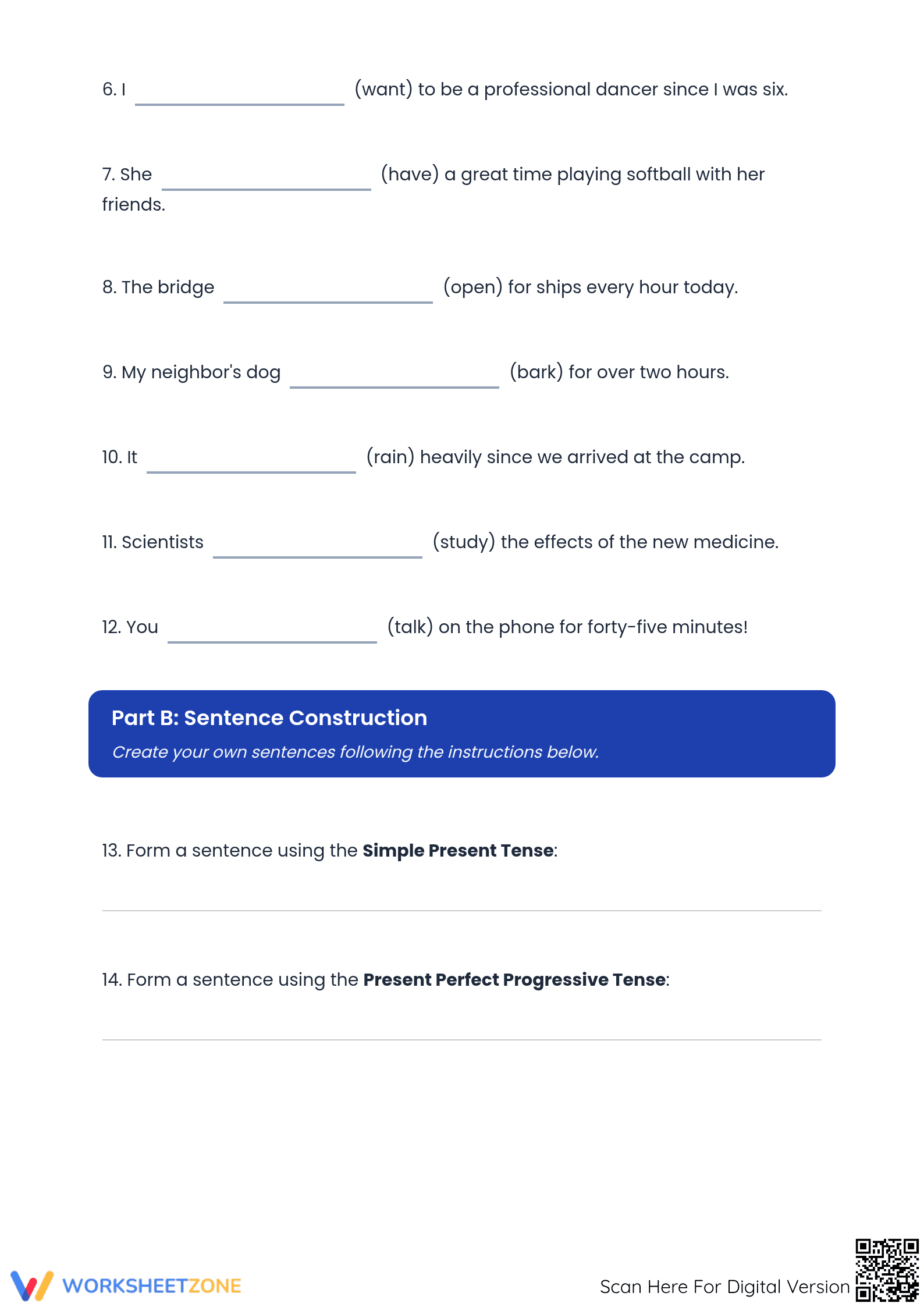
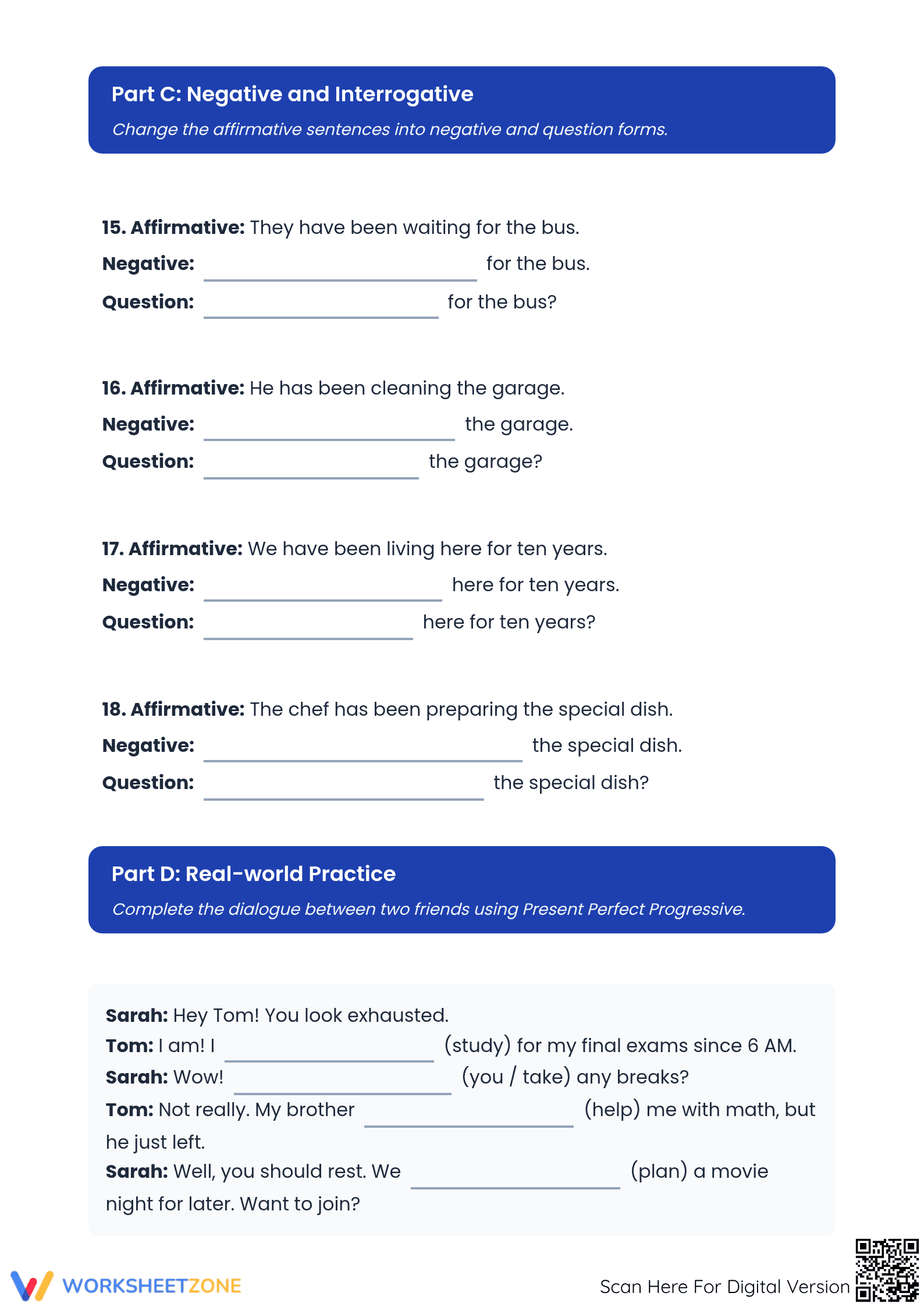
This printable set includes three pages designed to scaffold learning. Page one features a "Subject + has/have + been + verb-ing" formula box and completion tasks. Page two continues with varied contexts and sentence construction. Finally, page three challenges students with negative and question transformations alongside a real-world dialogue exercise to ensure functional mastery of the tense.
Skill Progression
- Guided Practice: 12 fill-in-the-blank sentences provide contextual cues and verb stems to help students internalize the formulaic structure of the present perfect progressive.
- Supported Practice: Sentence construction and negative/interrogative transformations require students to manipulate the grammar rules independently while working within controlled sentence structures.
- Independent Practice: The real-world dialogue completion tasks demand high-level application, requiring students to determine the correct tense and form based on conversational context.
This scaffolding ensures that students build confidence before tackling open-ended application.
Standards Alignment
The primary focus is CCSS.ELA-LITERACY.L.5.1.B, which requires students to form and use the perfect verb tenses. While this worksheet specifically targets the progressive (continuous) form, it builds the necessary morphological and syntactic awareness required for middle school language standards. Both standard codes can be copied directly into lesson plans, IEP goals, or district curriculum mapping tools.
How to Use It
This resource is ideal for use after direct instruction on the present perfect progressive tense. Assign the first two pages as in-class guided practice and use the third page as a "ticket out the door" or a formative assessment to check for understanding of negatives and questions. Teachers should observe whether students correctly select "has" or "have" based on the subject, as this is a common point of confusion.
Who It's For
This worksheet is designed for Grade 5-8 students who have a basic grasp of simple tenses but need to expand their range of expression. It is particularly effective for English Language Learners (ELLs) who struggle with the multi-part nature of progressive perfect tenses. Pair this resource with a short reading passage to identify instances of the tense in authentic literature.
According to Fisher & Frey (2014), effective grammar instruction must move beyond isolated drills into contextual application. This worksheet aligns with CCSS.ELA-LITERACY.L.5.1.B, ensuring students can form and use perfect verb tenses in varied formats. The sequence of tasks targets the plain-English skill of describing actions that started in the past and continue into the present, a critical component of academic writing. By providing 26 high-quality problems across three pages, the resource offers the volume of practice necessary for syntactic fluency. Data from the RAND AIRS 2024 indicate that structured grammar scaffolds significantly improve sentence complexity in middle school writing. Educators can use these tasks to bridge the gap between mechanical accuracy and expressive communication, making it a vital addition to any ELA curriculum. This summary provides the research backing needed for district-level curriculum adoption.


