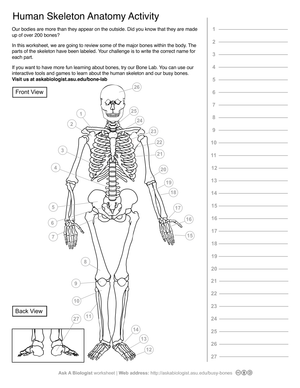
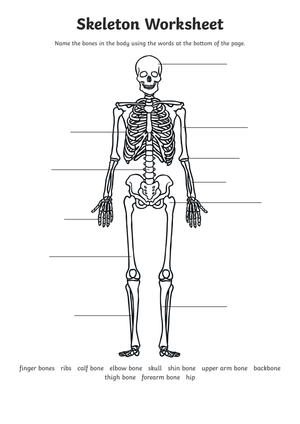
These bones printable worksheets for 4th grade give teachers a focused set of anatomy resources covering both the names and functions of major skeletal structures — the kind of targeted practice that moves students past surface-level facts toward real conceptual understanding. The set includes labeling diagrams, function-matching exercises, and bone health activities, each suited to a different point in the unit, from the first day of instruction through end-of-unit review.
What Students Practice in Each Worksheet
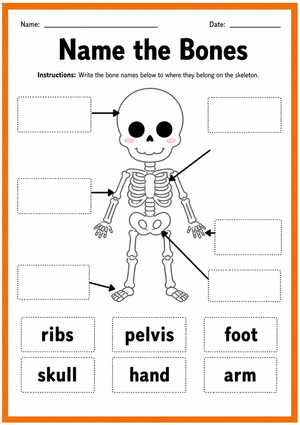
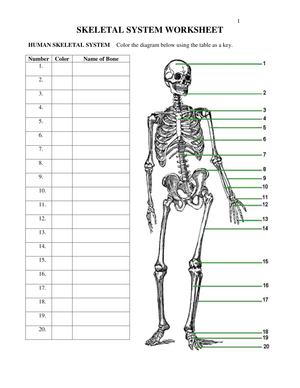
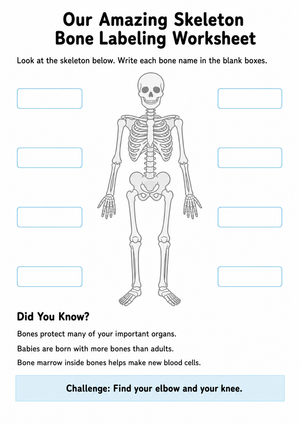
The core work across most of the worksheets is anatomy labeling. Students identify and mark major bones on full-skeleton diagrams, including:
- Cranium and facial bones
- Clavicle, sternum, and rib cage
- Vertebral column
- Humerus, radius, and ulna
- Femur, tibia, fibula, and patella
Fourth graders handle this vocabulary when they encounter it across multiple formats. The diagrams give them a visual anchor that carries the terms past the unit test and into later body systems work.
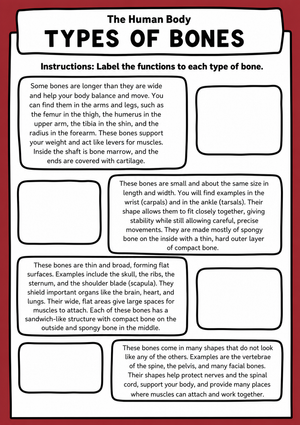
Function-matching activities ask students to connect specific bones to the organs they protect. The skull-to-brain pairing is easy for most. The relationship between the rib cage and the heart and lungs takes more discussion, partly because students tend to picture ribs as a solid shell rather than individually articulated bones that expand with each breath. A separate category of exercises covers bone biology — what bones are made of, why they don't snap under ordinary pressure, and how a child's skeleton differs structurally from an adult's. The 206-versus-270-plus comparison (adult versus newborn) generates real questions in a way that most anatomical facts don't. Bone health and nutrition worksheets complete the set, asking students to evaluate specific food choices against what they've learned about calcium and Vitamin D in class.
Student Errors Worth Anticipating Before You Teach This Unit
The most persistent misunderstanding is that bones are inert — students frequently describe them as "just hard stuff" that doesn't grow or change. Getting past that assumption requires explicit contrast with the bone biology content: bone tissue is alive, constantly remodeling, and meaningfully different at age 8 than it will be at 25. The function-matching worksheets help here because students are forced to think about what a structure does, not just where it sits on the diagram.
During labeling work, students consistently confuse the radius and ulna, and they swap the femur and tibia when working from memory rather than a diagram in front of them. Writing each name in two or three separate contexts — once on a full-skeleton diagram, once on a close-up of the lower limb — builds the distinction more reliably than a single labeled reference chart.
There's also a recurring language confusion: students use "bone" and "joint" interchangeably. When they say "the knee bone," they typically mean the joint, not the patella. A short clarifying moment before the joint-function worksheet prevents a significant amount of confusion in both class discussion and written responses.
Lesson-Planning Ideas for Getting the Most From These Worksheets
Start the unit with the full-skeleton labeling worksheet used as a pre-assessment. Students mark everything they already know, which tells you within one class period how much vocabulary instruction you need upfront and which bones the group is already somewhat familiar with. Tape that same worksheet into the science notebook — students return to it during the bone biology lesson and again when the 206-versus-270 discussion happens. Watching their own notes evolve gives them a concrete record of what they've learned.
The function-matching worksheet runs well as a small-group station after a whole-class introduction to protective structures. Groups of three or four, fifteen minutes, one diagram shared per group — the conversation before anyone writes an answer surfaces misconceptions faster than independent work does and gives you information you can address the next day during the warm-up.
The bone health activities fit the Monday warm-up slot after morning meeting, or the 8 to 10 minutes before end-of-day cleanup when you need structured work that doesn't launch a new concept. Bones printable worksheets for 4th grade in this category also travel well as homework — the nutrition activities ask students to evaluate specific foods, which generates the kind of kitchen-table conversation that reinforces the lesson without requiring parental expertise in science.
Standard Alignment
These bones printable worksheets for 4th grade support NGSS LS1.A: Structure and Function, which asks students at this level to investigate how internal and external structures serve specific functions in growth, survival, and behavior. In classroom terms, that standard surfaces when students ask why the femur looks so different from the cranium — the long, dense shaft built for load-bearing versus the flat, interlocked plates that deflect impact and protect the brain. Function-matching activities make that structural comparison explicit rather than incidental. The bone biology content also connects to the broader LS1 thread about organisms changing over time, particularly when students examine the ossification process and trace why a newborn's more than 270 bones consolidate to 206 by adulthood.
Adjusting the Worksheets Across Ability Levels
For students who struggle with the volume of new vocabulary, start with a narrowed-down version of the skeleton diagram — eight to ten bones that appear most frequently in 4th-grade assessments: cranium, spine, ribs, femur, humerus. Providing a word bank during the first two labeling exercises removes the vocabulary retrieval demand and lets those students focus on spatial and functional relationships instead. They can work up to the full set once the core structures are solid.
Advanced students benefit from extension tasks built directly onto a worksheet they've already completed. After the function-matching activity, ask them to consider what would happen structurally if the rib cage were a solid plate instead of individually curved bones — that question demands structural reasoning rather than recall, with no additional materials required. For students with fine motor challenges, sort-and-match formats are more accessible than tasks that involve writing bone names on small diagram labels. The conceptual demand stays the same; the physical demand decreases.
Frequently Asked Questions
Why do babies have more bones than adults?
Newborns have roughly 270 to 300 bones, many of which are cartilage rather than fully calcified tissue. Through a process called ossification, those segments gradually fuse during childhood and adolescence, leaving adults with 206. Some fusions complete by early adolescence; others aren't finished until the mid-twenties. Students find this counterintuitive — the idea that growing up means ending up with fewer bones tends to stick in a way that straightforward anatomy facts often don't, and it opens a natural discussion about why the body develops that way.
Can the same labeling worksheet function as both a pre-assessment and a summative check?
Yes. Students complete one copy at the start of the unit with whatever prior knowledge they bring, then fill out a second copy at the close. Placing them side by side makes progress visible in a concrete way — students can see exactly which bones they couldn't name before and can now label with confidence. That kind of visible growth is motivating in a way a single scored test rarely is, and it gives students a tangible artifact of what the unit accomplished.
How do these worksheets work for students who are just beginning English?
Bones printable worksheets for 4th grade that pair diagram labels with a word bank are well-suited for students building English language skills, because the visual-to-word connection carries significant meaning on its own. Supplementing with color-coding — one color for the axial skeleton, another for the appendicular — gives students an organizational system that doesn't rely entirely on language. Pairing these students with a partner during the function-matching station creates an oral processing opportunity before written responses are expected, which reduces the all-at-once language demand considerably.












 Interactive Worksheet Maker
 Quiz Maker
 Word Search Maker
 Crossword Puzzle Maker
 Word Scramble Generator
 Sentence Scramble Generator
 Handwriting Worksheet Generator
 Name Tracing Generator
 Fill In The Blank Generator