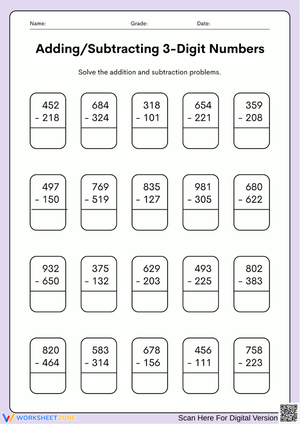
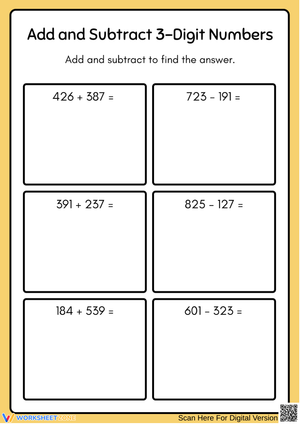
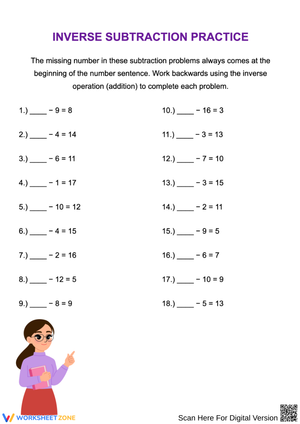
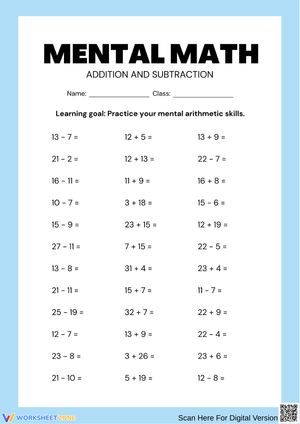
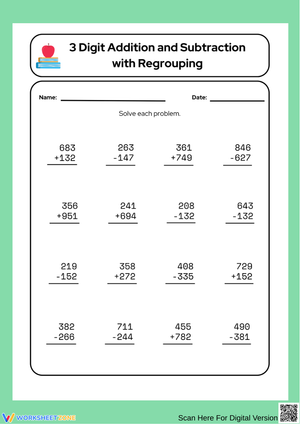
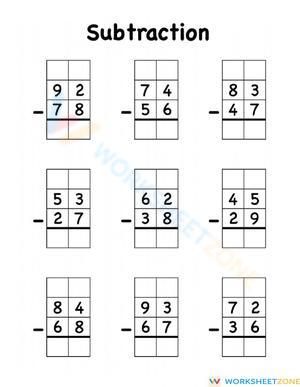
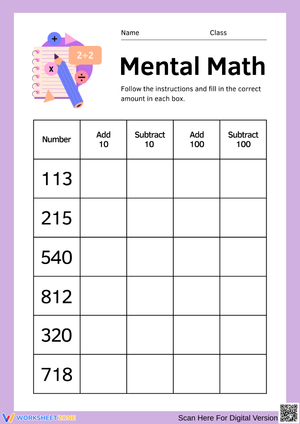
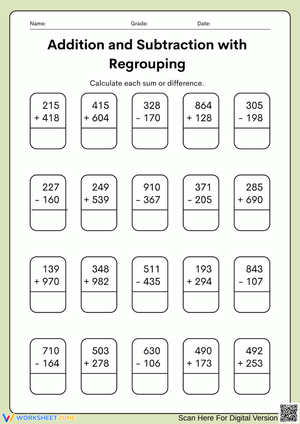
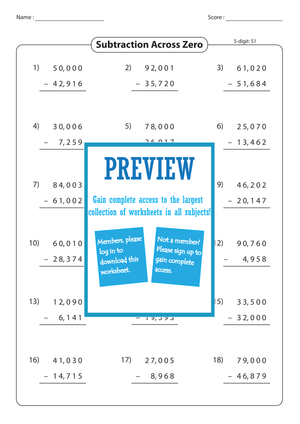
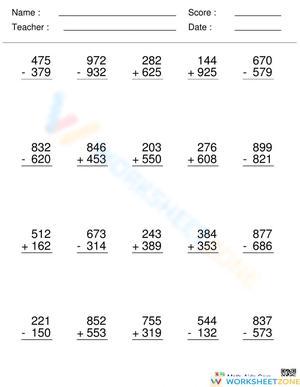
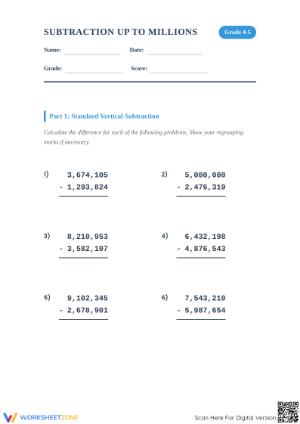
By fourth grade, subtraction practice has to move past single-digit review and into multi-digit problems that require regrouping across two, three, or four place values. CCSS.MATH.CONTENT.4.NBT.B.4 asks students to fluently add and subtract multi-digit whole numbers using the standard algorithm, and it expects that fluency to be connected to place-value reasoning rather than memorized steps. Worksheets built around this standard give a 4th grade classroom teacher, math interventionist, or curriculum lead a fast way to check whether students can execute the algorithm and explain why it works.
A strong worksheet set for this grade sequences problems so regrouping demands increase gradually, and it leaves room for students to show their thinking about place value, not just the final digit.
The Regrouping Errors These Worksheets Target
Two error patterns show up again and again in 4th grade subtraction work. The first is subtracting the smaller digit from the larger digit within a column instead of regrouping, even when regrouping is required. The second is borrowing from a place value without correctly adjusting that digit, which breaks the place-value relationship the whole algorithm depends on.
Both of these errors are procedural symptoms of a conceptual gap: students are treating each column as an isolated fact problem instead of a place-value system. Worksheets that isolate regrouping steps, rather than mixing them into large problem sets, make these errors visible fast, because a teacher scanning ten problems can spot a repeated pattern in seconds instead of reteaching from scratch after a unit test.
Pairing Worksheet Drills with Conceptual Models
Pure algorithm drills have a place in 4th grade subtraction practice, but they work better when paired with visual or concrete models earlier in the unit. A worksheet that includes a place-value chart alongside the standard algorithm problems gives students a way to check their regrouping against a visual reference instead of relying purely on memorized steps.
A brief, source-grounded note on this approach: guidance on teaching 4.NBT.B.4 describes fluency with the standard algorithm as something that should be built on, and connected back to, place-value reasoning developed through models like base-ten blocks and charts, rather than taught as an isolated procedure. That framing supports using worksheets as a follow-up to modeling, not a replacement for it.
Classroom Implementation
To put subtraction worksheets to work across a 4th grade unit, consider this sequence:
- Start each new regrouping level with a short whole-class warm-up worksheet of three to five problems to check readiness.
- Use matched worksheet sets for small-group intervention, aligned to the same regrouping complexity a student is working on with manipulatives.
- Reserve full-length worksheets for guided or independent practice once a student has shown accuracy on the warm-up level.
- Use a short worksheet as a formative check before moving to a new regrouping complexity, so students aren't stacked with new demands before the current skill is solid.
- Watch for the two common error patterns during grading, and group students by error type rather than by overall score for reteaching.
This structure keeps worksheet practice tied to where each student actually is, instead of moving the whole class through the same problem set regardless of individual regrouping accuracy.
Frequently Asked Questions
1. What subtraction skills should a 4th grader master by the end of the year?
By the end of 4th grade, students should be able to fluently subtract multi-digit whole numbers using the standard algorithm, including problems that require regrouping across multiple place values, while connecting their steps to place-value reasoning.
2. How can worksheets help identify and fix regrouping errors?
Worksheets that isolate specific regrouping levels make error patterns easier to spot. A teacher can quickly see whether a student is skipping regrouping entirely or borrowing without adjusting the digit correctly, then match intervention to that specific error.
3. How many regrouping steps should 4th grade subtraction problems include?
Practice should be sequenced from one regrouping step, to two adjacent regrouping steps, and finally to three or more steps in a single problem, so students build accuracy at each level before adding complexity.
4. How can these worksheets be used for intervention versus whole-class review?
For whole-class review, short warm-up worksheets check general readiness before a new lesson. For intervention, matched worksheet sets paired with base-ten manipulatives give small groups a consistent bridge from concrete models to the abstract algorithm.
5. How do subtraction worksheets connect to place-value understanding, not just procedure?
Worksheets that ask students to briefly explain a regrouping step, or that include a place-value chart alongside the algorithm, check whether students understand why regrouping works, not just whether they can execute the steps correctly.













 Interactive Worksheet Maker
 Quiz Maker
 Word Search Maker
 Crossword Puzzle Maker
 Word Scramble Generator
 Sentence Scramble Generator
 Handwriting Worksheet Generator
 Name Tracing Generator
 Fill In The Blank Generator