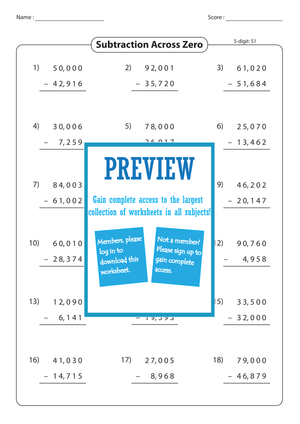
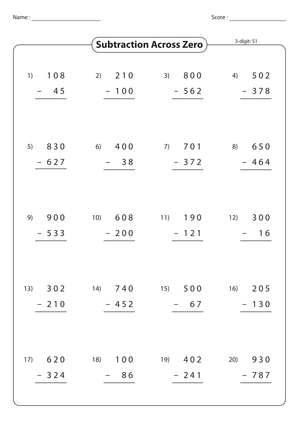
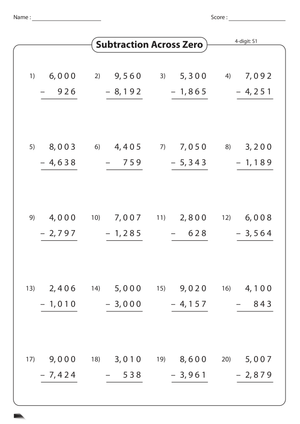
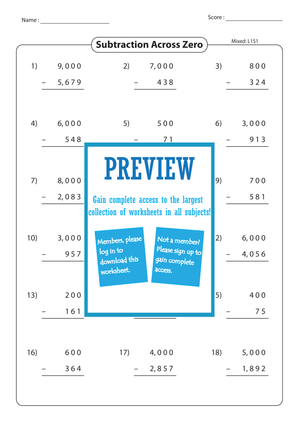
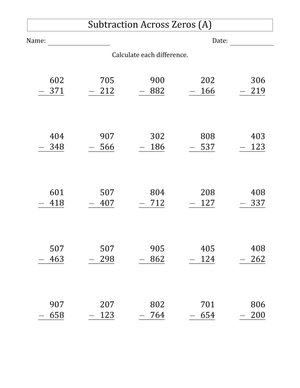
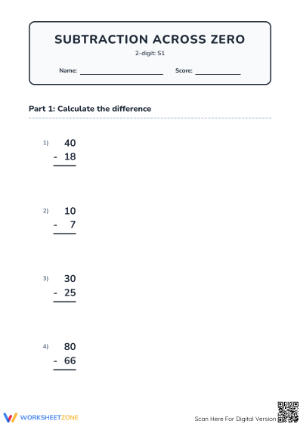
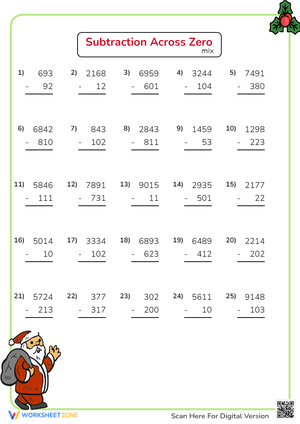
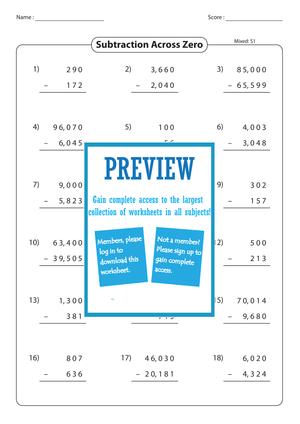
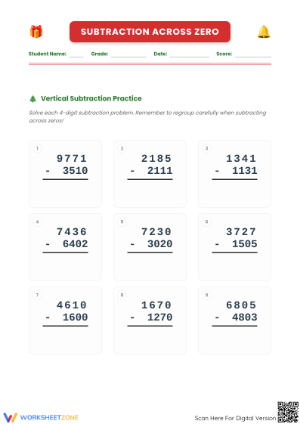
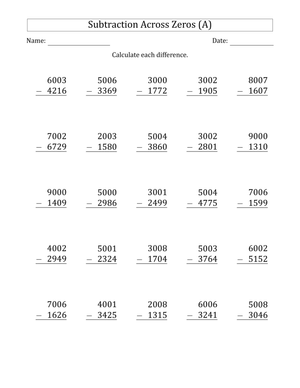
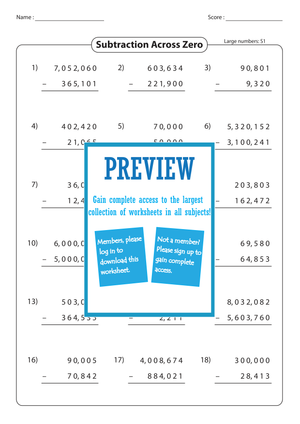
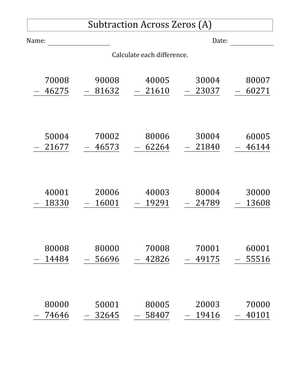
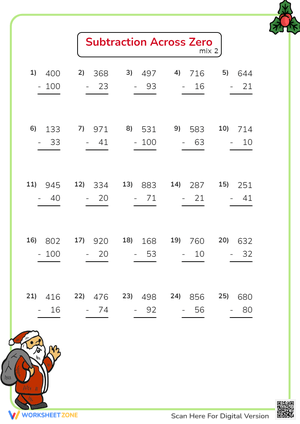
These subtraction across zeros pdf worksheets for 4th grade target the specific procedural obstacle that appears when zeros sit in the interior of a multi-digit minuend and block the usual one-step regrouping. Teachers get a set of practice resources covering 3-digit through 5-digit problems, with focused work on the chain-regrouping sequence that trips most fourth graders before they build real fluency with the standard algorithm.
The Specific Skills Targeted Across the Set
Problems here are organized by the number of consecutive zeros involved. The entry point is a single interior zero — something like 403 minus 178 — where students regroup once across an empty column. Each subsequent worksheet moves toward two and three consecutive zeros, requiring students to track multiple place-value changes in the correct order. The set also includes problems where a zero sits in the thousands place but not the hundreds, which produces a different regrouping path and exposes students who have memorized a procedure without understanding what each step actually represents.
Beyond standard vertical computation, the subtraction across zeros pdf worksheets for 4th grade in this collection ask students to rewrite problems in vertical form, identify and correct errors in pre-worked examples, and verify answers using the inverse relationship between addition and subtraction. That checking habit — adding the difference back to the subtrahend to confirm the minuend — builds over repeated practice into something students reach for automatically rather than skipping when they feel confident.
Error Patterns Worth Tracking at Every Step of the Regrouping Chain
The most revealing error isn't a wrong digit in the answer — it's what students do to the zeros before they even start subtracting. A student who handles standard regrouping without trouble will often default to flipping when zeros appear: faced with 7,000 minus 2,456, they write 6 minus 0 equals 6, 5 minus 0 equals 5, 4 minus 0 equals 4, and 2 from 7 equals 5, arriving at 5,546 instead of 4,544. This subtract-up pattern signals that the student is applying an earlier rule by rote rather than reading the actual place values.
The second major error is an incomplete regrouping chain. Students reach into the thousands column, correctly reduce 7 to 6, and stop — placing 10 in the ones column without renaming the hundreds and tens in between. They record 10 minus 6 equals 4 in the ones place, then face 0 minus 5 and stall again. The middle zeros do not automatically become 9s in a student's working memory; each conversion requires a deliberate decision, and that decision doesn't solidify until students have made the error in a real problem and traced it back through each column.
A third pattern worth catching is column drift. When students crowd their digits without grid paper, a regrouped 10 written above the ones column slides visually into the tens column, and students subtract from the wrong value. This is an organization issue rather than a conceptual gap, but it produces wrong answers that look identical to procedure errors when reviewing a full stack of papers.
Fitting These Worksheets Into Your Instructional Week
The "box the tens" approach pairs well with this set as an opening move before independent practice begins. In 500 minus 167, rather than regrouping one digit at a time, ask students to box the 50 — treating those two digits as 50 tens — and work from there. Taking one ten from 50 leaves 49; students write 49 above the tens-hundreds space and place 10 in the ones column. The zeros in the original number become 4 and 9 automatically from the 49, which answers the persistent "why does that zero turn into a 9?" question without requiring a separate explanation. Once students see the logic through this approach, the standard multi-step algorithm reads as a slower version of the same reasoning.
For pacing, these resources work best after students have solid accuracy with regrouping across single non-zero digits. A Monday warm-up using one worksheet from the 3-digit section establishes the week's focus; a Thursday version using 4-digit numbers gives a quick formative read before the end of the week. Timed fluency work belongs after conceptual accuracy is consistent — not as the entry point. Error-analysis tasks run as partner discussion, rather than silent seat work, surface more place-value language per minute than almost any other format in the rotation.
These subtraction across zeros pdf worksheets for 4th grade also hold up well in the 8 to 10 minutes before a specials pickup: each worksheet is self-contained, students can start without whole-group instruction, and an answer key makes a real-time teacher check realistic in that compressed window.
Standard Alignment
CCSS.MATH.CONTENT.4.NBT.B.4 requires students to fluently add and subtract multi-digit whole numbers using the standard algorithm. "Fluency" here implies both accuracy and efficiency — which is why problems involving consecutive zeros fall directly within this standard's scope. A student who can regroup across a single non-zero digit but stalls at a zero has not fully met the requirement. In classroom sequencing, this skill surfaces mid-year after students have revisited 3-digit subtraction carried over from third grade and before multi-step word problems with larger numbers move to the foreground of instruction.
Tiering the Practice for Below-Level and Advanced Learners
Students who struggle with the chain regrouping sequence benefit from working with base-ten block manipulatives alongside the earlier worksheets in the set. Physically trading a hundreds flat for ten ten-rods — then trading a ten-rod for ten unit cubes — connects written notation to a concrete action they can see and reverse. Once a student can describe what they're doing with the blocks in place-value terms, the transfer to paper becomes an extension of that reasoning rather than a separate procedure to memorize.
For students who have the algorithm well in hand, subtraction across zeros pdf worksheets for 4th grade with embedded word problems extend the practice into applied reasoning: calculating remaining inventory, finding the gap between two population figures, or determining change from a large bill. These contexts demand the same regrouping procedure without advertising it as drill, which sustains effort from students who disengage the moment they recognize a straight computation set.
Students who process slowly or freeze under time pressure do better starting with problems that have a single interior zero rather than multiple consecutive zeros, until that simpler case is automatic. Moving to full chain regrouping before the foundational move is secure adds cognitive load at exactly the wrong moment in skill development.
Frequently Asked Questions
How do you explain to a 4th grader why a zero can't give anything to the column beside it?
The clearest framing is transactional: a zero in the tens column means that column is empty — it has nothing to give. To get a ten for the ones column, the student moves to the nearest column to the left that holds a value and trades one unit from there into ten smaller units, working back step by step. The warehouse analogy translates well — the local shelf is empty, so stock has to come from the back room, repackaged into smaller units before it reaches the front. Consistency in this language across lessons matters more than which specific analogy a teacher settles on.
Is the "Subtract 1" trick worth teaching alongside the standard algorithm?
As a checking tool, yes. Subtracting 1 from both the minuend and subtrahend — turning 4,000 minus 1,562 into 3,999 minus 1,561 — removes all zeros from the top number and eliminates the regrouping chain entirely. The difference stays the same because both numbers shift the same distance on the number line. Fourth graders who can explain why this works show genuine place-value understanding. The tradeoff: students who are still shaky on the algorithm sometimes adopt this approach to avoid the standard method altogether, which creates problems when numbers don't set up cleanly for the adjustment.
Why do students keep making errors on this skill even after a strong first lesson?
Retention gaps here are predictable. Students who execute chain regrouping correctly on Wednesday often lose a step by the following Monday — particularly the conversion of middle zeros to 9s. Spaced retrieval practice, returning to one worksheet from the set every week or two rather than massing all practice into a single unit, produces more durable accuracy than a concentrated focus followed by moving on. The forgetting curve hits procedural skills hard, and brief re-exposure costs far less time than a full reteach three weeks later.
How does checking with addition actually work in practice?
Students add their answer — the difference — to the number they subtracted. The result must match the original top number. If 500 minus 125 gives 375, then 375 plus 125 must return to 500. When the check fails, the mismatch tells the student exactly where to look: the addition is usually straightforward, so a wrong sum points directly back to an error in the subtraction. Building this as a routine step — not optional — catches incomplete regrouping chains before work gets turned in.













 Interactive Worksheet Maker
 Quiz Maker
 Word Search Maker
 Crossword Puzzle Maker
 Word Scramble Generator
 Sentence Scramble Generator
 Handwriting Worksheet Generator
 Name Tracing Generator
 Fill In The Blank Generator