


























Views
Downloads




Printable Subtraction Worksheet | Grade 4 Math
Paste this activity's link or code into your existing LMS (Google Classroom, Canvas, Teams, Schoology, Moodle, etc.).
Students can open and work on the activity right away, with no student login required.
You'll still be able to track student progress and results from your teacher account.
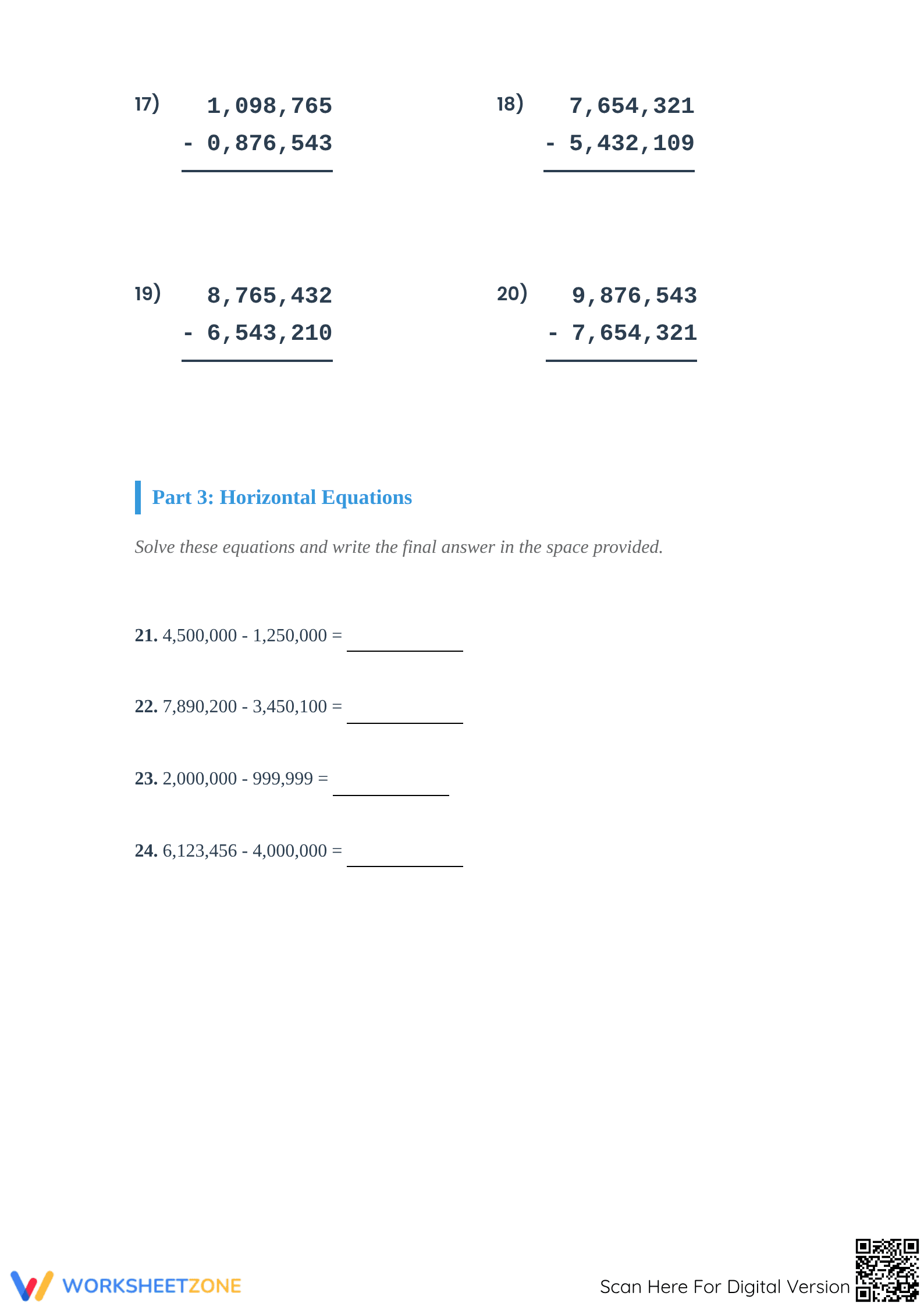
This complete worksheet provides focused practice on subtracting multi-digit numbers up to the millions. Designed for Grade 4 or as a Grade 5 review, it helps students build procedural fluency with the standard algorithm. Students will solve 48 problems, reinforcing their understanding of place value and regrouping in a clear, structured format.
At a Glance
- Grade: 4–5 · Subject: Math
- Standard:
CCSS.MATH.CONTENT.4.NBT.B.4— Fluently subtract multi-digit whole numbers using the standard algorithm.- Skill Focus: Multi-Digit Subtraction (up to millions)
- Format: 4 pages · 48 problems · Answer key included · PDF
- Best For: Independent practice, homework, or fluency drills.
- Time: 25–40 minutes
What's Inside
This resource includes four pages of subtraction problems, with 12 questions per page, for a total of 48 practice items. The problems involve numbers up to the millions, requiring students to apply regrouping across multiple place values. A complete four-page answer key is also provided, showing the final answer for every problem, making for quick and easy grading.
A Clear Path to Fluency
The consistent format and gradual-release model of this worksheet set build student confidence and mastery through sufficient practice, moving them from initial instruction to confident, independent application of procedural fluency.
- Guided practice: The first page can be used as guided practice. A teacher can model solving the first few problems, emphasizing proper alignment of place values and the steps for regrouping.
- Supported practice: Students can work on the second and third pages in pairs or with teacher support, reinforcing the learned procedure. The consistent problem structure allows them to focus solely on calculation.
- Independent practice: The final page serves as an excellent tool for independent practice or a formative assessment, allowing students to demonstrate their mastery of the standard algorithm on their own.
Standards-Aligned for Your Classroom
This worksheet is directly aligned with the Common Core State Standard for Grade 4 Mathematics:
CCSS.MATH.CONTENT.4.NBT.B.4: Fluently add and subtract multi-digit whole numbers using the standard algorithm.
These 48 problems provide extensive practice with the target skill. The standard code can be easily integrated into lesson plans, IEP goals, or curriculum mapping tools.
Practical Classroom Applications
This versatile resource can be implemented at various points in your instruction. Use it as independent practice after a direct instruction lesson on multi-digit subtraction to solidify the concept. It also functions perfectly as a homework assignment to reinforce skills learned in class. For formative assessment, assign the final page as a quick quiz to check for understanding; the clear format makes it easy to spot common errors in regrouping. Expect students to take between 25 and 40 minutes to complete all four pages.
Designed for Grade 4 and 5 Learners
This worksheet is ideal for fourth-grade students learning multi-digit subtraction for the first time. It is also an excellent resource for fifth graders who need a review of the standard algorithm before moving on to more complex operations with decimals. The straightforward layout is accessible for all learners, and it can be paired with a place value chart or base-ten blocks to provide concrete support for students who need it.
Mastering procedural fluency in multi-digit subtraction is crucial for elementary mathematics and future success in algebra. This worksheet offers extensive practice aligned with CCSS.MATH.CONTENT.4.NBT.B.4, ensuring students fluently subtract multi-digit whole numbers using the standard algorithm. Sufficient practice builds automaticity, freeing cognitive resources for higher-order problem-solving and establishing a solid computational foundation for advanced mathematical concepts.


