When a 4th grade student sits down with a multi-digit subtraction problem, the goal isn't just a correct answer. CCSS.MATH.CONTENT.4.NBT.B.4 asks students to fluently subtract multi-digit whole numbers using the standard algorithm, which means the work has to be efficient, accurate, and flexible enough to hold up under pressure. Subtraction strategies worksheets built for this grade level give teachers a way to sequence that growth instead of jumping straight to the algorithm and hoping it sticks.
For a classroom teacher planning a subtraction unit, that sequencing decision matters more than any single worksheet. Students arrive at 4th grade with a range of prior experience: some can already regroup across zeros, others are still counting back by ones. Worksheets that isolate one strategy at a time, then blend strategies together, let you meet both groups without slowing the whole class down.
From Place-Value Models to the Standard Algorithm
Grade 4 subtraction instruction works best when it treats the standard algorithm as the destination, not the starting point. Students need to see why the algorithm works before they're asked to use it quickly. That means early worksheets in a unit should use base-ten blocks, place-value charts, or expanded-form subtraction so students can connect each regrouping step to an actual quantity of tens and ones changing hands.
A useful classroom checkpoint is to have students explain a regrouping step out loud before writing it down, using language like taking one ten and regrouping it into the ones place. Teachers who build this verbal step into worksheet routines tend to catch misconceptions days before they show up as wrong answers on a quiz, because the error is audible before it's written.
Once students can explain their reasoning, worksheets can shift toward the standard algorithm itself, still keeping place-value language in the margins or in a sentence starter so the procedure doesn't detach from meaning.
Subtraction With Regrouping Worksheets That Build Conceptual Understanding
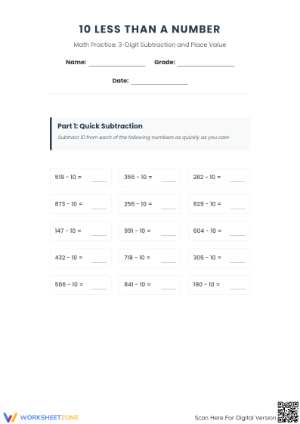
Regrouping, sometimes still called borrowing by students who learned it at home, is the single skill most likely to break down in 4th grade subtraction. Worksheets that isolate regrouping across one zero, then two zeros, then mixed problems, give students a controlled way to practice the exact move that trips them up.
- Single regrouping problems, such as 542 minus 178, to practice one ten-for-ones exchange
- Regrouping across a zero, such as 600 minus 245, to practice borrowing through an empty place value
- Mixed problem sets that require students to decide whether regrouping is even necessary
That last bullet matters. A worksheet full of problems that always require regrouping trains students to regroup automatically, even when it isn't needed. Mixing in problems that don't require regrouping forces students to check the ones and tens columns before committing to a strategy, which is closer to the flexible fluency the standard describes.
Classroom Implementation
In practice, a two-week subtraction strategies unit might open with two days of place-value modeling worksheets, move into three days of targeted regrouping practice including the across-zero case, add two days of estimation-paired problem sets, and close with a fluency checkpoint that mixes regrouping and non-regrouping problems.
- Keep early worksheets untimed so students can show their reasoning
- Introduce timed fluency practice only after regrouping errors have dropped in untimed work
- Use small-group worksheets as a checkpoint, not a replacement, for whole-class instruction
Teachers running intervention groups can reuse the same worksheet sequence at a slower pace, spending an extra day on the across-zero regrouping set since that's where most 4th grade subtraction errors cluster.
Frequently Asked Questions
1. What subtraction strategies should 4th graders know before mastering the standard algorithm?
Students should be comfortable with place-value based subtraction, including expanded form and base-ten block models, and able to explain a regrouping step in place-value language before worksheets shift toward the standard algorithm.
2. How many digits should 4th grade subtraction worksheets include to match grade-level standards?
CCSS.MATH.CONTENT.4.NBT.B.4 centers on multi-digit whole numbers, and grade-level practice sets commonly range from three-digit to four-digit subtraction problems, with and without regrouping.
3. How can teachers use subtraction worksheets to identify regrouping errors?
Mixed problem sets that include regrouping across a zero, alongside problems that need no regrouping at all, reveal whether a student is applying the procedure automatically or actually checking each place value before subtracting.
4. How does estimation support subtraction fluency in 4th grade?
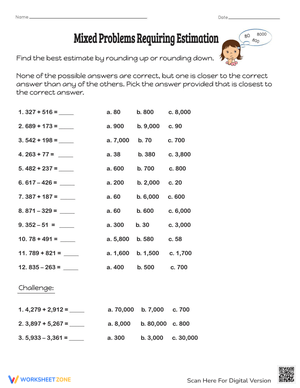
Rounding numbers before solving gives students a benchmark to compare against their exact answer, which helps them catch regrouping mistakes independently instead of waiting for a teacher to grade the work.













 Interactive Worksheet Maker
 Quiz Maker
 Word Search Maker
 Crossword Puzzle Maker
 Word Scramble Generator
 Sentence Scramble Generator
 Handwriting Worksheet Generator
 Name Tracing Generator
 Fill In The Blank Generator