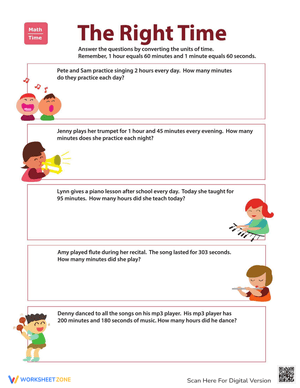
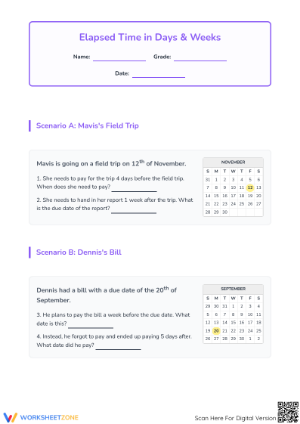
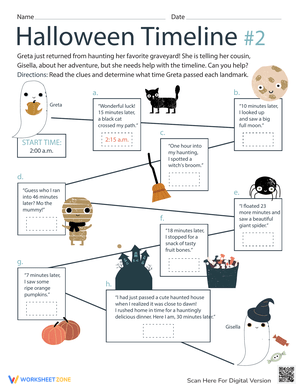
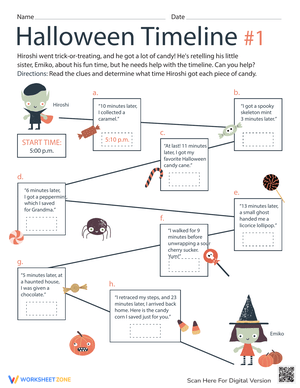
These word problems worksheets for 4th grade give teachers a ready-to-print set of elapsed time problems built around the three question types that define this skill at the Grade 4 level: finding duration, finding start time, and finding end time. Each worksheet uses short real-world situations — school assemblies, field trips, swim practice, bus rides — with numbers students can work through without the reading load becoming the obstacle. The problems invite multiple solving strategies, which matters when students are still deciding whether counting forward, drawing a clock, or using a number line works best for them.
The Specific Skills Targeted in Each Worksheet
Elapsed time sits at the crossing point of number sense, measurement, and careful reading. The problems ask students to hold two times in mind, determine their relationship, and choose a method for computing the gap. That cognitive demand is meaningfully different from telling time on a clock face, which is why elapsed time appears as its own instructional focus in Grade 4 rather than folding into earlier time-telling units.
- Calculating elapsed time when both start and end times appear in the problem
- Determining start time by counting backward from an end time and a known duration
- Determining end time by counting forward from a start time and a known duration
- Distinguishing AM from PM in contexts where the transition matters for the answer
- Checking answers for reasonableness — a 10-minute school activity should not yield a 2-hour answer
- Choosing among strategies: open number lines, clock diagrams, or jump counting in 15- or 30-minute increments
Mistakes Students Make That These Worksheets Help You Catch
The most predictable error in Grade 4 elapsed time work is treating minutes as if they follow base-10 rules. A student who adds 45 minutes to 1:30 will often write 1:75 instead of 2:15, applying the same regrouping logic they use with whole numbers. This turns up in roughly half the class the first time elapsed time is formally introduced, and it persists when students never stop to verify whether their answer actually names a real time on a clock.
Crossing hour boundaries trips up a different group. A student might handle elapsed time correctly within a single hour but lose track when a problem spans two hour markers. Take a problem running from 10:45 to 1:15: students will sometimes count forward one hour to 11:45, then stall at the transition to 12:00 or double-count the noon hour entirely. Students who work in smaller jumps — 15 or 30 minutes at a time marked on a number line — navigate this more reliably than those trying to span the full gap in one step.
A third pattern is misidentifying what the question actually wants. Some students read a problem asking for start time and calculate elapsed time instead, because "find how long" is the version of this skill they practiced first. Sorting problems by unknown type — start, end, or total — before attempting any computation is a small pre-solving step that interrupts this confusion before the numbers get involved.
Getting the Most From These Worksheets in Your Lesson Plans
The most reliable setup before distributing an elapsed time worksheet is to model one problem publicly. Read the scenario aloud, underline the two times explicitly, and name what the question is actually asking — because students who skip that step often compute the right quantity for the wrong question. After the model, students work the remaining items independently before the class debriefs strategies together.
For teachers looking for word problems worksheets for 4th grade that fit multiple lesson formats, this set slots into several spots across the week. A full worksheet works as independent practice after direct instruction. Three or four items from the set make a clean exit ticket after a lesson. A single problem used as morning work — one that asks students to solve two different ways and compare — runs about 8 minutes and reactivates prior knowledge before the math block starts.
In math centers, one station can run the worksheet independently while a second station pairs students to compare how they approached the same problem. That comparison conversation — "why did you start at 9:30 and I started at 10:00?" — surfaces conceptual understanding that written answers alone rarely show. For small-group intervention, pull three or four problems, slow the pace, and ask students to narrate each step aloud before writing anything down.
Standard Alignment
These worksheets address CCSS.MATH.CONTENT.4.MD.A.2, which asks students to use the four operations to solve word problems involving intervals of time, distances, and other measurement quantities. In classroom terms, this standard moves well past clock-reading and into problem-solving situations where students must identify what is known, what is unknown, and which operation or counting method bridges the gap. Teachers who incorporate word problems worksheets for 4th grade into their 4.MD.A.2 instruction will find elapsed time the most demanding application within this standard — it calls on careful reading, strategic thinking, and number fluency simultaneously rather than any of those skills in isolation. This standard typically lands in the second semester of Grade 4, after whole-number operations are strong enough to carry applied measurement work.
Adjusting Each Worksheet for a Range of Learners
Students hit walls in elapsed time for different reasons, and the same worksheet can be used flexibly without writing separate versions for each group. For students who lose track mid-computation, annotating the worksheet before they start helps: highlight the start and end times, add an open number line below the problem, and ask them to record each jump separately rather than computing the full span in one move. That reduces working-memory demand without stripping out the mathematical reasoning the problem requires.
On-level students work the standard worksheet with one added expectation: show the strategy, not just the answer. Students ready for more can solve each problem using two different methods, then verify that both produce the same result — a task that reveals understanding of elapsed time structure that a single correct answer cannot show. Another extension is asking those students to write an original elapsed time word problem using times from their actual school day, then trade with a partner to solve.
Frequently Asked Questions
Do these worksheets cover all three elapsed time question types?
Yes. Each worksheet includes problems where students find elapsed time, start time, and end time. Mixing all three within the same worksheet forces students to read each problem carefully rather than defaulting to one routine across the full worksheet.
What solving strategies are students expected to use?
The work space in each worksheet is open-ended rather than formatted for one specific method. Students can use number lines, clock diagrams, step-by-step counting, or equations. That flexibility also makes it easier for teachers to observe strategy preferences across the class during group review.
Are these appropriate for students who are still shaky on clock reading?
Students who cannot reliably read an analog clock will need brief re-teaching before working with elapsed time independently — this skill builds directly on time-reading fluency. That said, word problems worksheets for 4th grade in this set present all times in digital notation rather than as drawn clock faces, which removes one layer of difficulty for students who know their numerals but are still building clock-reading confidence.
How should teachers use the answer key after students finish?
The most useful move is to look for error patterns rather than just tallying correct and incorrect answers. A student who missed three problems all involving start-time unknowns is showing a different gap than one who made scattered computation errors throughout. That distinction changes what re-teaching looks like the following day, and it is easy to spot when the answer key is right there.













 Interactive Worksheet Maker
 Quiz Maker
 Word Search Maker
 Crossword Puzzle Maker
 Word Scramble Generator
 Sentence Scramble Generator
 Handwriting Worksheet Generator
 Name Tracing Generator
 Fill In The Blank Generator