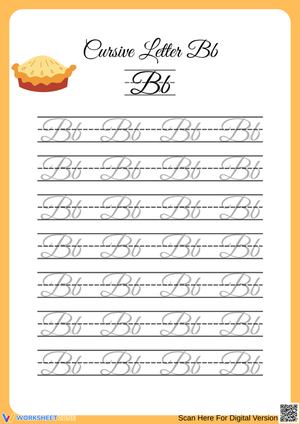
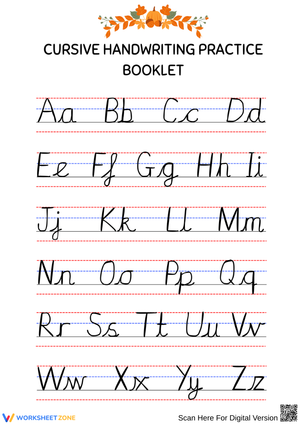
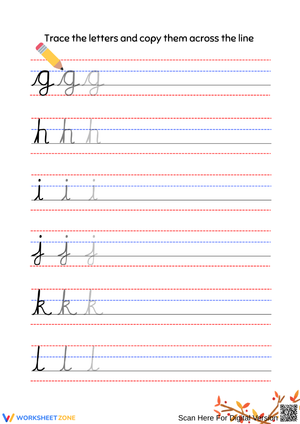
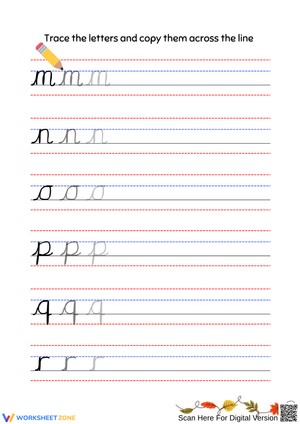
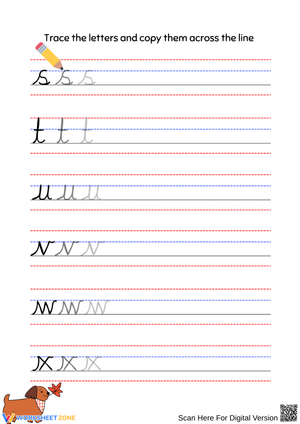
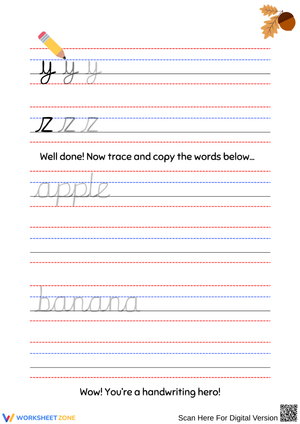
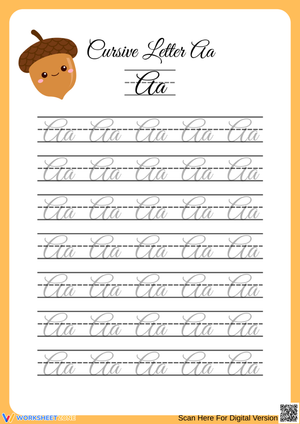
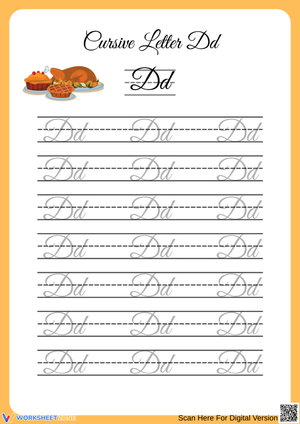
These 4th grade cursive alphabet handwriting printable worksheets give teachers a focused review tool for a specific moment in handwriting development: students have already been introduced to cursive, but formation habits are still settling. The set covers uppercase and lowercase letters with model examples, tracing lines, and open practice space — a layout clean enough that a student can pick up a pencil and start without needing a three-minute explanation.
What's Inside the Set
Each worksheet targets a specific letter or small letter group rather than stacking the full alphabet into one cluttered worksheet. Uppercase and lowercase letters are treated separately, because they present genuinely different challenges at this grade level. Students trace the model letter first, work through guided tracing lines, then move to open practice lines — progressing from supported writing to independent recall within each worksheet.
Beyond formation, the practice targets the details that make cursive actually readable: consistent slant, correct letter height relative to the guideline, and smooth entry and exit strokes. When a student's lowercase l sits at the same height as her lowercase a, the word becomes harder to read than the content deserves. The tall ascender letters — b, h, k, l — belong at full ascender height, and the line structure on each worksheet makes it visually clear when a student has drifted below it.
The Formation Errors That Show Up Most in Grade 4
The letters that cause the most trouble are the ones students use least often. Uppercase Q is the reliable example: students reproduce something that resembles a printed 2 with a curved tail — technically matching the standard cursive form — but because they've rarely practiced the transition out of it, they don't connect smoothly to the following lowercase letter. Uppercase X causes a similar problem: instead of forming the crossing loops of cursive, students draw two straight intersecting lines the way they would in print, then look at the result and sense something is off without knowing what.
Lowercase letters produce a different category of error. The f is the one to watch closely — it loops above the midline and below the baseline, and students who work quickly close the bottom loop too early, producing something closer to a j. Letter height is the other consistent issue. Students let ascender letters drift toward midline height, which collapses the visual contrast between tall and short letters in a word. A single alphabet worksheet surfaces this habit clearly in a way that running cursive writing cannot — you see the pattern in isolation before it disappears into a sentence.
Getting the Most Out of These Worksheets, Day by Day
Short, consistent sessions produce better results than occasional long handwriting blocks. Ten focused minutes right before the writing block helps students carry cleaner habits into whatever they write next. 4th grade cursive alphabet handwriting printable worksheets sit naturally in morning work routines: one worksheet at the start of the day gives students something purposeful to do between unpacking and morning meeting, and they've already reviewed two or three letter forms before the first lesson begins.
The format also fits several other spots in the school day without any extra setup:
- Writing center: Place worksheets alongside a model alphabet strip for independent practice without teacher direction.
- Intervention block: Tracing lines give students who need motor support enough structure to practice without constant oversight.
- Homework: One focused worksheet per night is a low-burden review that most families can manage without any explanation from you.
- Sub plans: The directions are embedded in the format — a substitute needs to say nothing beyond "complete the worksheet."
The most useful approach in Grade 4 is to treat alphabet review as a quick diagnostic rather than a standing unit. Pull one uppercase worksheet and one lowercase worksheet in the same week, watch what students produce, and let that inform what the class actually needs. If lowercase letters are clean across the board but several students are forming capital G with a printed curve instead of the full cursive loop, you've run a formative check without setting aside separate assessment time. When a specific weakness shows up, assign only the relevant worksheet rather than pushing every student through the same sequence.
How the Same Worksheet Serves Different Students
The same worksheet can serve different students with minimal added preparation. Students who need motor support work through the tracing lines only — completing the tracing portion of each worksheet gives them a correct, finished model of the letter without demanding independent recall before they're ready. Students with stronger fluency skip the tracing entirely and move directly to the open practice lines, where they retrieve the letter form without visual guidance. That shift from tracing to independent writing is a meaningful increase in cognitive demand using the exact same resource.
For students who rush and produce careless work, add one instruction: circle the two best-formed letters on each line and write one word that uses the target letter. The brief reflection slows them down and sharpens attention without requiring a separate worksheet. Students working with an occupational therapist find this format a natural fit as well — the consistent line structure and clear letter models match the kind of structured motor practice OT programs commonly recommend. 4th grade cursive alphabet handwriting printable worksheets also translate easily to at-home practice, making them a straightforward choice when families request a print-ready resource that needs no additional explanation from the teacher.
Frequently Asked Questions
Do fourth graders really need to review the cursive alphabet if they were taught it in earlier grades?
Yes — and at this stage the goal is refinement, not re-teaching. Students learned cursive quickly in second or third grade and then used it unevenly. By fourth grade, infrequently practiced letters — especially capital forms — have drifted from the original model. A focused review worksheet brings those habits back into view before they become permanent.
How many letters should students practice in one session?
For a 10-minute block, two to four letters is a realistic target. Working through more than that in one sitting tends to produce declining attention and messier work toward the end. Each worksheet in this set stays within that range, keeping sessions short enough to feel purposeful rather than tedious.
How do these worksheets fit into a broader writing curriculum?
Think of them as maintenance practice rather than a curriculum component. 4th grade cursive alphabet handwriting printable worksheets support the mechanical side of writing — fluency and legibility — which frees up cognitive attention for composing ideas. Brief, regular use alongside authentic writing tasks (short responses, note-taking, paragraph work) gives students the strongest combination of practiced skill and applied writing.
Can these worksheets work for students who have never been formally taught cursive?
They can, but they work best for students with at least some prior exposure. The tracing lines provide enough structure for a beginning learner, but the open practice lines assume the student can recall the letter shape without step-by-step verbal instruction. For a student with no prior cursive background, pair each worksheet with direct teacher modeling before asking them to work independently.