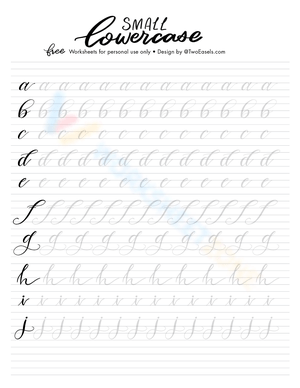
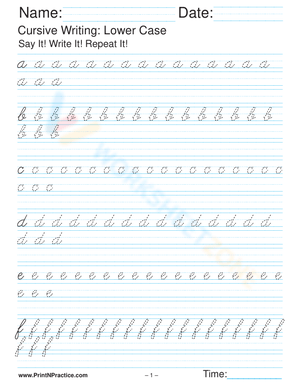
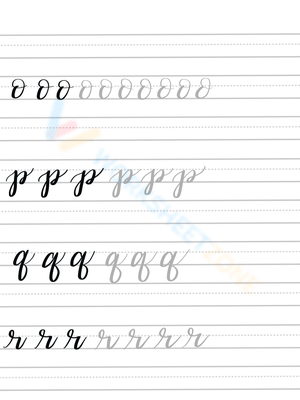
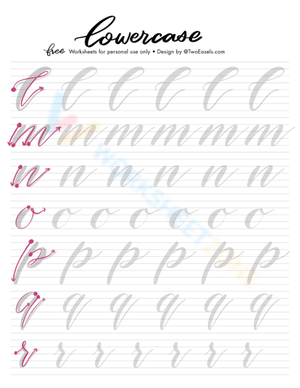
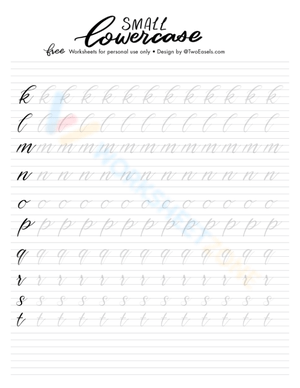
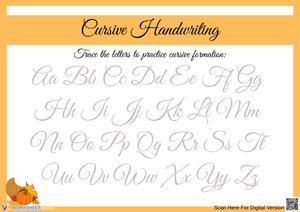
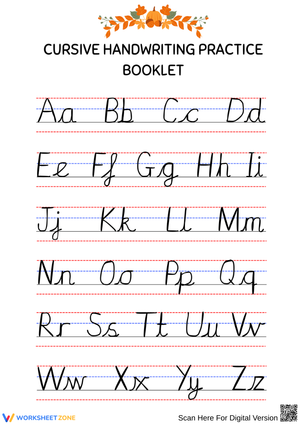
When a fourth grade teacher searches for lowercase cursive handwriting letters for grade 4, the goal usually is not teaching cursive from scratch. By this point, most students have already had one or more years of exposure to cursive formation, so grade 4 practice is really about smoothing out inconsistent letter shapes, tightening spacing, and building the kind of automatic recall that lets a student write a full sentence without stopping to think about every stroke. Worksheets built specifically for this stage should assume some prior exposure and push toward speed and consistency rather than starting with basic strokes.
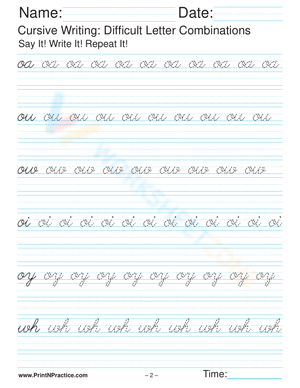
A fourth grade cursive worksheet that only covers isolated letter tracing will feel too easy and will not address the real problem: uneven letter height, inconsistent slant, or letters that technically look right in isolation but fall apart once a student tries to connect them in a word. Grade 4 lowercase cursive practice should combine review of tricky letters with connected writing practice so students transfer isolated skill to real writing tasks.
How Lowercase Letter Consistency Boosts Spelling and Writing Speed
Letter formation is not just a fine motor exercise. When lowercase cursive letters become automatic, students spend less mental energy on the mechanics of writing and more on choosing words, spelling them correctly, and organizing their ideas. That is why handwriting fluency and composition quality tend to move together as students progress through the upper elementary grades.
Handwriting research summarized by the Iowa Reading Research Center notes that fluent cursive writing consistently predicts stronger spelling and composition skills for students in grades 4 through 7, which places grade 4 squarely inside the window where consistent lowercase letter practice pays off in measurable writing gains rather than simply neat penmanship.
Using These Worksheets for Daily Warm-Ups and Handwriting Centers
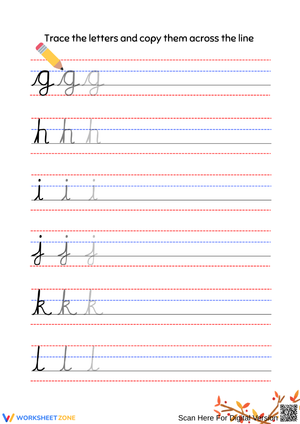
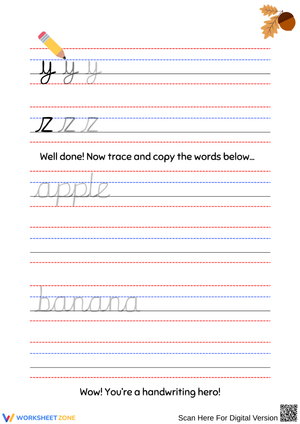
Short, frequent practice beats long, infrequent sessions for handwriting fluency. Many fourth grade teachers use a lowercase cursive worksheet as a five to eight minute warm-up before writing block, or as one rotation in a literacy center where students trace, copy, then write from memory without looking at a model. A simple three-step worksheet structure works well for this: trace the letter several times, copy it independently, then write it inside a short word.
Homework can extend this practice without adding much grading load. A single worksheet sent home to review that week's stroke family, paired with a quick two-minute check the next morning, keeps practice consistent without turning cursive into a separate subject that competes for instructional minutes.
Classroom Implementation
Practical use of lowercase cursive worksheets works best when it is folded into the existing writing routine rather than treated as an add-on. A few approaches that hold up across a typical fourth grade schedule:
- Open writing block with a two-minute cursive warm-up tied to that day's stroke family before moving into the main writing task.
- Use one worksheet per week as a formative check, keeping a quick record of which letters or joins need re-teaching for individual students.
- Pair students for peer review, where partners circle the neatest word on each other's sheet and name one thing done well.
- Rotate cursive practice into a literacy center so it does not always require direct teacher instruction time.
- For students who need extra repetition on specific letters, a short targeted worksheet works better than repeating the full alphabet sheet.
These routines keep cursive practice light but consistent, which matters more for fluency than occasional long sessions.
Cursive Requirements Are Expanding Across States
Classroom demand for structured lowercase cursive practice has grown alongside a broader policy shift. As of 2025, multiple US states have passed or reinstated laws requiring cursive instruction in elementary grades, which means more grade 4 teachers are expected to show consistent, sequenced cursive practice rather than occasional enrichment activities. This makes it worth keeping a simple record of which stroke families a class has covered across the year, both for planning and for demonstrating coverage if a school or district asks for evidence of instruction.
A 2020 study cited in handwriting research found that cursive handwriting instruction improved spelling accuracy, storytelling ability, and the length of writing produced by elementary students, according to research summarized by the OT Toolbox: this reinforces that lowercase cursive practice is not a cosmetic skill but one tied directly to measurable gains in written output that grade 4 teachers can expect to see over a semester of consistent practice.
Frequently Asked Questions
1. Why do grade 4 students still need lowercase cursive practice if cursive is introduced earlier?
Introduction and fluency are different goals. Most students have seen cursive letters in earlier grades, but grade 4 practice focuses on making formation automatic, consistent, and fast enough to support real writing tasks rather than isolated letter copying.
2. How much time should grade 4 teachers dedicate to cursive practice each week?
Short, frequent sessions work better than long ones. Five to ten minutes daily, or a slightly longer session two to three times a week, is generally enough to maintain and build fluency without crowding out other writing instruction.
3. What are the hardest lowercase cursive letters for grade 4 students to master?
Letters that require tricky joins or unusual starting strokes, such as r, s, v, and z, tend to cause the most trouble. Rounded letters like a, d, and g also commonly show inconsistent shape if not reviewed as a group.
4. How does lowercase cursive practice support spelling and writing fluency?
When letter formation becomes automatic, students free up attention for spelling choices and idea organization instead of the mechanics of forming each letter, which research links to stronger spelling accuracy and longer written output.
5. Are states requiring cursive instruction again, and how does that affect grade 4 curriculum?
Yes. Several US states have reinstated cursive requirements in elementary grades as of 2025, which means grade 4 teachers should expect to document consistent, sequenced cursive instruction rather than treating it as optional enrichment.