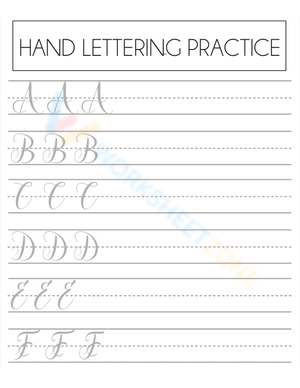
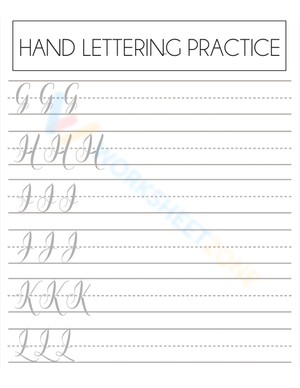
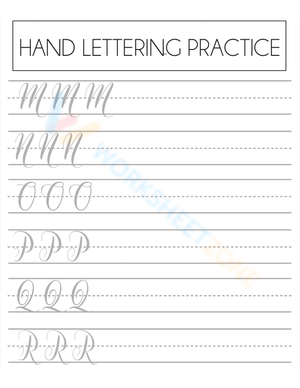
By fourth grade, most students have already met cursive in earlier elementary grades, so capital letter work shifts from forming the shape correctly to writing it accurately, at speed, and inside real sentences. That distinction shapes how you choose 4th grade cursive capital letters worksheets. The goal is legible, automatic capitals students can drop into proper nouns and sentence starts without slowing their thinking. This page pairs practice pages with an instructional approach built for that fluency stage, whether you are running whole-class review or targeted intervention.
Cursive capitals are the trickiest part of the alphabet for upper-elementary writers. They carry more entry strokes, loops, and directional changes than lowercase letters, and several rarely appear in everyday student writing. A fourth grader might write a lowercase letter hundreds of times a week but form a cursive capital Q or Z only a handful of times all year. That imbalance is exactly why capitals deserve their own focused practice block instead of being folded into general handwriting review.
Why Fourth Graders Still Practice Capital Letters
Teachers sometimes ask why capital letter drills reappear at all in fourth grade. The short answer is that state requirements and classroom reality rarely line up. Many mandates place core cursive instruction in the primary grades, which means fourth grade often works as a reinforcement and fluency year rather than a first exposure. Students arrive with uneven memory of the shapes, and the capitals fade fastest because they show up least often in daily writing.
State policy adds urgency. Several states set cursive proficiency targets tied to fourth grade specifically. Florida, for example, expects students to write legibly in cursive by grade 4, so capital letter accuracy becomes a measurable checkpoint rather than an optional extra you fit in when time allows.
Education Week reports that 25 US states now require cursive handwriting instruction in public schools as of 2025, up from 14 states less than a decade earlier. That growth explains why fourth grade cursive capital letters practice increasingly shows up as a fluency and compliance checkpoint, not a first introduction.
Classroom Implementation
Fourth grade cursive time is tight, so capital practice has to earn its place. Short and frequent beats long and rare: five to ten minutes of focused capital work three or four times a week does more than one long handwriting block on Friday. Keep the load light and the reps consistent.
- Open with a two-minute warm-up on the capital family you are targeting that day, modeled slowly on the board.
- Have students say the stroke path aloud as they write the first few reps, then drop the narration for speed.
- End each session with one authentic application, such as writing three proper nouns or a full sentence that starts with the target capital.
- Rotate families weekly so every capital cycles back before it fades, giving harder letters a second and third pass.
- Keep a small model card at each desk so students self-correct instead of waiting for you.
Quick Formative Checks for Capital Formation
You do not need a full grading cycle to know whether capitals are landing. A few fast checks tell you who is ready for independent work and who needs another pass.
- Ask for a single capital on a sticky note as an exit ticket, then sort the notes into fluent, close, and reteach piles.
- Watch the pencil, not just the paper: hesitation, backtracking, or lifting mid-letter signals the motor pattern is not automatic yet.
- Have students write their first and last name in cursive and check the two capitals they will use most for life.
- Time a short proper-noun list and look for legibility holding steady as speed climbs.
Frequently Asked Questions
1. Why are 4th graders still practicing cursive capital letters if cursive is introduced earlier?
Because introduction and mastery are not the same thing. Core cursive usually lands in the primary grades, but capitals appear least often in daily writing, so they fade first. Fourth grade is the fluency year where students lock in accuracy and speed, and several states expect legible cursive by grade 4.
2. What is the most efficient order to teach cursive capital letters in upper elementary?
Group by shared stroke pattern instead of alphabetical order. Teach families of capitals that start with a similar cane, loop, oval, or hump so the hand repeats one movement across several letters. This builds motor memory faster and isolates the few tricky outliers instead of spreading difficulty evenly across the alphabet.
3. How much classroom time should 4th grade teachers dedicate to cursive capital letter practice?
Short, frequent sessions win. Five to ten minutes three or four times a week generally outperforms a single long block, because handwriting is a motor skill that improves with spaced repetition. Keep each session focused on one capital family and end with a quick authentic application.
4. How can teachers tell if a 4th grader's cursive capitals are ready for independent writing?
Look for capitals that stay legible when students write at their normal pace, not just slowly and carefully. If a student can write proper nouns and sentence starts without stopping to recall the shape, the letter is automatic enough for independent work. Persistent hesitation or backtracking signals more practice is needed.