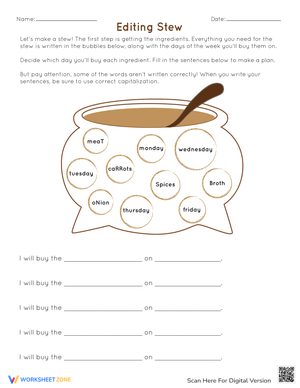
These 4th grade revising writing printable worksheets resources give teachers a ready structure for the writing stage students most want to skip. Each worksheet targets a discrete revision move — adding sensory detail, removing repetition, rearranging sentences for logical order, or swapping flat words for precise ones — so students build revision habits one concrete skill at a time rather than stalling on the vague instruction to "make it better."
The Specific Skills Each Worksheet Targets
The set is organized around the ARMS strategy, a framework that names four core revision moves and gives students a specific verb for each one:
- Add: inserting specific sensory details, facts, or examples at marked locations in a paragraph
- Remove: identifying and crossing out repeated information or sentences that drift from the main idea
- Move: renumbering sentences into a more logical sequence, then rewriting the paragraph in that new order
- Substitute: replacing overused words — said, walked, good, nice — with more precise, specific alternatives
Each letter gets its own targeted worksheets rather than one catch-all revision task. The set also includes sentence-combining exercises — students merge three or four short, choppy sentences into two smoother ones — and open-ended full-draft worksheets where students apply all four moves to a paragraph of their choice.
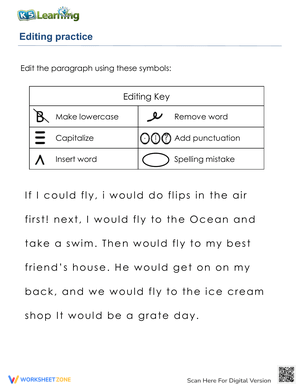
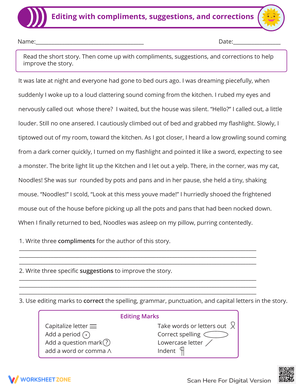
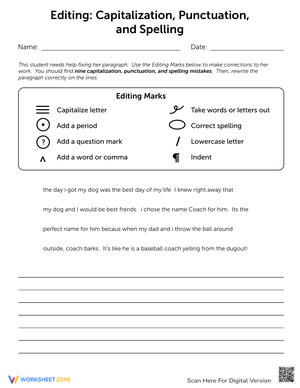
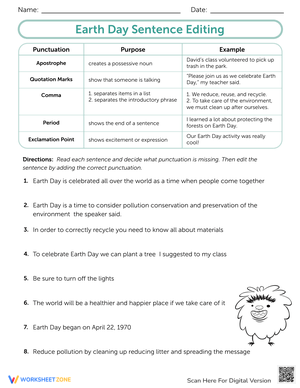
None of these worksheets ask students to fix a comma or find a misspelling. That boundary is deliberate. Revising asks whether writing communicates clearly and engagingly; editing asks whether it follows the conventions of written English. Teaching both in the same session splits student attention in a way that benefits neither goal, and these worksheets stay on the revision side so students give full attention to meaning before surface corrections enter the picture.
Revision Errors Worth Catching Before They Become Habits
The most persistent problem at Grade 4 is what might be called cosmetic addition: students told to add detail insert the word very before an existing adjective. "The big dog" becomes "the very big dog." Word count increases; specificity does not. The Substitute worksheets address this directly by asking students to answer a focused question about the word they are replacing — What kind? Which one? How many? — which redirects attention from length to meaning.
A second pattern worth watching is that students will not cut their own sentences. A student who has spent two days on a draft feels genuine attachment to every line, including the redundant ones. The worksheets that practice the Remove move use provided paragraphs rather than the student's own draft for exactly this reason. Working on someone else's writing, students locate over-explanation and drift without the defensiveness that protects their own text. The judgment transfers, but it develops faster when the emotional stakes have been removed.
Where These Worksheets Work Best in Your Writing Instruction
The most reliable placement is the 10 to 12 minutes of guided practice that follow a revision mini-lesson. If Monday's mini-lesson introduces the Substitute move — trading weak verbs for specific ones — distribute a worksheet immediately after. Students apply the strategy to a printed paragraph before returning to their own drafts. The worksheet creates distance from their personal writing and removes the cognitive load of generating new content while simultaneously thinking about craft.
A dedicated revision station during writing workshop rotations is another strong fit. A stack of 4th grade revising writing printable worksheets materials alongside colored pencils — one color per ARMS move — gives students a tactile, visible system. When a student returns a worksheet marked in only one color, that's immediate formative information: they applied one strategy and stopped.
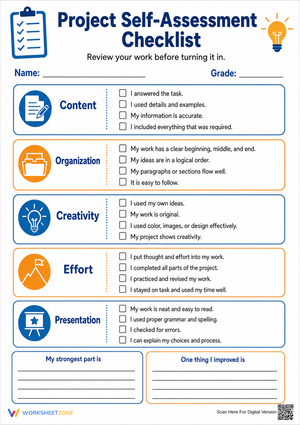
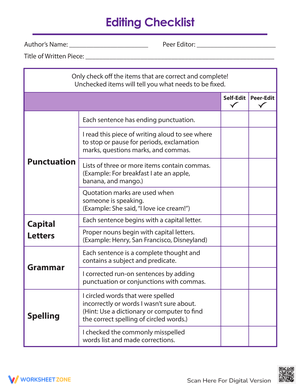
For writing portfolios, a bi-weekly revision routine pairs well with the full-draft worksheets. Students select one piece from their folder, run it through the ARMS checklist printed at the top, and mark at least two revisions before returning it. Over a semester, the accumulated changes become something students can point to and name — more motivating at this age than most grades.
Standard Alignment
CCSS.ELA-LITERACY.W.4.5 requires Grade 4 students to develop and strengthen writing by planning, revising, and editing with guidance and support from peers and adults. This standard addresses process, not product — it sits separately from the writing-type standards (W.4.1 through W.4.3) and specifically names revision as a stage that requires explicit instruction. These worksheets occupy that revision phase, and the completed set gives teachers concrete, dated evidence of W.4.5 instruction when unit documentation is needed. That kind of records clarity matters more in practice than it might seem when a school year is in full motion.
Scaling the Set for Your Range of Writers
Students who need more support start well with single-skill ARMS worksheets where revision targets are marked directly in the provided paragraph. The ARMS reference chart printed on each worksheet removes the burden of holding all four steps in working memory — students glance at the chart as they go. Partner work during revision practice also helps: one student reads the paragraph aloud while the other marks it, which keeps the task moving for students who stall when reading silently.
For students ready for more challenge, the Substitute worksheets carry the most room to push. Rather than swapping one weak word, ask these students to rewrite the entire sentence so the new word lands naturally and the line gains rhythm. A sentence like "She said she was tired" might become "She dropped into the chair and closed her eyes without a word." That is a fundamentally different revision move — rewriting for effect rather than patching — and the 4th grade revising writing printable worksheets set includes open-ended sentence prompts that push toward exactly that level for students who are ready for it.
Frequently Asked Questions
Do students need their own draft before using these worksheets?
No. Most worksheets provide a sample paragraph for students to revise. Practicing on someone else's writing removes the emotional barrier of marking up their own work and makes it easier to isolate the specific revision skill. Once students are comfortable applying the move to the provided paragraph, using it on their own draft is the natural next step — and a less guarded one.
What if students haven't been introduced to the ARMS strategy before?
Each worksheet includes a brief reference to the ARMS steps, so prior exposure helps but is not required. Teachers who spend 10 minutes introducing all four moves before distributing the first worksheet will get more traction in the opening session. After that, the reference printed on each worksheet is enough to keep students working independently.
How are these worksheets different from editing worksheets?
These 4th grade revising writing printable worksheets address meaning and craft — whether the writing is clear, whether stronger words are available, whether the sequence is logical. No worksheet in the set asks students to correct a grammar rule or find a spelling error. Teachers who want both revision and editing practice should run them in sequence, with revision always first.
How often should teachers use these during a writing unit?
One worksheet per writing session works well during the revision phase of a unit — typically a two-to-three-week window after students have first drafts in hand. Outside of a dedicated writing unit, one worksheet per week as a morning warm-up keeps revision habits active without making it feel like a separate curriculum layer.












 Interactive Worksheet Maker
 Quiz Maker
 Word Search Maker
 Crossword Puzzle Maker
 Word Scramble Generator
 Sentence Scramble Generator
 Handwriting Worksheet Generator
 Name Tracing Generator
 Fill In The Blank Generator




 BACK TOSCHOOL