4th Grade Creating a Title Printable Worksheets
These 4th grade creating a title printable worksheets give teachers a focused practice set for one of the most consistently rushed steps in the writing process — naming the work. Students at this level spend real effort on their drafts, then scrawl something vague at the top in the final two minutes: "My Favorite Sport" for a nuanced opinion piece, or "Dogs" when the story is genuinely about loyalty. These worksheets slow that moment down and make title creation deliberate rather than an afterthought at the publishing stage.
The Specific Skills Each Worksheet Targets
The set addresses title creation across four distinct activity types, each placed at a different level of cognitive demand.
- Matching titles to passages: Students read a short paragraph and choose the strongest title from a provided list. This builds evaluative judgment before students are asked to generate anything on their own — a critical step that matching-format activities do especially well.
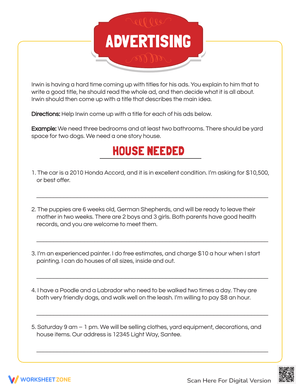
- Revising weak titles: A passage arrives paired with a flat or overly broad title — something like "The Environment" over a detailed essay about ocean plastic. Students rewrite it to be specific, accurate, and engaging, which mirrors exactly what revision looks like in practice.
- Generating titles from scratch: Students read a passage with no title and must brainstorm several options, then explain which they would choose and why. The justification is where the real reading comprehension work happens.
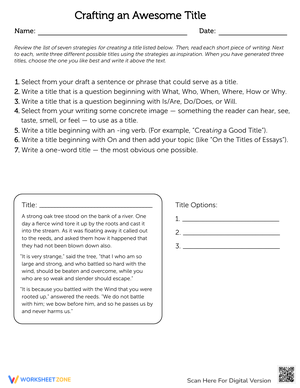
- Multi-format brainstorming: Students write one title as a question, one using alliteration, and one as a direct statement of fact. This pushes past a student's default phrasing and shows that a single piece of writing can be framed in genuinely different ways.
Title Writing at Grade 4: The Developmental Shift
Title writing becomes a formal expectation in fourth grade because it demands a skill students at this age are just beginning to consolidate: synthesizing a full text into one precise phrase. In second and third grade, students can identify the main idea when it's stated directly in a passage. By fourth grade, the expectation shifts toward inferring central ideas and constructing thesis-adjacent statements in original writing. A title is a compressed version of that same thinking. Asking a student to write a title for their own essay forces them to step back from paragraph-level details and ask: what is this whole piece actually about? That's a metacognitive move that doesn't come naturally to most nine- and ten-year-olds without repeated, structured practice — and it explains why this set rewards returning to across a full writing unit rather than using once and moving on.
How to Build These Worksheets Into Your Lesson Plans
The matching and revising worksheets work well at the opening of a writing block — five to eight minutes of independent practice before students open their own drafts. Using a passage they didn't write removes the emotional attachment that makes self-revision difficult, so students evaluate the title options more honestly. These 4th grade creating a title printable worksheets are also a natural fit for an independent station during writing conferences: while one group meets with the teacher, another group generates or revises titles for provided passages without needing additional instructions mid-rotation.
A high-yield variation: give every student the same short passage, have each student write a title on a sticky note, and post all of them at the front of the room before discussing as a class. Watching three students produce three genuinely different titles for the same paragraph makes visible that this is a real decision requiring judgment, not just a label slapped on top. That five-minute discussion does more to build editorial instinct than any direct instruction about what a title should contain.
Frequent Student Errors Worth Watching For
The most common error in student title work isn't weak vocabulary — it's misidentifying what the text is actually about. A student who writes "The Bicycle Race" for a story where the race is only the opening scene has anchored to the most concrete, action-forward detail rather than the theme. The story might be about a character choosing honesty over winning, but students at this age consistently gravitate toward events rather than ideas. When this pattern appears in title work, it reliably predicts the same problem in written summaries and main-idea responses — which makes these worksheets a useful early diagnostic before a formal assessment.
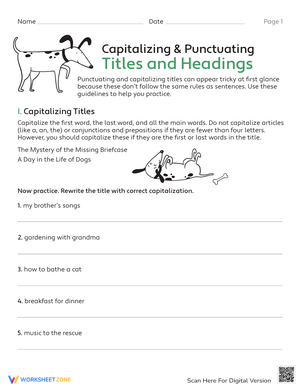
Title capitalization is a second persistent issue. Students who correctly capitalize "Monday" in a sentence will write "the great journey" as a title without a second thought. Students who overcorrect go the other direction — "The Great Journey Of A Small Dog Who Learned To Trust" — applying capital letters to prepositions and articles along with everything else. Both errors surface quickly in low-stakes title practice, which is far easier to address here than buried inside a finished draft.
Standard Alignment
These worksheets connect most directly to CCSS W.4.4, which requires students to produce clear and coherent writing with development, organization, and style appropriate to task, purpose, and audience. A title is a student's first signal to the reader that they understand their own work's purpose — it has to do everything at once in the fewest possible words. In classroom terms, title creation belongs inside the revising and publishing phases, not drafting. When these worksheets are used during revision cycles, they reinforce W.4.4 in a way that longer editing checklists often miss because they require students to evaluate the whole piece rather than correct its parts.
Adjusting the Worksheets for a Range of Learners
For students who struggle to summarize, the matching format is the right entry point. It asks for recognition, not generation, which reduces the cognitive load enough that students can focus on why one title works better than another rather than spending all their energy trying to produce something from scratch. Pairing a matching worksheet with a brief whole-class discussion of the rejected options usually does more for these students than any additional writing prompt would.
Students who move quickly through the standard activities benefit most from being challenged at the craft level. Ask them to write a title that uses a literary device — alliteration, a paradox, or deliberate understatement — and then explain in one sentence how that device shapes what a reader anticipates before reaching the first line. These 4th grade creating a title printable worksheets also pair well with mentor text analysis: strong nonfiction titles from National Geographic Kids articles or well-known narrative titles from the classroom library give above-level students concrete models to study and adapt rather than starting entirely from instinct.
Frequently Asked Questions
Should students finalize their title before or after completing a draft?
After the draft is finished. A working title during drafting is fine, but students who commit too early often force their paragraphs to match the title rather than letting the piece develop naturally. The revision stage is the right moment to write a title that reflects what the piece actually became. These worksheets reinforce that sequence by always presenting students with completed texts to title, never partial ones.
How does title practice fit into a multi-week writing unit?
Use the matching and revising worksheets during the first week of a unit to establish the concept, then introduce the generating-from-scratch format once students have a finished first draft of their own piece. These 4th grade creating a title printable worksheets return the most value when used as touchpoints across the unit — title judgment improves when students return to it with more writing experience than they had the first time around.
What if a student writes a title that's technically correct but still feels flat?
That's the most instructive moment in title work. A title like "My Summer" for a vivid personal narrative is grammatically fine and topically relevant — but it signals the student hasn't stepped back far enough to see their own writing from the outside. Sitting with that student, having them read only their first and last sentences, and asking "what changed between those two moments?" usually produces a sharper title within a minute. It also gives the student a concrete revision move they can use independently going forward.
Clear All