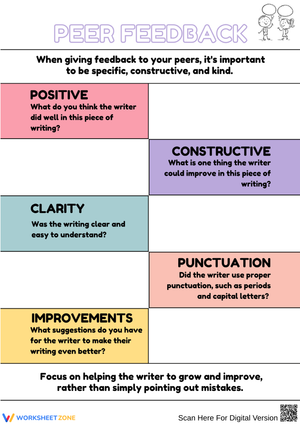
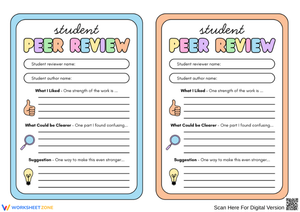
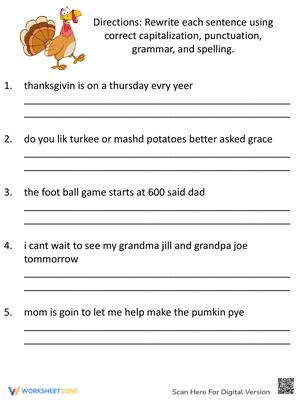
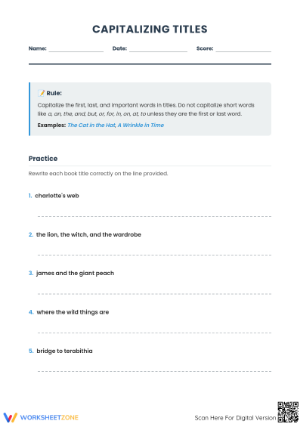
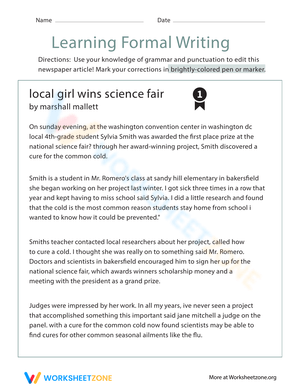
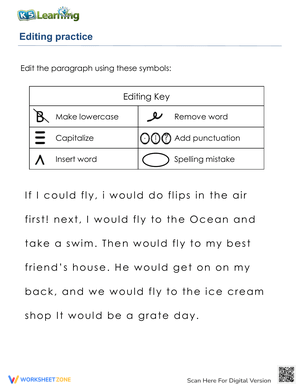
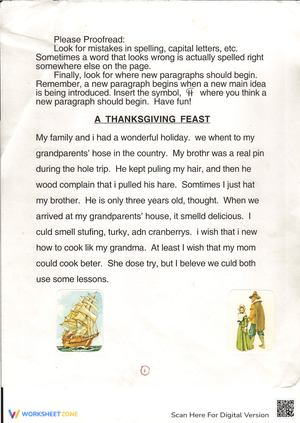
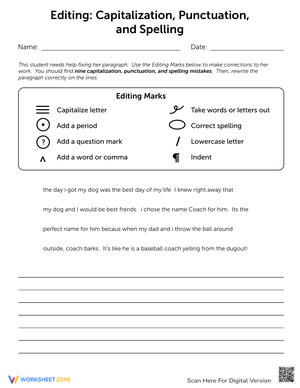
These 4th grade editing worksheets resources give teachers a fast, repeatable way to build proofreading accuracy without converting the entire literacy block into open-ended writing time. Each worksheet places students inside real sentence-level editing work—correcting capitalization, punctuation, grammar, and usage in short passages—rather than asking them to memorize rules in the abstract.
The Specific Skills Each Worksheet Targets
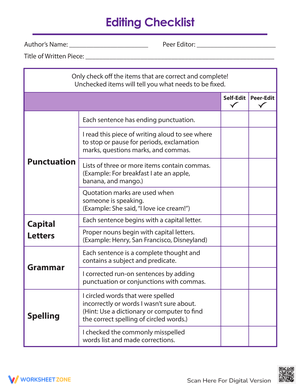
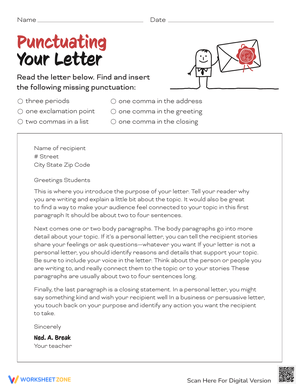
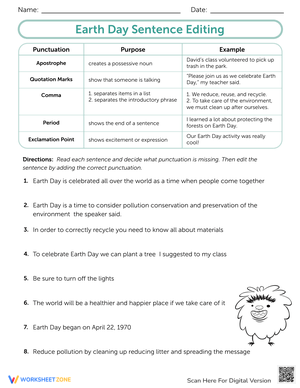
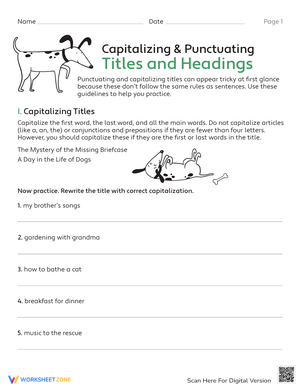
The set covers the four convention areas fourth graders are expected to control independently by year's end. Capitalization work addresses sentence starters, proper nouns, names of specific places, and titles of books or films students might reference in their own writing. Punctuation practice includes periods, question marks, commas in a series, the comma before a coordinating conjunction in compound sentences, apostrophes in possessives and contractions, and quotation marks around dialogue. Grammar tasks address subject-verb agreement, pronoun reference, progressive verb tense, and sentence completeness—fragments and run-ons both.
Usage work deserves its own mention because commonly confused words remain a persistent gap at this level. Students regularly swap their/there/they're, its/it's, and your/you're even after direct instruction. The worksheets build in repeated exposure to these pairs so the correction becomes automatic rather than effortful—students stop relying on which form "looks right" and start applying an actual rule.
Errors Teachers Consistently See in Fourth-Grade Work
The comma-before-conjunction rule produces one of the most predictable error patterns at this grade. Students learn that compound sentences need a comma, and then they start placing commas before every "and"—including sentences where the second clause has no subject at all. A student writes "I packed my lunch, and walked to school" rather than "I packed my lunch and walked to school," because they've overapplied the rule without internalizing when it actually triggers. These worksheets include enough examples of both patterns—comma required versus comma incorrect—that students start distinguishing the two cases rather than applying a blanket rule to every conjunction they see.
Dialogue punctuation is a second predictable trouble spot. After third grade, most students know that spoken words go inside quotation marks, but the internal comma trips them up reliably. They write "I'm ready." she said instead of "I'm ready," she said. Some students handle the period correctly when dialogue ends the sentence but miss the comma entirely when the attribution follows. A worksheet that presents both patterns in the same editing passage surfaces that distinction in a way a single-example mini-lesson often does not.
Capitalization errors also follow a recognizable pattern worth watching for. Students who correctly capitalize "Lake Michigan" will write "the amazon river" in the same paragraph—not out of carelessness, but because some proper nouns have grown so familiar that students stop reading them as names requiring a capital. Brief editing tasks that mix well-known and less common proper nouns help break that habit before it carries into student writing.
Building These Worksheets Into Your Weekly Lesson Rhythm
The most reliable use pattern is a short daily routine that rotates skill focus across the week. Monday and Tuesday target punctuation and capitalization separately. Wednesday introduces grammar. Thursday uses a mixed-passage worksheet where students catch and label three or four error types without being told in advance what kind to look for. Friday shifts from the worksheet to student drafts—students apply the same checklist to their own writing rather than to a practice passage. That final move matters because it closes the gap between isolated practice and transfer.
Within a single lesson, a gradual release structure works better than simply handing out the worksheet cold. Project one short passage, edit it as a class with students calling out corrections and explaining them aloud, then have partners work through a second example together, then assign the independent worksheet. That sequence takes roughly 12 to 15 minutes total and fits comfortably inside a morning literacy block opener or the first segment of writing workshop. Teachers who use 4th grade editing worksheets materials as warm-up tools often find that students arrive more attentive to error patterns during the rest of the writing lesson—convention-spotting is fresh, not an afterthought.
These resources also double as diagnostic snapshots. Collect the same worksheet from two class periods and look across responses: if eight students miss the compound-sentence comma in the same sentence, that's a whole-class mini-lesson, not individual remediation. A simple tally of error types by student takes only a few minutes to build across a week and makes instructional gaps visible quickly.
Editing and Revising Are Not the Same Instruction
Fourth graders—and sometimes their teachers—conflate these two steps, so keeping them distinct in how assignments are framed pays off. Revising asks students to improve meaning: reorganize ideas, add supporting detail, clarify confusing sentences, sharpen word choice. Editing asks students to clean up surface errors in mechanics, spelling, and grammar after the meaning is already set. Both belong in a writing unit, but they call for different kinds of attention, and blending them into one activity tends to make students worse at both.
Assigning an editing worksheet immediately before students return to proofread their own drafts takes advantage of a simple priming effect: the convention focus makes students actually read the surface of their writing rather than skim past familiar sentences. That's why these worksheets tend to produce more visible improvement when they're attached to a writing context than when they're assigned as standalone homework with no draft work around them.
Adjusting the Worksheets Across Ability Levels
Differentiation here works most naturally by adjusting one of three variables: text length, the number of error types present in the passage, or the amount of direction built into the instructions. The same worksheet can often serve multiple levels with a different prompt attached rather than requiring an entirely different document.
- Students who need more support: Identify which sentence or paragraph contains each error before students begin, so they search within a smaller space. Pair the worksheet with a reference card showing the three conventions in focus alongside one corrected example of each.
- On-level students: Assign the standard mixed-review worksheet without additional guidance. Errors from multiple convention categories appear without being labeled by type.
- Students who finish quickly: After correcting the passage, ask them to rewrite one sentence three different ways—each version using a different punctuation mark—and briefly explain how the meaning changes in each version.
- Partner editing: One student marks each error and the other must explain the correction before both agree on the final version. This forces articulation rather than simple pattern-matching.
Standard Alignment
These worksheets address CCSS ELA-Literacy L.4.1 (conventions of grammar and usage) and L.4.2 (conventions of capitalization, punctuation, and spelling). Within L.4.1, the tasks most directly target L.4.1f—producing complete sentences and correcting inappropriate fragments and run-ons—and L.4.1g, correctly using frequently confused words. Within L.4.2, the primary targets are L.4.2a (capitalization), L.4.2b (commas and quotation marks to mark direct speech), and L.4.2c (comma before a coordinating conjunction in a compound sentence). L.4.2b is worth noting specifically: commas inside quotation marks receive little instructional emphasis at the third-grade level, so the transition to fourth grade is exactly where that gap reliably surfaces in student work. The dialogue editing tasks in this set are doing convention work that is genuinely new for most students—not review material dressed up as new instruction.
Frequently Asked Questions
How are editing worksheets different from revising worksheets?
Revising worksheets ask students to improve ideas, organization, and clarity—content-level decisions. Editing worksheets ask students to find and correct errors in spelling, punctuation, grammar, and capitalization—surface-level correction. Both skills belong in the same writing unit, but they should be practiced separately so students learn to approach a draft in distinct passes rather than trying to improve meaning and fix mechanics simultaneously.
How long should a daily editing activity take in fourth grade?
For most classrooms, 10 to 15 minutes covers one worksheet with enough time left for a brief whole-class review of the corrections. That window fits inside a literacy block opener, a center task during small-group rotation, or the first segment of writing workshop without pushing other instruction out of the period.
Can these worksheets be used for assessment, or are they only for practice?
They work well for both purposes. As formative tools, the worksheets reveal which conventions individual students are controlling and which ones they're guessing at. Patterns across the class, tracked across a week, point directly to the next mini-lesson. As summative checkpoints near the end of a conventions unit, a mixed-review worksheet gives a concrete picture of retention. The 4th grade editing worksheets format—short, focused, quick to score—makes either use manageable without adding meaningful grading time to a teacher's week.
Why use printable worksheets rather than a digital editing activity?
Printable worksheets let students mark directly on the text—crossing out, circling errors, inserting carets—which mirrors the physical act of proofreading an actual paper draft. That motor experience matters for some learners. They also work without device access, login delays, or platform loading issues, which makes them reliable for morning work, sub coverage, and homework where tech support is inconsistent. A well-designed 4th grade editing worksheets set is especially useful for sub plans precisely because the task is self-contained: clear directions, fixed text, no technology required.












 Interactive Worksheet Maker
 Quiz Maker
 Word Search Maker
 Crossword Puzzle Maker
 Word Scramble Generator
 Sentence Scramble Generator
 Handwriting Worksheet Generator
 Name Tracing Generator
 Fill In The Blank Generator




 BACK TOSCHOOL