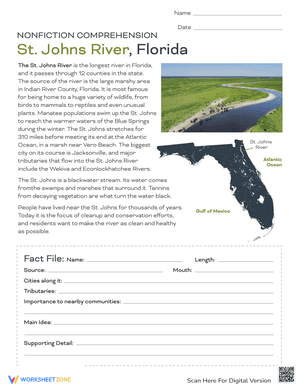
These main idea in nonfiction worksheets for 4th grade give teachers short, text-based practice students can complete independently — without a 40-minute setup. Fourth grade is when the curriculum stops accepting "it's about animals" as a finished answer and starts requiring students to articulate what a text is saying about its subject, then cite sentences that prove it. That shift from topic-naming to main-idea reasoning is where this set does its most useful work.
What Each Worksheet Asks Students to Do
In fourth grade nonfiction reading, main idea is a cluster of related moves, not a single step. Students must distinguish the topic — a noun phrase — from the main idea — a claim about that topic — and then locate supporting details that connect back to the central point rather than simply being interesting. Each worksheet in the set addresses a piece of that cluster instead of asking students to execute everything at once.
- Naming the topic of a short informational passage in three words or fewer
- Writing a complete main idea sentence that goes beyond naming the subject
- Selecting two or three supporting details and explaining their connection to the main idea
- Distinguishing essential details from true-but-not-central facts
- Using a graphic organizer to sort evidence before drafting a written response
- Working across both multiple-choice and short written-response formats within the same passage
Patterns in Student Work Teachers Should Anticipate
The most predictable fourth-grade error is writing the topic as the main idea. A student reads a passage about monarch butterfly migration and writes "monarch butterflies" — which names the subject but says nothing about the author's point. A close second: selecting a detail that is striking but not central. "Monarchs travel up to 3,000 miles" is memorable evidence, but it does not capture the author's overall message.
A third pattern shows up in written responses — students who correctly identify the main idea orally but write something vague enough to fit three different passages. "The text is about how animals are interesting" could describe almost any nature article. That kind of answer reveals that the student knows a central idea exists but has not yet attached their thinking to the specific evidence of this text. One move that consistently sharpens accuracy: ask students to cross out one detail that is true but not essential before they choose or write the main idea. That step forces comparison instead of collection, and it produces better results more reliably than offering hints about which answer choice is correct.
Building These Worksheets Into Your Teaching Week
These worksheets fit into a standard 45- to 60-minute ELA block in several low-prep slots. During whole-group instruction, project the passage and model the first question — "What is this paragraph mostly teaching me?" — then let students finish independently. In small-group time, the worksheet works as guided practice after a brief vocabulary preview of two or three key terms. The short passage length means a group of four students can finish the task, compare answers, and still have time to talk through why one response is stronger than another.
For a five-day week, one sequence that works: use one worksheet as a quick formative check on Monday after morning meeting, a second during a mid-week center rotation, and a third as a Friday exit ticket before pickup. Teachers who use main idea in nonfiction worksheets for 4th grade sets most effectively keep the format consistent week over week — students who tend to lose time at task-transition moments skip the orientation step and get directly to the reading.
Standard Alignment
A strong main idea in nonfiction worksheets for 4th grade set aligns to CCSS.ELA-LITERACY.RI.4.2, which asks fourth graders to determine the main idea of an informational text, explain how it is supported by key details, and summarize the text. In classroom terms, RI.4.2 is the standard most likely to appear on the passage-based section of state reading assessments, and it is where students most often operate at surface level — circling a topic word and calling the task complete. The text-dependent questions in each worksheet press students toward the "explain how" part of the standard, not just the "determine" part.
Adapting These Worksheets for the Range of Readers in One Room
For students who need more support, shorten the reading chunk before asking for a written response. Read the first paragraph together, stop, and ask students to name the topic in two or three words. Then reread and ask: what does the author want you to understand about that topic? That question shift — from "what is this about" to "what does the author want you to understand" — moves students from single-noun responses toward complete sentences. Letting students underline supporting sentences before they write reduces the working-memory load without lowering the intellectual target.
For students ready for more challenge, the same passages work when the follow-up task changes. Instead of identifying the main idea, these students explain why one answer option is only the topic, or why a specific detail supports rather than simply relates to the main idea. That second layer of reasoning is exactly what stronger fourth-grade readers need before they move into longer informational texts. One honest limitation worth naming: the worksheet format serves students who can read the passages with minimal support. Students significantly below grade level in decoding get more traction from the discussion moves described above than from repeated worksheet practice alone.
Frequently Asked Questions
How long should passages be on a fourth-grade main idea worksheet?
One to three short paragraphs works well for focused skill practice. Two paragraphs is the most common passage length across this set — long enough to require reading across multiple sentences, short enough to keep attention on the skill rather than on reading endurance. Longer texts belong in full-text comprehension work, not in targeted skill practice.
What is the difference between a main idea response and a summary?
RI.4.2 asks for both, but they are separate tasks. The main idea is a single sentence about what the text is mostly teaching. A summary includes the main idea plus key supporting details restated in the student's own words. These worksheets address main idea and supporting details as distinct steps, which makes writing a summary more manageable once students have worked through both parts.
Can these worksheets work for sub plans or morning work?
The format supports both uses. Each worksheet is self-contained — passage and questions together — so students know what to do without a teacher walking them through it. Answer keys make checking fast for a substitute or for a student-led share-out at the end of the period.
How can I tell whether a student truly understands main idea or is guessing on multiple choice?
Written-response items are the clearest window. A lucky guess can produce a correct multiple-choice answer; a sentence that explains why specific details support a central claim cannot. When reviewing student work on main idea in nonfiction worksheets for 4th grade, watch for students who write the correct main idea but cite a detail from a different paragraph — that pattern signals surface-level understanding that still needs targeted instruction.















 Interactive Worksheet Maker
 Quiz Maker
 Word Search Maker
 Crossword Puzzle Maker
 Word Scramble Generator
 Sentence Scramble Generator
 Handwriting Worksheet Generator
 Name Tracing Generator
 Fill In The Blank Generator