




























Views
Downloads


Printable Chaparral Biome Game | Grade 4 ELA

Paste this activity's link or code into your existing LMS (Google Classroom, Canvas, Teams, Schoology, Moodle, etc.).
Students can open and work on the activity right away, with no student login required.
You'll still be able to track student progress and results from your teacher account.
This interactive Grade 4 reading activity transforms nonfiction comprehension into an engaging memory game. Students read a short informational text about the chaparral biome, then match fact cards to reinforce their understanding of the ecosystem. It provides a hands-on approach to processing informational text and identifying key details.
At a Glance
- Grade: 4 · Subject: ELA
- Standard:
CCSS.ELA-LITERACY.RI.4.10— Read and comprehend informational texts independently- Skill Focus: Nonfiction Comprehension
- Format: 2 pages · 11 matching pairs · PDF
- Best For: Partner reading centers
- Time: 15–20 minutes
What's Inside
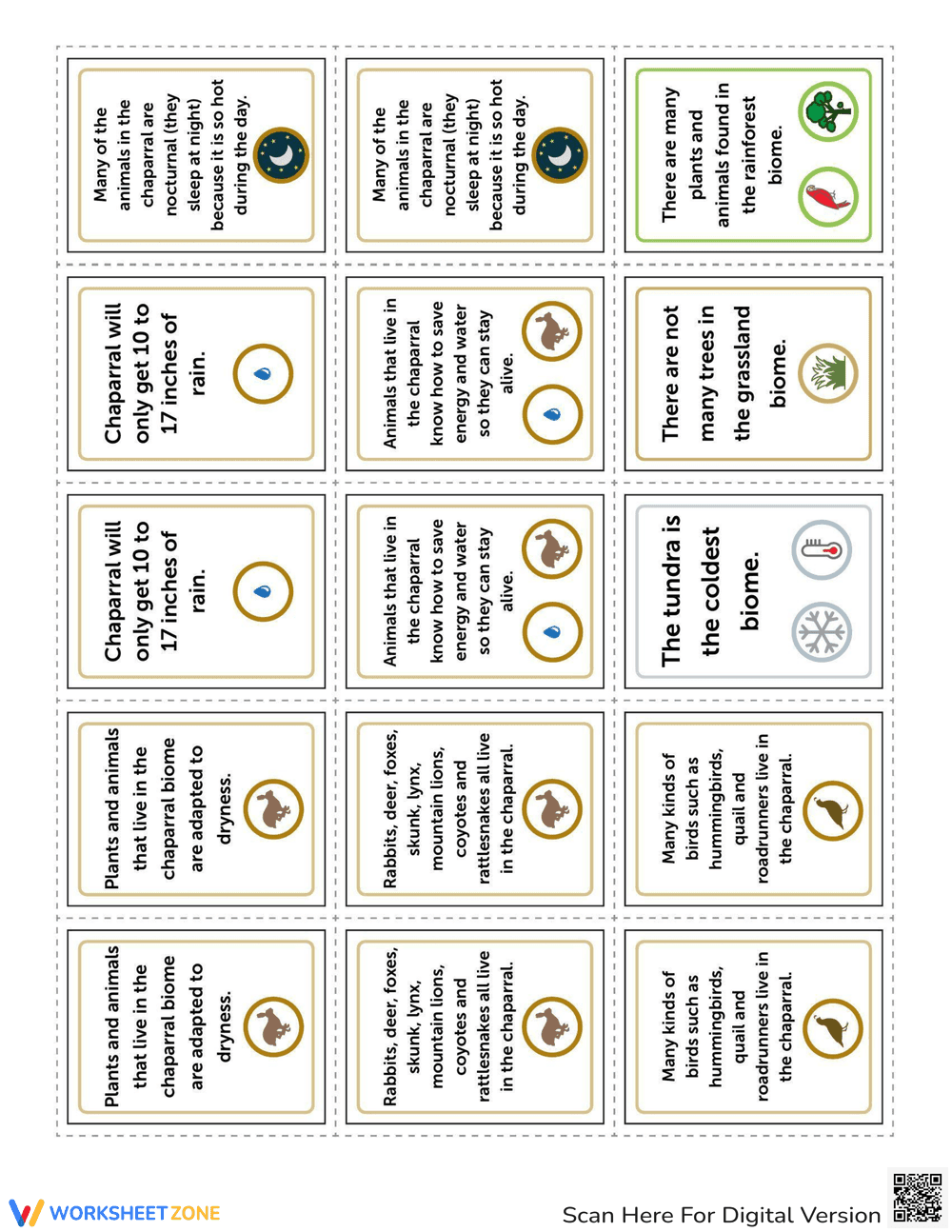
This resource includes a one-page informational passage detailing the climate, plants, and animals of the chaparral biome, alongside clear game instructions. The second page features 25 printable playing cards, comprising 11 matching fact pairs and three sneaky cards containing facts about other biomes to challenge student comprehension.
Skill Progression
- Guided practice: Teachers can read the introductory passage aloud, modeling how to identify key facts about the chaparral ecosystem.
- Supported practice: Students work in pairs to play the memory game, discussing the facts on each card to determine if they match the passage.
- Independent practice: Learners independently evaluate the sneaky cards, using their reading comprehension skills to explain why those facts belong to different biomes.
This gradual-release approach ensures students confidently transition from direct instruction to collaborative application.
Standards Alignment
Aligned to CCSS.ELA-LITERACY.RI.4.10, this activity requires students to read and comprehend informational texts, including history/social studies, science, and technical texts, in the grades 4-5 text complexity band proficiently. It also supports cross-curricular science learning about ecosystems. Both standard codes can be copied directly into lesson plans, IEP goals, or district curriculum mapping tools.
How to Use It
This memory game is perfect for literacy centers or as a collaborative post-reading activity after a science lesson on biomes. As students play, teachers can circulate and use formative assessment to observe how well learners recall specific details from the text. Expect this activity to take 15 to 20 minutes to complete.
Who It's For
Designed for fourth-grade students, this activity is ideal for kinesthetic learners who benefit from hands-on reading tasks. The visual icons on the cards provide helpful scaffolds for English Language Learners. It pairs excellently with a broader unit on global ecosystems or a direct instruction lesson on identifying main ideas and supporting details.
Integrating interactive elements into reading instruction significantly boosts student engagement and retention of informational text. According to Fisher & Frey (2014), collaborative learning structures like partner games provide essential opportunities for peer-to-peer academic discourse, which deepens comprehension. This activity aligns with CCSS.ELA-LITERACY.RI.4.10 by challenging students to read and comprehend informational texts independently while actively processing the information through a matching task. By requiring learners to distinguish between accurate chaparral facts and the sneaky cards from other biomes, the game moves beyond simple recall into critical evaluation of text details. This hands-on approach ensures that students are not just passively reading, but actively analyzing and discussing the content, leading to stronger literacy outcomes and improved academic confidence in the upper elementary grades.


