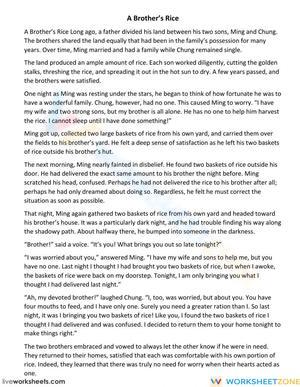
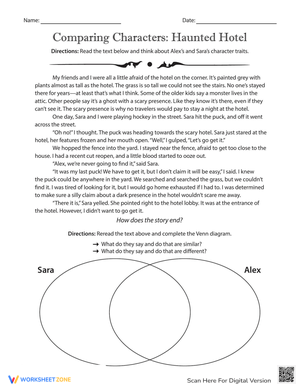
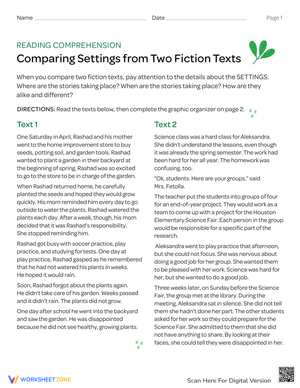
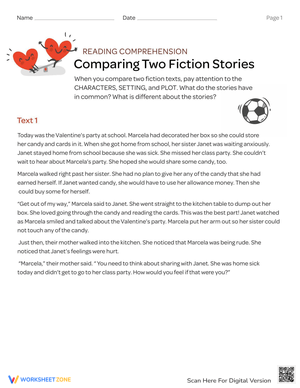
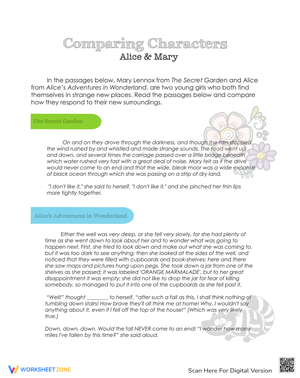
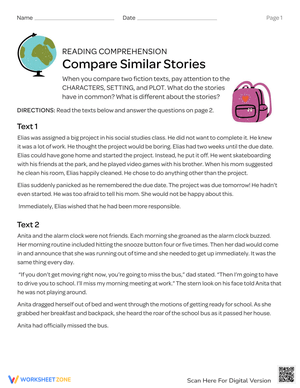
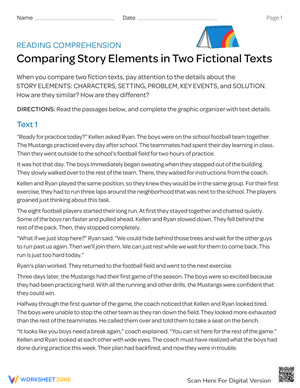
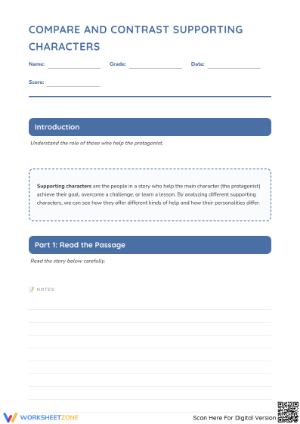
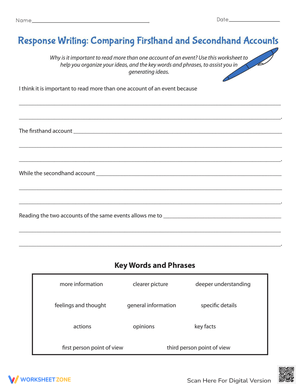
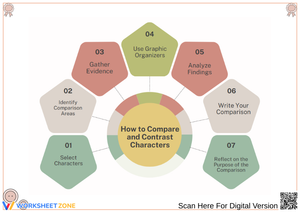
These compare and contrast characters worksheets for 4th grade give teachers a direct path to RL.4.3 — the standard that asks students to describe characters in depth using text details, not general impressions. The set covers both within-text comparisons (protagonist against antagonist in the same story) and cross-text comparisons (a character from one version of a folktale paired with a parallel figure from another), which tracks the two places in the 4th grade reading curriculum where this skill actually shows up.
The Specific Skills Targeted in Each Worksheet
Each worksheet asks students to work with character traits at a level of precision that most 3rd grade instruction doesn't yet require. The distinction between internal traits — personality, motivation, values — and external ones is a key starting point, and students are expected to use a character's actions, dialogue, and the narrator's language as evidence for internal traits. That's not automatic for 9-year-olds; it requires repeated, structured practice before it becomes a reading habit.
The set moves through several formats built around different comparison tasks:
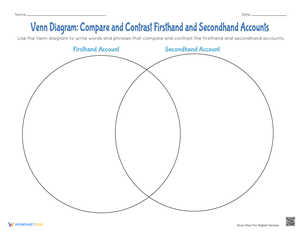
- Venn diagrams for two-character comparisons within a single text, with separate rings for traits unique to each character and an overlap section for shared traits
- T-charts organized by analytical category — how each character responds to a central conflict, what each character wants, how each character changes from beginning to end
- Comparison matrices for texts with three or more characters, where a Venn diagram creates more visual clutter than clarity
- Cross-text worksheets pairing characters from different versions of the same story, particularly useful when a class reads multiple Cinderella variants or compares trickster figures across cultures
- A "Character Report Card" format that asks students to assign a letter grade on specific attributes — honesty, persistence, compassion — write a brief justification citing the text, and then compare the two report cards side by side
The report card format deserves a separate note. It shifts the task from descriptive to evaluative: a student who can grade a character's honesty and defend that grade with a textual citation is constructing an argument, not just filling in boxes. That's a meaningful step up from standard trait-listing work, and it tends to produce more engaged effort during the 20-minute independent block when interest in plain graphic organizers tends to flag.
Common Misconceptions to Watch For and Correct
The most predictable error at this grade level is the unsupported trait label. Students write "the character is kind" and move on — no page number, no specific moment from the story. The worksheets address this directly by pairing each trait column with a text-evidence column; the physical layout of each worksheet makes skipping the evidence step harder than completing it. What compare and contrast characters worksheets for 4th grade surface most reliably is the gap between students who can name a trait and students who can actually infer one from the text — and those are not the same skill.
A subtler problem appears during the comparison step itself. Students will list the same trait word for two characters and treat "both are brave" as a complete analysis. It isn't. Two characters can share a trait label while expressing it in entirely different ways — one character's courage is impulsive and reckless, another's is quiet and calculated — and drawing that distinction is exactly the close reading RL.4.3 requires. The T-chart and comparison matrix formats push students toward this by asking them to describe each character's specific actions, not just apply a shared adjective.
Lesson-Planning Ideas to Get the Most From These Worksheets
The most reliable entry point is a whole-group modeling session using a read-aloud the class already knows well. Projecting a blank Venn diagram worksheet and completing it together while re-reading key passages gives students a working model before they attempt independent work. That first guided pass through the evidence columns matters — students frequently underestimate how much they need to return to the text rather than relying on memory, and seeing the teacher flip back to a specific page makes that habit concrete.
For literature circles and guided reading groups, each worksheet can function as a discussion anchor. One student cites a trait and the text moment that supports it; the group challenges or confirms. That oral rehearsal before the written comparison reduces the blank-page slowdown that stalls independent work. The cross-text comparison worksheets fit particularly well at the end of a mythology or folktale unit, when students have read enough material to draw across multiple texts. As a pre-writing tool, compare and contrast characters worksheets for 4th grade give students an organized body of evidence to work from before drafting a comparative paragraph — the graphic organizer becomes their planning document rather than a standalone exercise.
Standard Alignment
RL.4.3 requires students to describe characters in depth — including traits, motivations, and feelings — and explain how their actions contribute to the story's sequence of events. Every worksheet in the set addresses this standard directly: students identify traits, cite supporting text, and analyze how a character's choices drive the narrative. The evidence columns and text-citation fields are formatted to match what this standard expects students to demonstrate.
RL.4.9 asks 4th graders to compare and contrast the treatment of similar themes and patterns across texts. The cross-text comparison worksheets in the set align to this standard by pairing characters who serve similar roles in different stories — a protagonist facing isolation in one culture's folktale alongside a parallel figure in another — and asking students to analyze both what they share and what different cultural contexts change about them. In practice, RL.4.9 often shows up at the end of a text set or genre unit, and these worksheets are formatted to fit that instructional moment.
Adjusting the Worksheets for a Range of Learners
Students who are still developing fluency with the reading itself need a reduced-load version of the comparison task. Assign a shorter, more accessible text and use the Venn diagram worksheet with a trait word bank already provided. The word bank removes the vocabulary retrieval step without removing the analytical work — students still have to match the right word to the right character using text evidence. That small adjustment keeps the cognitive demand on the skill being taught rather than on vocabulary recall.
For students who complete the basic comparison quickly and accurately, the report card format and cross-text worksheets offer a natural extension. Asking a stronger reader to compare the same character trait across two different books — evaluating how two different authors build the same type of character — moves the task closer to the analysis expected in 5th and 6th grade. The compare and contrast characters worksheets for 4th grade in this set are sequenced so that the Venn diagram and T-chart formats serve as the starting point, while the comparison matrix and report card worksheets function as extension tasks for students who need a more demanding challenge.
Frequently Asked Questions
Do these worksheets require specific books, or do they work with any class text?
Every worksheet in the set is text-neutral — students supply the character names, traits, and text evidence from whatever the class is reading. They work equally well with a whole-class novel, a guided reading title, or a read-aloud that the class has just finished.
What is the difference between comparing character traits and comparing character actions?
Traits are the underlying personality qualities — persistent, compassionate, deceptive. Actions are what the character actually does in the story. In strong character analysis, actions serve as evidence for traits: a student argues that a character is generous because she divided her lunch with a classmate who had nothing. The worksheets treat actions as the proof and traits as the claim, which is the structure RL.4.3 expects students to produce.
When does the comparison matrix work better than a Venn diagram?
Once a class is comparing three or more characters — as happens with ensemble novels or a unit on multiple folktale variants — the Venn diagram becomes difficult to read and draw. The matrix worksheet lists characters across the top and analytical categories down the side, so students can scan across a single row to see how all three characters respond to the same situation. It's cleaner for larger comparisons and much easier to use later as a pre-writing reference.
How do I push students past "nice" and "mean" when describing characters?
A trait word bank is the fastest correction. A list that includes words like "relentless," "calculating," "impulsive," or "compassionate" gives students language they wouldn't generate on their own and pushes their written analysis toward something more precise. The more specific the vocabulary students have access to, the more their comparisons move from surface-level observation toward genuine character analysis — and specificity is exactly what separates adequate from strong work at this grade level.












 Interactive Worksheet Maker
 Quiz Maker
 Word Search Maker
 Crossword Puzzle Maker
 Word Scramble Generator
 Sentence Scramble Generator
 Handwriting Worksheet Generator
 Name Tracing Generator
 Fill In The Blank Generator